The sample copy of this report is available for access.
“Global Behind-the-Meter Energy Storage Market to reach a market value of USD 26.29 billion by 2033 growing at a CAGR of 18.6%”
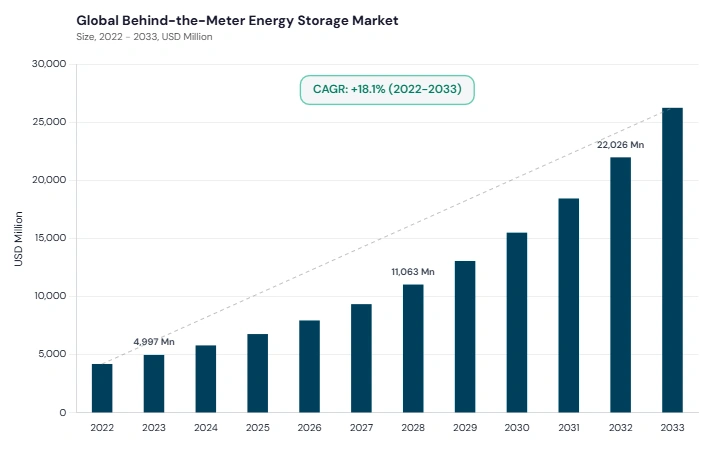
The Global Behind-the-Meter Energy Storage Market size is expected to reach USD 26.29 billion by 2033, rising at a market growth of 18.6% CAGR during the forecast period.
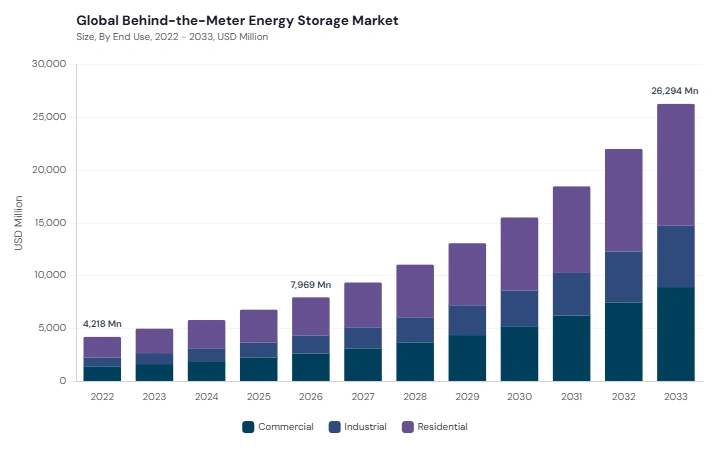
The market is witnessing strong growth due to increasing deployment of distributed energy systems, rising renewable energy adoption, and growing demand for energy resilience across residential, commercial, and industrial sectors. Advancements in lithium-ion battery technologies, declining storage costs, and increasing investments in smart energy management platforms are further accelerating global market expansion.
The Global Behind-the-Meter Energy Storage Market has evolved rapidly from a niche backup power solution into a critical component of modern distributed energy infrastructure. Initially, energy storage systems were primarily used for emergency power support and basic energy management applications. However, increasing electricity demand, growing concerns regarding grid reliability, and rising penetration of renewable energy systems have significantly expanded the role of behind-the-meter energy storage across residential, commercial, and industrial environments. Technological advancements in battery systems, particularly lithium-ion technologies, have improved storage efficiency, reduced costs, and enhanced scalability, making these solutions increasingly accessible worldwide.
Today, behind-the-meter energy storage systems are playing an important role in supporting energy independence, peak load management, renewable energy optimization, and grid flexibility. Integration of artificial intelligence, cloud-based monitoring platforms, predictive analytics, and smart energy management systems is further improving operational performance and enabling real-time energy optimization. Governments and utilities across major economies are also supporting adoption through incentive programs, decarbonization initiatives, and distributed energy policies. As a result, behind-the-meter storage solutions are becoming an integral part of smart buildings, virtual power plants, and decentralized energy ecosystems globally.
The major strategies followed by the market participants are Product Launches, Partnerships, and Expansion as the key developmental strategies to strengthen market presence and enhance technology capabilities. For instance, in March 2025, Tesla, Inc. expanded deployment of Powerwall energy storage systems integrated with solar and EV charging solutions to strengthen residential energy ecosystems. Additionally, in January 2025, Schneider Electric partnered with distributed energy platform providers to enhance AI-enabled energy optimization and grid integration capabilities.
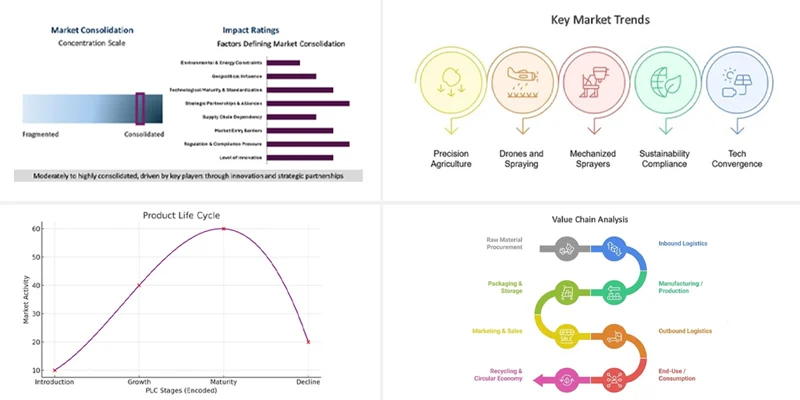
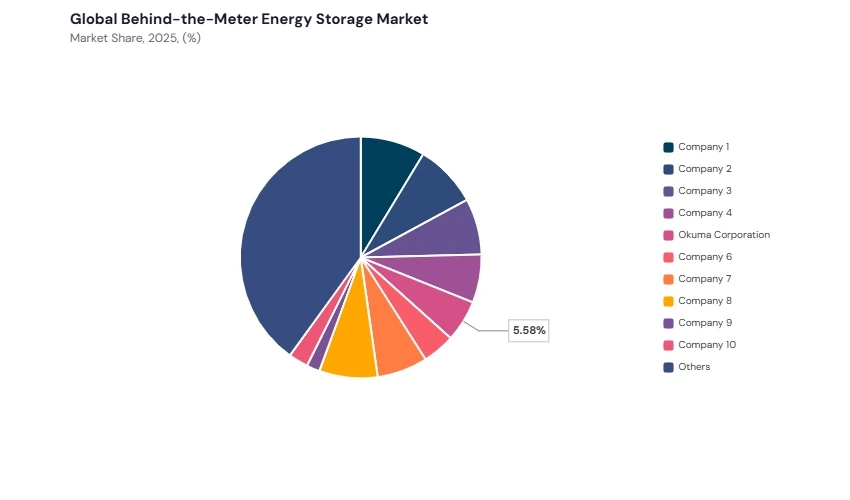
The leading players in the market are competing with diverse innovative offerings to strengthen their market presence globally. Major participants are increasingly focusing on strategic partnerships, product innovation, AI-driven optimization platforms, and expansion of battery manufacturing capacities. The market is moderately consolidated with leading battery manufacturers and integrated energy solution providers accounting for a significant share of total market revenue. Mid-tier and niche companies are also gaining traction through specialized energy management platforms, virtual power plant solutions, and long-duration storage technologies.

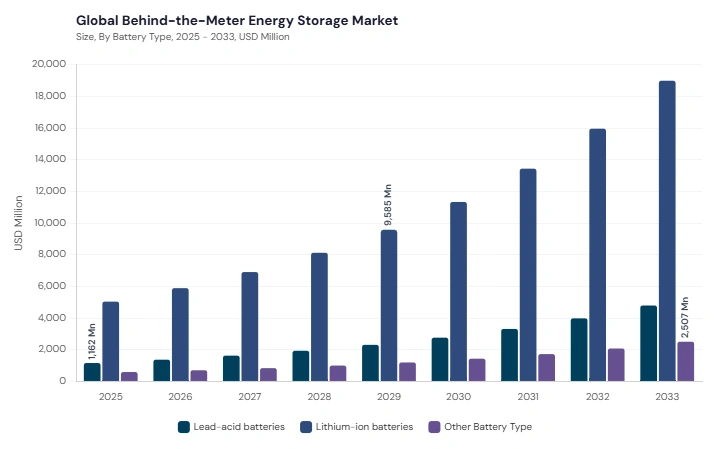
Based on battery type, the behind-the-meter energy storage market is segmented into lithium-ion batteries, lead-acid batteries, and other battery types. The lithium-ion batteries segment dominated the market in 2025 driven by higher energy density, longer operational lifecycle, declining battery costs, and increasing deployment in solar-plus-storage systems. Lithium-ion technologies continue to gain strong adoption across residential, commercial, and industrial sectors due to improved efficiency and compatibility with advanced energy management systems. Meanwhile, alternative battery technologies are gaining attention for long-duration storage applications and sustainability-focused energy infrastructure.
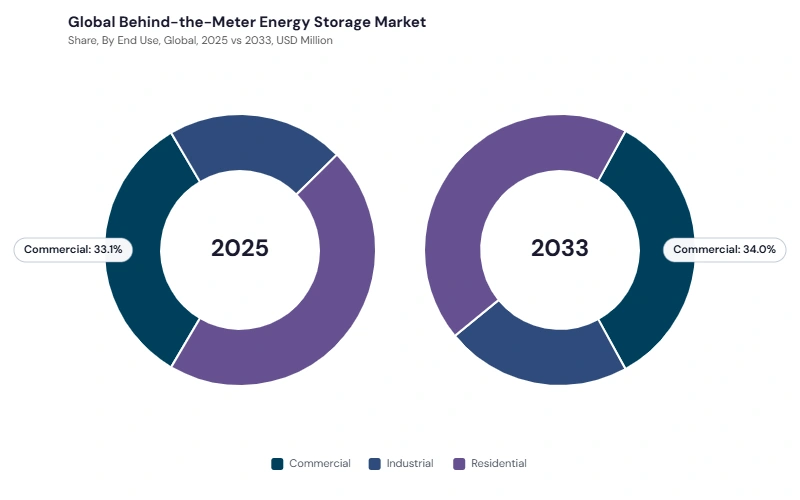
By end use, the behind-the-meter energy storage market is segmented into residential, commercial, and industrial sectors. The residential segment dominated the market in 2025 owing to increasing rooftop solar installations, rising electricity costs, and growing consumer focus on energy independence and backup power capabilities. Commercial users are increasingly deploying storage systems for peak demand management and operational cost optimization, while industrial facilities are focusing on energy resilience, uninterrupted power supply, and renewable energy integration to improve operational efficiency.
Free Valuable Insights: Behind-the-Meter Energy Storage Market Size to reach $26.29 Billion by 2033
Region-wise, the Behind-the-Meter Energy Storage Market is analyzed across North America, Europe, Asia Pacific, and LAMEA. The North America segment dominated the market in 2025 supported by strong renewable energy adoption, advanced grid infrastructure, and supportive government incentives for distributed energy systems. Utilities and commercial users across the region are increasingly investing in energy storage technologies to improve grid reliability and energy optimization.
Europe continues to witness strong market growth driven by decarbonization targets, rising renewable energy penetration, and supportive regulatory frameworks for distributed energy resources. Meanwhile, Asia Pacific is projected to emerge as the fastest-growing regional market due to rapid urbanization, rising electricity demand, increasing renewable energy deployment, and growing investments in battery manufacturing infrastructure. In LAMEA, improving energy infrastructure and growing focus on reliable electricity access are supporting adoption of behind-the-meter storage systems.
The behind-the-meter energy storage market is highly competitive and characterized by rapid innovation in battery technologies, energy management software, and distributed energy optimization systems. Competition is increasingly centered on integrated energy ecosystems that combine storage, solar generation, EV charging, and AI-enabled analytics platforms. Companies are differentiating themselves through battery efficiency, lifecycle performance, cloud-based monitoring capabilities, and interoperability with renewable energy infrastructure.
Strategic collaborations between battery manufacturers, utilities, renewable energy developers, and software providers are playing a critical role in market expansion. Companies are also investing in predictive analytics, virtual power plant integration, and intelligent automation technologies to improve operational performance and customer value. Regional manufacturing expansion, pricing strategies, and localized deployment capabilities continue to influence competitive dynamics across the global market.
| Report Attribute | Details |
|---|---|
| Market size value in 2026 | USD 7.96 billion |
| Market size forecast in 2033 | USD 26.29 billion |
| Base Year | 2025 |
| Historical period | 2022 to 2024 |
| Forecast Period | 2026 to 2033 |
| Revenue Growth Rate | CAGR of 18.6% from 2026 to 2033 |
| Number of Pages | 411 |
| Tables | 450 |
| Report Coverage | Market Trends, Revenue Estimation and Forecast, Segmentation Analysis, Regional and Country Breakdown, Competitive Landscape, Market Share Analysis, Company Profiling, Growth Drivers, Restraints, Opportunities |
| Segments Covered | Battery Type, End Use, Region |
| Country Scope |
|
| Companies Included | Tesla, Inc., LG Energy Solution, Samsung SDI, Panasonic Holdings Corporation, ABB Ltd., Schneider Electric SE, Siemens AG, Enphase Energy, BYD Company Ltd., Delta Electronics, Inc. |
By Battery Type
By End Use
By Geography
Valued at USD 7.96 billion in 2026, reaching USD 26.29 billion by 2033 at 18.6% CAGR during 2026-2033.
Lithium-ion batteries dominate, projected to hit USD 18.99 billion by 2033 at 18.2% CAGR during the forecast period.
Tesla, Inc., LG Energy Solution, Samsung SDI, and Panasonic Holdings Corporation hold dominant positions.
Residential leads at USD 11.54 billion by 2033, growing at 18.0% CAGR during the forecast period.
Rising renewable energy integration, increasing demand for energy resilience, and declining battery costs fuel market expansion.
North America leads from USD 2.57 billion in 2025 to USD 9.59 billion by 2033.
Our team of dedicated experts can provide you with attractive expansion opportunities for your business.








 Unique Offerings