
“Global Battery Cell Formation Analytics Software Market to reach a market value of USD 445.17 Million by 2033 growing at a CAGR of %”
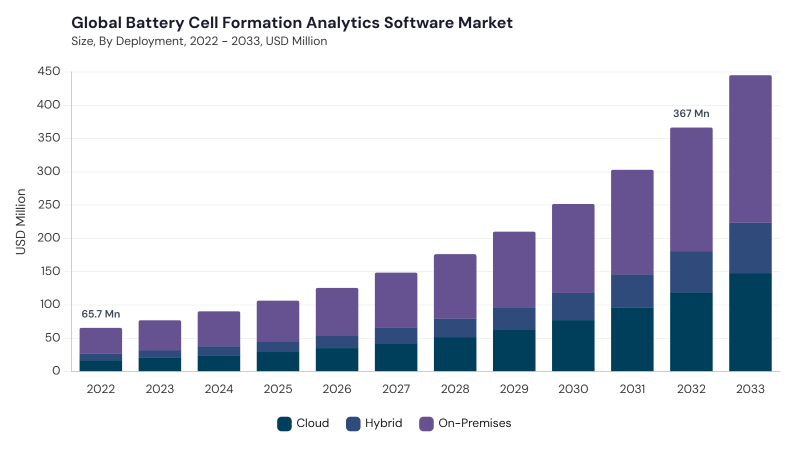
The Global Battery Cell Formation Analytics Software Market is expected to reach USD 445.2 million by 2033, growing at a CAGR of 19.8% during (2026 - 2033).
Battery cell formation analytics software converts data from initial charging, discharging, and associated finishing operations into information about process behavior and cell quality. Platforms collect and organize voltage, current, temperature, time, capacity, and relevant production records, then apply visualization, statistical analysis, or predictive models. The market includes software and related services used specifically to understand and improve formation. Formation equipment, basic cycle execution, general manufacturing systems, and battery monitoring after deployment require separate treatment unless their formation-analytics contribution is explicitly included.
Formation and finalization occur after materials and earlier processing have already contributed to cell cost. Detecting problems only at the end of an extended finishing sequence can therefore create significant waste and delay corrective action. Siemens and Voltaiq identify late problem discovery in the finishing stage as a manufacturing challenge addressed by their joint analytics offering. This supports demand for earlier visibility into abnormal behavior and its production context. Buyers need tools that help engineers distinguish isolated cell variation from systematic process issues. Commercial value follows faster and better-supported decisions about containment, investigation, and corrective action, rather than simply generating additional quality alerts.
Formation protocols influence the initial electrochemical development of a cell and can affect capacity, stability, and service life. Fraunhofer FFB’s formation review highlights the relationship between materials, cell design, and the formation process, as well as the difficulty of comprehensive optimization. Manufacturers therefore need analytical tools to compare protocols with relevant quality outcomes. The driver is the opportunity to improve production economics while preserving required performance. Shorter processing time is not sufficient evidence of a better protocol. Software must help connect candidate changes with measured cell behavior and appropriate follow-up testing before production teams adopt a revised process.

Based on Component, the market is segmented into Software Platforms, Services. Software Platforms dominated in 2025 and is projected to reach USD 348.1 million by 2033, growing at a CAGR of 20.7%. Software Platforms is expected to record the highest CAGR of 20.7% during the forecast period.
By Component, the market comprises Software Platforms and Services. Software platforms provide data ingestion, organization, visualization, feature extraction, quality analytics, and other eligible formation-specific functions. Services include integration, configuration, consulting, validation support, model development, training, and continuing analytical assistance. Bundled contracts require consistent allocation between software and services where both are measured separately. Equipment operation and general data storage should not be counted automatically as analytics. Likewise, a broader battery-intelligence subscription should contribute only the portion attributable to the defined formation use case. These boundaries keep the market focused on interpreting formation data and supporting related process or quality decisions.
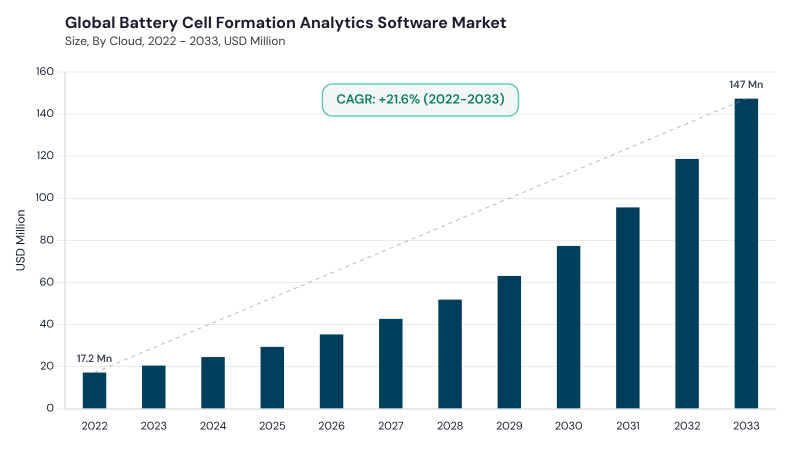
Based on Deployment, the market is segmented into On-Premises, Cloud, Hybrid. On-Premises dominated in 2025 and is projected to reach USD 221.7 million by 2033, growing at a CAGR of 17.6%. Cloud is expected to record the highest CAGR of 22.6% during the forecast period.
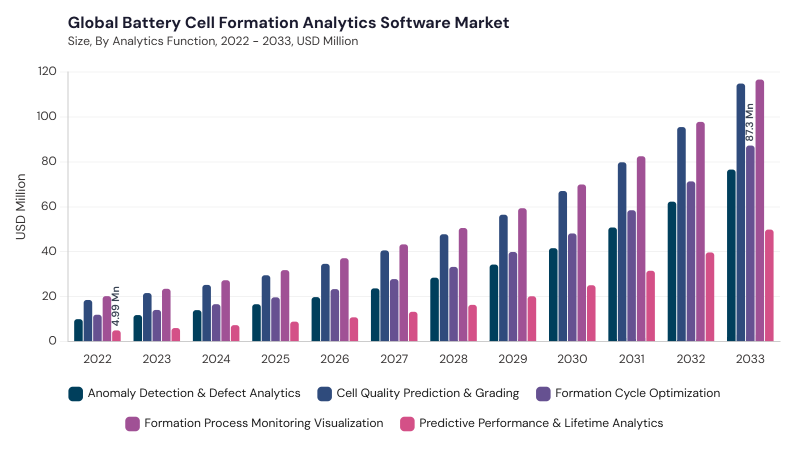
Based on Analytics Function, the market is segmented into Formation Process Monitoring & Visualization, Cell Quality Prediction & Grading, Formation Cycle Optimization, Anomaly Detection & Defect Analytics, Predictive Performance & Lifetime Analytics. Formation Process Monitoring & Visualization dominated in 2025 and is projected to reach USD 116.6 million by 2033, growing at a CAGR of 17.8%. Predictive Performance & Lifetime Analytics is expected to record the highest CAGR of 24.4% during the forecast period.
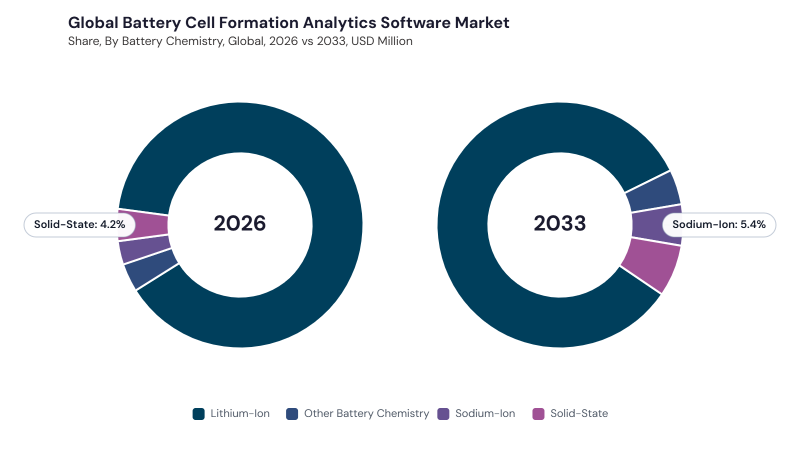
Based on Battery Chemistry, the market is segmented into Lithium-Ion, Sodium-Ion, Solid-State, Other Battery Chemistry. Lithium-Ion dominated in 2025 and is projected to reach USD 370.4 million by 2033, growing at a CAGR of 18.7%. Sodium-Ion is expected to record the highest CAGR of 29.8% during the forecast period.
Based on Application, the market is segmented into Electric Vehicle Batteries, Energy Storage System Batteries, Consumer Electronics Batteries, Industrial & Other Batteries. Electric Vehicle Batteries dominated in 2025 and is projected to reach USD 236.8 million by 2033, growing at a CAGR of 18.5%. Energy Storage System Batteries is expected to record the highest CAGR of 23.3% during the forecast period.
Region-wise, the Battery Cell Formation Analytics Software Market is analyzed across North America, Europe, Asia Pacific, LAMEA. Asia Pacific led in 2025 and is projected to reach USD 247.5 million by 2033, growing at a CAGR of 19.4%. North America is projected to grow at a CAGR of 22.5%. Europe is projected to grow at a CAGR of 18.2%. LAMEA is projected to grow at a CAGR of 22.5%.
By Component
By Deployment
By Analytics Function
By Battery Chemistry
By Application
| Report Attribute | Details |
|---|---|
| Market size value in 2026 | USD 125.7 million |
| Market size forecast in 2033 | USD 445.2 million |
| Base Year | 2025 |
| Historical Period | 2022 to 2024 |
| Forecast Period | 2026 to 2033 |
| Revenue Growth Rate | CAGR of 19.8% from 2026 to 2033 |
| Number of Tables | 720 |
| Number of Figures | 120 |
| Report Coverage | Market Trends, Revenue Estimation and Forecast, Segmentation Analysis, Regional and Country Breakdown, Competitive Landscape |
| Segments Covered | Component, Deployment, Analytics Function, Battery Chemistry, Application and Geography |
| Country Scope |
|
By Geography
The market is projected to reach USD 445.2 million by 2033, growing at a CAGR of 19.8% during 2026–2033, from USD 125.7 million in 2026.
Growth is driven by the need to improve battery cell production yields, optimize formation cycles, detect defects earlier, and use advanced analytics to enhance cell quality and manufacturing efficiency.
Predictive Performance & Lifetime Analytics is projected to grow the fastest, registering a 24.4% CAGR during 2026–2033, supported by demand for battery performance prediction and quality optimization.
Sodium-Ion is expected to register the highest growth, with a 29.8% CAGR during 2026–2033, reflecting increasing interest in alternative battery chemistries and associated formation analytics requirements.
Energy Storage System Batteries is projected to grow at the fastest rate, with a 23.3% CAGR during 2026–2033, driven by increasing requirements for battery quality assessment and performance optimization in energy storage applications.
Asia Pacific dominated the market in 2025 and is projected to reach USD 247.5 million by 2033, growing at a CAGR of 19.4% during 2026–2033. North America and LAMEA are both projected to register the highest regional CAGR of 22.5%.
Our team of dedicated experts can provide you with attractive expansion opportunities for your business.




 Unique Offerings
