The sample copy of this report is available for access.
“Global Barcode Printers Market to reach a market value of USD 9,734.8 Million by 2033 growing at a CAGR of 9.1%”
The Global Barcode Printer Market size is expected to reach USD 9,734.8 Million by 2033, rising at a market growth of 9.1% CAGR during the forecast period.
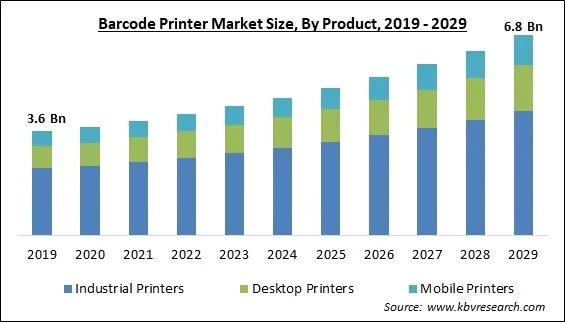
Growth in the Barcode Printer Market is driven by increasing adoption of automated identification and data capture technologies, expansion of e-commerce and logistics operations, rising demand for inventory management solutions, and growing implementation of digital supply chain systems across manufacturing, healthcare, transportation, retail, and government sectors. The market continues to benefit from advancements in thermal printing technologies, RFID integration, wireless connectivity, cloud-enabled printing solutions, and smart labeling systems that improve operational efficiency and product traceability. Furthermore, growing investments in warehouse automation, industrial digitization, and real-time asset tracking technologies continue to support long-term market expansion globally.
Today, barcode printers serve as critical components in inventory management, warehouse automation, logistics tracking, retail operations, healthcare labeling, asset management, product authentication, and supply chain visibility systems. The proliferation of e-commerce platforms, increasing deployment of Industry 4.0 technologies, expansion of transportation and logistics networks, and growing focus on real-time inventory visibility continue to expand application opportunities worldwide. Additionally, increasing emphasis on sustainability, regulatory compliance, and digital traceability requirements is influencing product innovation across the industry. As organizations continue investing in smart supply chain technologies, cloud-based inventory systems, and automated operational workflows, barcode printers are expected to become increasingly important across multiple end-use industries.
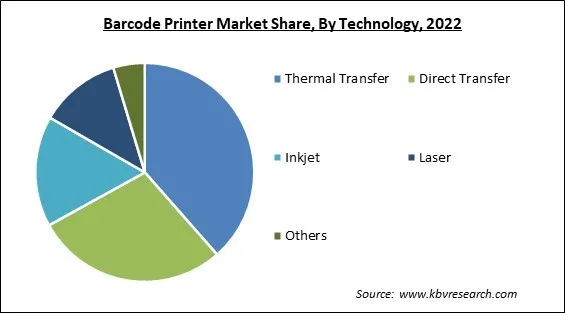
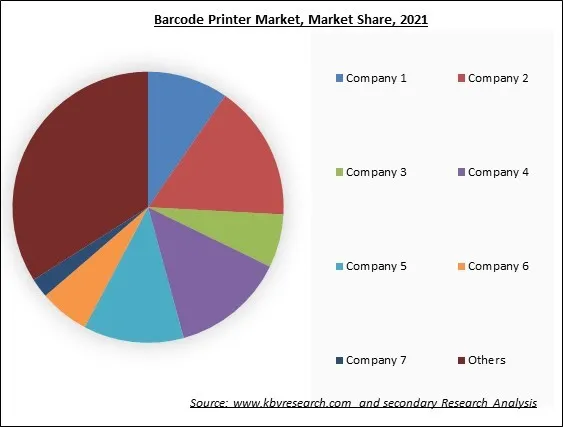
The major strategies followed by the market participants are Product Innovation, Strategic Partnerships, Geographic Expansion, RFID Integration, AI-Enabled Workflow Automation, and Cloud Connectivity Development as the key developmental strategies to strengthen their competitive positions. Leading companies continue investing in intelligent printing systems, mobile printing platforms, smart labeling technologies, enterprise mobility integration, and automated data capture solutions to address evolving industry requirements.
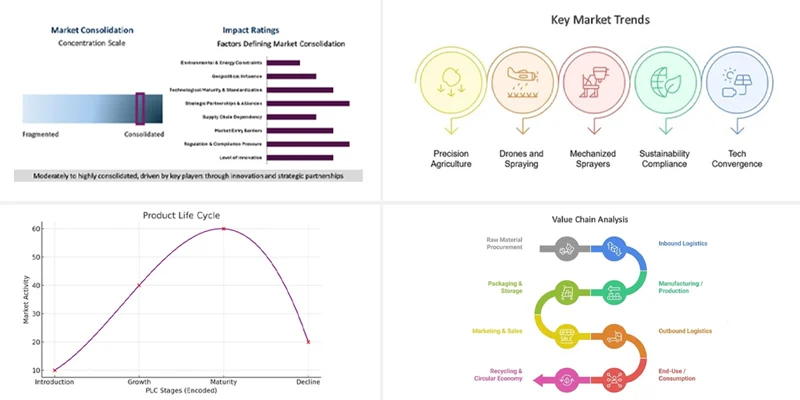

Based on Product, the Barcode Printer Market is segmented into Industrial Printers, Desktop Printers, and Mobile Printers. The Industrial Printers market dominated the Global Barcode Printer Market by Product in 2025, and would continue to be a dominant market till 2033; thereby, achieving a market value of USD 5676.6 million by 2033, growing at a CAGR of 8.8 % during the forecast period. The Desktop Printers market is expected to witness a CAGR of 9.4% during (2026 - 2033).
The Industrial Printers segment dominated the Global Barcode Printer Market in 2025 and would continue to be the dominant segment throughout the forecast period. The growth of this segment is driven by increasing demand for high-volume and durable barcode printing solutions across manufacturing facilities, logistics centers, warehouses, and industrial automation environments. Desktop printers continue to witness significant adoption across retail, healthcare, and office applications, while mobile printers are experiencing strong growth due to increasing demand for portable and real-time labeling solutions across field operations and transportation services.
Based on Technology, the Barcode Printer Market is segmented into Thermal Transfer, Direct Transfer, Ink-Jet, Laser, and Impact.
The Thermal Transfer market dominated the Global Barcode Printer Market by Technology in 2025, and would continue to be a dominant market till 2033; thereby, achieving a market value of USD 3420.1 million by 2033, growing at a CAGR of 7.9 % during the forecast period. The Direct Transfer market is expected to witness a CAGR of 9.3% during (2026 - 2033).
The Thermal Transfer segment dominated the Global Barcode Printer Market in 2025 and is expected to remain the leading technology segment throughout the forecast period. The growth is attributed to increasing demand for durable, high-quality, and long-lasting barcode labels across industrial and logistics applications. Direct Transfer technology continues to gain traction due to cost-efficiency and low maintenance requirements, while Ink-Jet, Laser, and Impact technologies serve specialized operational requirements across packaging, office, industrial, and document management applications.

Based on End-use, the Barcode Printer Market is segmented into Manufacturing, Transportation & Logistics, Retail & E-commerce, Healthcare, Government, and Other End-use. Manufacturing represented the leading end-use segment in 2025 owing to increasing adoption of barcode labeling systems across production facilities, industrial inventory management operations, and smart manufacturing environments. Transportation & Logistics and Retail & E-commerce continue to witness strong adoption due to expanding warehouse automation and digital commerce infrastructure. Healthcare and Government sectors are also increasingly deploying barcode printing technologies to improve operational efficiency and compliance management.
Free Valuable Insights: Barcode Printer Market Size to reach $9,734.8 Million by 2033

Region-wise, the Barcode Printer Market is analyzed across North America, Europe, Asia Pacific, and LAMEA. The North America market dominated the Global Barcode Printer Market by Region in 2025, and would continue to be a dominant market till 2033; thereby, achieving a market value of USD 3057.7 million by 2033, growing at a CAGR of 8.5 % during the forecast period. The Europe market is expected to witness a CAGR of 8.8% during (2026 - 2033).
North America dominated the Global Barcode Printer Market in 2025 and is expected to maintain its leading position throughout the forecast period. The region benefits from widespread deployment of warehouse automation systems, advanced logistics technologies, digital inventory management solutions, and strong e-commerce infrastructure. Europe and Asia Pacific continue to witness robust growth supported by industrial automation initiatives, supply chain modernization, manufacturing expansion, and increasing adoption of digital commerce platforms.
Barcode Printer Market Coverage
| Report Attribute | Details |
|---|---|
| Market size value in 2026 | USD 5,283.1 Million |
| Market size forecast in 2033 | USD 9,734.8 Million |
| Base Year | 2025 |
| Historical Period | 2022 to 2024 |
| Forecast Period | 2026 to 2033 |
| Revenue Growth Rate | CAGR of 9.1% from 2026 to 2033 |
| Number of Pages | 639 |
| Tables | 750 |
| Report Coverage | Market Trends, Revenue Estimation and Forecast, Segmentation Analysis, Regional and Country Breakdown, Competitive Landscape, Market Share Analysis, Company Profiling, Companies Strategic Developments, SWOT Analysis, Winning Imperatives |
| Segments Covered | Product, Technology, End-use, Region |
| Country Scope |
|
| Companies Included | Zebra Technologies Corporation; Honeywell International Inc.; SATO Holdings Corporation; TSC Auto ID Technology Co., Ltd.; Toshiba Tec Corporation; Brother Industries, Ltd.; Bixolon Co., Ltd.; Citizen Systems Japan Co., Ltd.; Seiko Epson Corporation; Avery Dennison Corporation |
By Product
By Technology
By End-use
By Geography
Expected to reach USD 9,734.8 million by 2033, growing at 9.1% CAGR during 2026-2033.
Thermal transfer printers dominate, projected to grow at 9.1% CAGR during the forecast period (2026-2033).
Zebra Technologies, Honeywell International, SATO Holdings, TSC Auto ID, Toshiba Tec, Brother Industries, Bixolon, Citizen Systems, Seiko Epson, Avery Dennison.
North America leads with a significant share, growing at 9.1% CAGR during 2026-2033.
Advanced technology integration in supply chains and e-commerce growth fuel demand.
The market is projected to grow significantly, reaching USD 9,734.8 million by 2033 at 9.1% CAGR.
Our team of dedicated experts can provide you with attractive expansion opportunities for your business.








 Unique Offerings