
“Global Automotive Tubeless Tire Market to reach a market value of USD 326296.88 Million by 2033 growing at a CAGR of 6.8%”
The Global Automotive Tubeless Tire Market is expected to reach USD 326.3 billion by 2033, growing at a CAGR of 6.8% during (2026 - 2033).
Automotive tubeless tires retain inflation air within the tire and compatible wheel assembly without a separate inner tube in their intended tubeless configuration. The inner liner, bead area, wheel, and valve contribute to air retention. Tubeless describes the inflation arrangement; radial and bias describe carcass construction. These distinctions are important because a tubeless tire is not automatically a run-flat or self-sealing product. Michelin’s tire terminology and marking guidance identify the inner liner and tubeless designation separately from radial construction.
Tires are recurring vehicle purchases, creating demand beyond new vehicle production. Owners and fleet operators replace eligible tires according to condition, service requirements, and professional assessment. This makes the existing vehicle population an important commercial base for tubeless tire suppliers. Manufacturers need suitable sizes and product ranges available where replacement decisions occur. The business opportunity depends on dependable replenishment and fitment coverage, rather than a fixed replacement interval assumed for every driver. Operating conditions and usage vary, so the supplied aftermarket share should not be converted into a uniform mileage or service-life claim.
Passenger cars, two-wheelers, light commercial vehicles, and heavy commercial vehicles create several routes to demand within the tubeless category. Each application brings different size, load, construction, and service requirements. Manufacturers can serve multiple groups through differentiated product families and qualified fitments. Apollo’s official two-wheeler assortment provides an example of tubeless products identified for a specific vehicle category. This supports commercial breadth, although it also requires disciplined catalog management. Growth in an overall vehicle segment does not automatically translate into the same increase in eligible tubeless tires without considering fitment and replacement patterns.
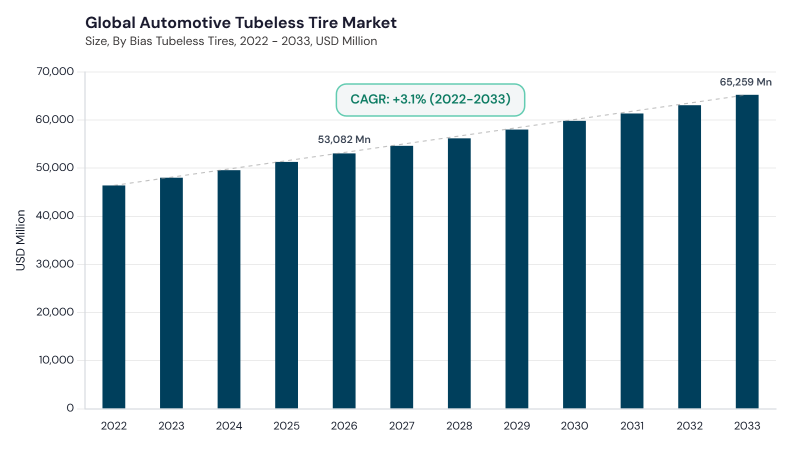
Based on Tire Type, the market is segmented into Radial Tubeless Tires, Bias Tubeless Tires. Radial Tubeless Tires dominated in 2025 and is projected to reach USD 261.0 billion by 2033, growing at a CAGR of 8.0%. Radial Tubeless Tires is expected to record the highest CAGR of 8.0% during the forecast period.
Radial tubeless tires benefit from a carcass architecture in which cords extend radially across the tire, supported by belts beneath the tread. This arrangement allows the tread and sidewall to respond differently to operating loads, supporting opportunities to optimize rolling resistance, heat generation, ride comfort and tread wear. Demand is reinforced by radial fitment across passenger vehicles and commercial fleets, where fuel economy, durability and total operating cost influence procurement. Manufacturers compete through compound formulation, belt design, air-retention performance and consistency across original equipment specifications.
Bias tubeless tires use diagonally arranged, overlapping carcass plies and retain a commercial role in selected vehicle applications where construction characteristics, purchase price and operating conditions favor their use. The segment faces substitution pressure as radial fitments expand, although established replacement requirements can sustain demand. Only bias tires designed for tubeless operation are included; bias construction alone does not establish tubeless eligibility.
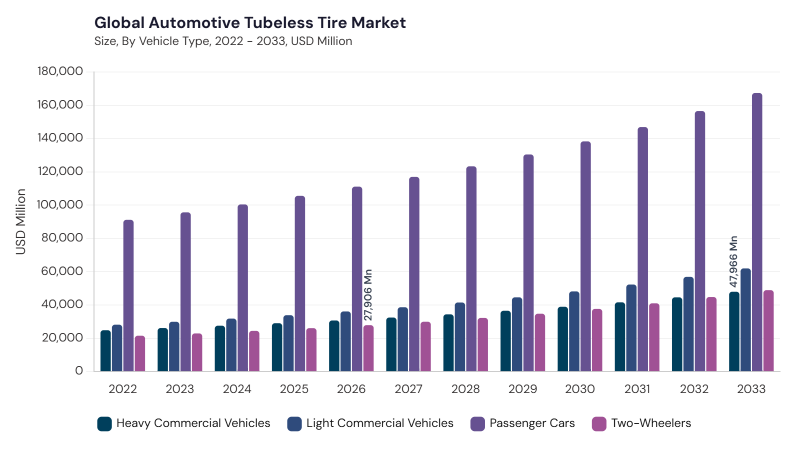
Based on Vehicle Type, the market is segmented into Passenger Cars, Two-Wheelers, Light Commercial Vehicles, Heavy Commercial Vehicles. Passenger Cars dominated in 2025 and is projected to reach USD 167.4 billion by 2033, growing at a CAGR of 6.0%. Two-Wheelers is expected to record the highest CAGR of 8.4% during the forecast period.
Passenger car demand is supported by the installed vehicle base, replacement requirements and original equipment fitments across compact cars, sedans, SUVs and crossovers. Tire suppliers differentiate their portfolios through wet grip, rolling resistance, noise reduction and tread durability. Electric vehicle applications introduce additional design considerations, including vehicle mass, torque delivery and efficiency, creating opportunities for application-specific tubeless tire development.
Two-wheelers provide expansion opportunities as compatible tubeless wheel assemblies become more widely available across motorcycles and scooters. Light Commercial Vehicles require products suited to variable payloads, urban delivery and frequent operating cycles, while Heavy Commercial Vehicles place greater emphasis on load capacity, casing durability, heat management and cost per kilometer. Fleet procurement and service networks influence supplier selection in both commercial categories.
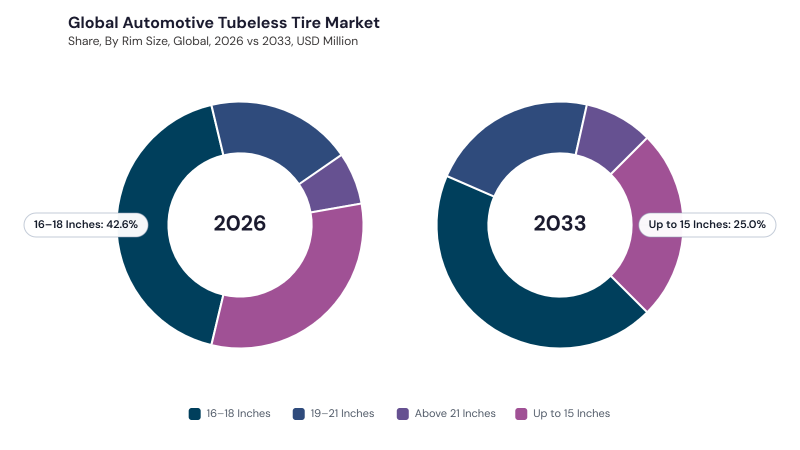
Based on Rim Size, the market is segmented into Up to 15 Inches, 16–18 Inches, 19–21 Inches, Above 21 Inches. 16–18 Inches dominated in 2025 and is projected to reach USD 143.6 billion by 2033, growing at a CAGR of 7.3%. Above 21 Inches is expected to record the highest CAGR of 11.1% during the forecast period.
The Up to 15 Inches segment serves numerous compact passenger vehicles and compatible two-wheeler applications, with replacement availability and affordability important to demand. The 16–18 Inches segment benefits from broad fitment across mainstream passenger cars, crossovers and selected commercial vehicles. Its extensive size and specification combinations favor manufacturers with efficient production scheduling and established dealer inventories.
The 19–21 Inches segment is associated with larger passenger vehicles, premium models and selected commercial fitments, creating opportunities for differentiated tread designs and higher-specification products. Above 21 Inches includes eligible large-wheel applications, including selected premium SUVs and heavy commercial vehicles. Higher material requirements, specialized tooling and narrower fitment demand can affect unit economics. Rim diameter alone does not determine load rating, vehicle compatibility or tire performance.
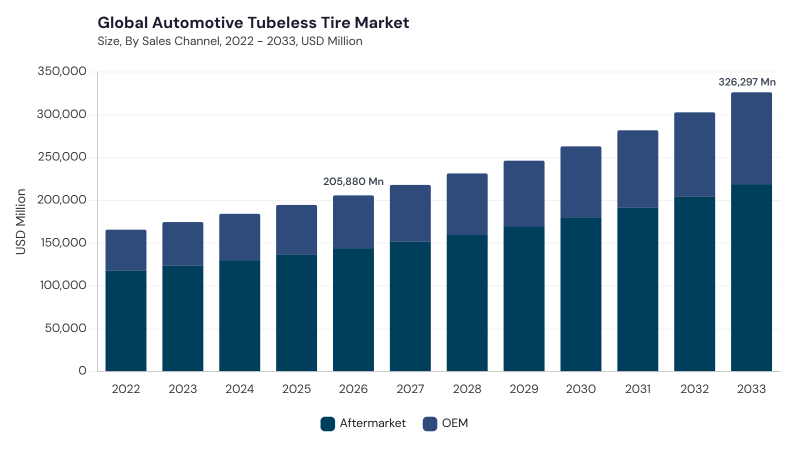
Based on Sales Channel, the market is segmented into OEM, Aftermarket. Aftermarket dominated in 2025 and is projected to reach USD 218.6 billion by 2033, growing at a CAGR of 6.2%. OEM is expected to record the highest CAGR of 8.2% during the forecast period.
OEM demand depends on vehicle production programs, model launches and qualification of tires against vehicle-specific engineering requirements. Suppliers must coordinate tire development with automakers, meeting applicable durability, handling, noise and efficiency targets while maintaining consistent quality and delivery schedules. Long qualification cycles can create barriers to entry, but successful fitment programs offer recurring supply opportunities over a vehicle platform lifecycle.
The Aftermarket benefits from the existing vehicle population and recurring replacement needs across private and commercial transport. Independent dealers, authorized service centers, distributors and online retail channels support product availability and fitment coverage. Competitive positioning depends on price tiers, warranty support, inventory availability and professional installation networks. Fleet contracts offer additional opportunities for suppliers that can demonstrate dependable service and operating-cost performance.
Free Valuable Insights: Automotive Tubeless Tire Market Size to reach $326.3 Billion by 2033
Region-wise, the Automotive Tubeless Tire Market is analyzed across North America, Europe, Asia Pacific, LAMEA. Asia Pacific led in 2025 and is projected to reach USD 159.9 billion by 2033, growing at a CAGR of 8.2%. North America is projected to grow at a CAGR of 4.8%. Europe is projected to grow at a CAGR of 4.2%. LAMEA is projected to grow at a CAGR of 10.2%.
Asia Pacific benefits from extensive automotive manufacturing ecosystems, substantial two-wheeler markets and expanding replacement requirements across diverse vehicle categories. China, Japan, India and South Korea provide different combinations of vehicle production, tire manufacturing and domestic consumption. Regional suppliers must balance affordable product ranges with higher-performance fitments as vehicle specifications evolve.
North America offers established replacement demand across passenger vehicles, pickups, SUVs and commercial fleets, while Europe presents opportunities in efficiency-oriented tire designs and qualified original equipment programs. LAMEA growth opportunities are linked to vehicle fleet expansion, road transport activity and improved distribution of compatible tubeless products. Across Brazil, the Middle East and African markets, affordability, road conditions, import costs and dealer coverage influence adoption. Regional growth therefore depends on eligible fitments and replacement economics rather than vehicle population growth alone.
By Tire Type
By Vehicle Type
By Rim Size
By Sales Channel
By Geography
| Report Attribute | Details |
|---|---|
| Market size value in 2026 | USD 205.9 billion |
| Market size forecast in 2033 | USD 326.3 billion |
| Base Year | 2025 |
| Historical Period | 2022 to 2024 |
| Forecast Period | 2026 to 2033 |
| Revenue Growth Rate | CAGR of 6.8% from 2026 to 2033 |
| Number of Tables | 510 |
| Number of Figures | 85 |
| Report Coverage | Market Trends, Revenue Estimation and Forecast, Segmentation Analysis, Regional and Country Breakdown, Competitive Landscape |
| Segments Covered | Tire Type, Vehicle Type, Rim Size, Sales Channel and Geography |
| Country Scope |
|
By Geography
Expected to reach USD 326.3 billion by 2033, growing at 6.8% CAGR during 2026-2033.
Radial Tubeless Tires lead with a market value of USD 261.0 billion by 2033.
Top companies include Bridgestone, Michelin, Goodyear, Continental, and Pirelli.
Asia Pacific leads with a market value of USD 159.9 billion by 2033.
Recurring replacement demand and product development for electric vehicles are key growth drivers.
Passenger Cars hold the highest revenue share, reaching USD 167.4 billion by 2033.
Our team of dedicated experts can provide you with attractive expansion opportunities for your business.