The sample copy of this report is available for access.
“Global Automotive Front End Module Market to reach a market value of USD 2,07,832.28 Million by 2033 growing at a CAGR of 5.9%”
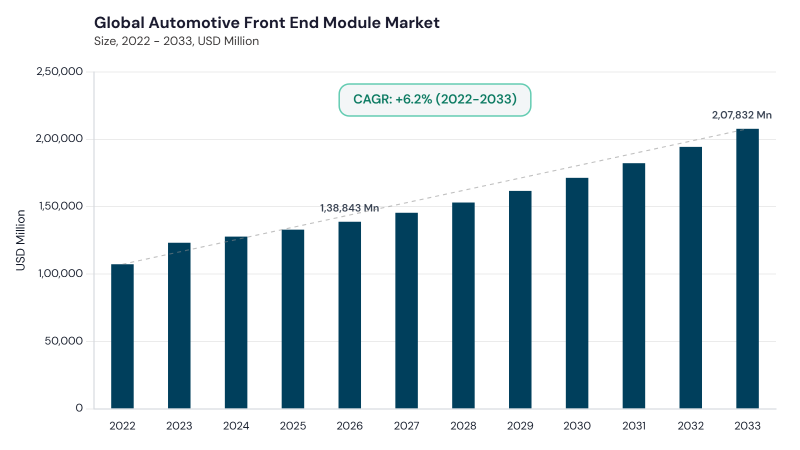
The Global Automotive Front End Module Market is expected to reach $2,07,832.3 million by 2033, growing at a CAGR of 5.9% during 2026 - 2033.
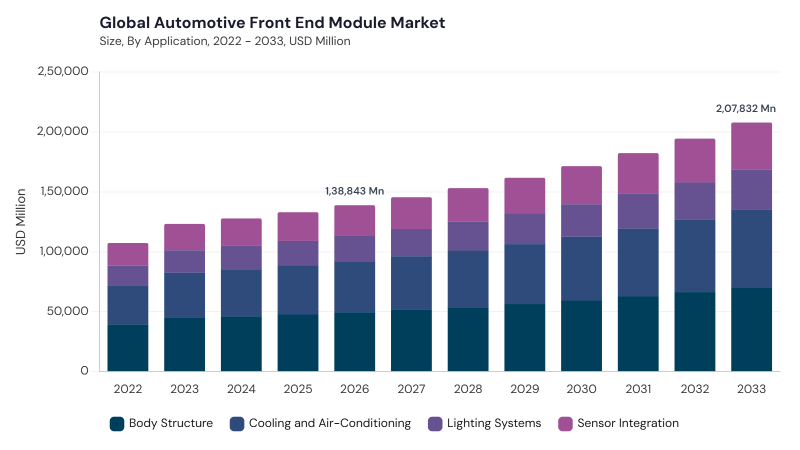
The Global Automotive Front End Module Market is witnessing steady growth driven by increasing vehicle production, rising adoption of modular automotive architectures, growing integration of advanced driver assistance systems (ADAS), and expanding demand for lightweight vehicle components. Automotive front end modules have evolved from conventional structural assemblies into multifunctional systems capable of integrating cooling components, lighting systems, sensor technologies, aerodynamic elements, and crash management structures. Growing electrification trends, advancements in autonomous driving technologies, and increasing focus on vehicle efficiency are further accelerating demand for technologically advanced front end modules globally.
The Automotive Front End Module Market is increasingly becoming a critical element of modern vehicle architecture, integrating structural, thermal, aerodynamic, safety, and electronic functionalities into a unified assembly. The growing incorporation of radar systems, lidar sensors, cameras, active grille shutters, adaptive lighting technologies, and thermal management systems is transforming front end modules into highly intelligent automotive platforms. Automakers are increasingly emphasizing modularization strategies to improve assembly efficiency, reduce manufacturing complexity, and enhance platform flexibility across multiple vehicle models.
The market is also benefiting from increasing adoption of electric vehicles, growing implementation of autonomous driving technologies, and rising demand for connected mobility solutions. Front-end modules are evolving into multifunctional assemblies that support vehicle safety, thermal management, electronic integration, and aerodynamic optimization simultaneously. Leading companies are investing heavily in lightweight structural technologies, advanced manufacturing processes, sensor-compatible designs, and software-defined vehicle architectures to strengthen their competitive positions.

OPmobility SE, Magna International Inc., Hyundai Mobis Co., Ltd., and Forvia SE maintain strong market positions through extensive front-end module integration capabilities, lightweight structural expertise, and strong relationships with global automotive manufacturers.
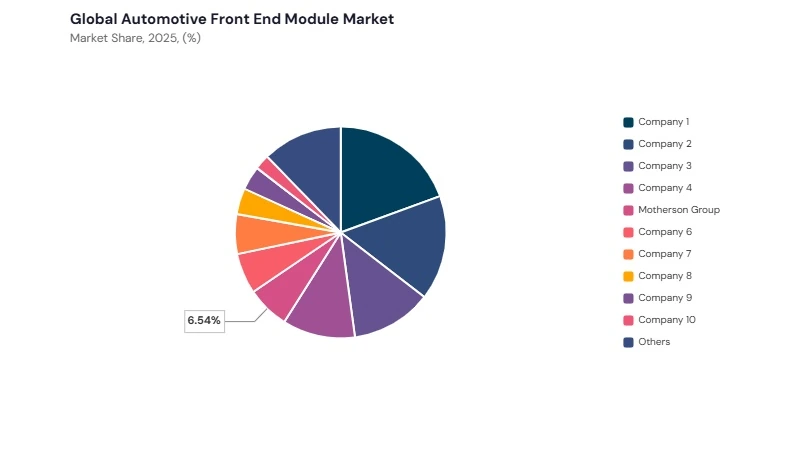
Companies such as Motherson Group, Valeo SA, Denso Corporation, Marelli Holdings Co., Ltd., Flex-N-Gate Group, and AISIN CORPORATION continue strengthening competition through innovations in lighting systems, thermal management technologies, active aerodynamic solutions, and advanced sensor integration platforms. Market competition is increasingly focused on lightweight design, EV-ready architectures, ADAS compatibility, modular manufacturing capabilities, and global production footprints.
Based on End Use, the Automotive Front End Module Market is segmented into OEM and Aftermarket.
The OEM market dominated the Global Automotive Front End Module Market by End Use in 2025, and would continue to be a dominant market till 2033; thereby, achieving a market value of $183359 million by 2033, growing at a CAGR of 5.6% during the forecast period. The Aftermarket market is expected to witness a CAGR of 8.3% during (2026 - 2033).
OEMs increasingly require front end modules capable of accommodating ADAS sensors, lighting systems, cooling units, and active aerodynamic components while maintaining structural performance and regulatory compliance. Growing adoption of electric vehicles and autonomous driving technologies further supports demand for highly integrated OEM front-end solutions. The Aftermarket segment continues to witness steady growth due to rising replacement demand, vehicle repair activities, and increasing interest in upgrading existing vehicles with advanced front-end technologies. The segment benefits from growing global vehicle parc, rising collision repair activities, and expanding availability of compatible replacement modules designed to support both traditional and advanced vehicle platforms.
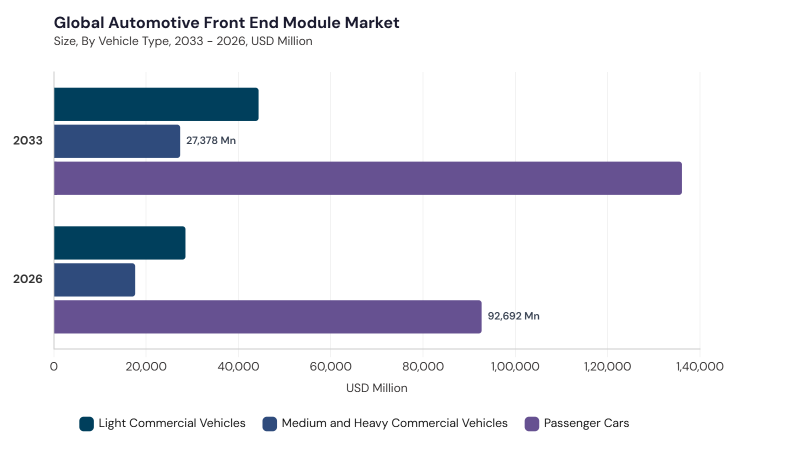
Based on Vehicle Type, the Automotive Front End Module Market is segmented into Passenger Cars, Light Commercial Vehicles, and Medium and Heavy Commercial Vehicles.
The Passenger Cars market dominated the Global Automotive Front End Module Market by Vehicle Type in 2025, and would continue to be a dominant market till 2033; thereby, achieving a market value of $1,36,088.6 million by 2033, growing at a CAGR of 5.6% during the forecast period. The Light Commercial Vehicles market is expected to witness a CAGR of 6.5% during (2026 - 2033).
The Light Commercial Vehicles segment is witnessing significant growth due to increasing demand for logistics and last-mile delivery vehicles, coupled with rising integration of safety systems and electrification technologies. The Medium and Heavy Commercial Vehicles segment continues to expand steadily as fleet operators adopt advanced safety systems, collision mitigation technologies, and fuel-efficiency solutions requiring more sophisticated front-end module architectures.
Based on Raw Material, the Automotive Front End Module Market is segmented into Metal, Plastic, Composite, and Hybrid.
The Metal market dominated the Global Automotive Front End Module Market by Raw Material in 2025, and would continue to be a dominant market till 2033; thereby, achieving a market value of $91933.4 million by 2033, growing at a CAGR of 5.4 % during the forecast period.
The Plastic segment is witnessing substantial growth due to increasing demand for lightweight materials that improve fuel efficiency and support electric vehicle range optimization. Composite materials continue gaining traction because of their high strength-to-weight ratio, design flexibility, and compatibility with advanced vehicle architectures. Hybrid materials are emerging as an important segment as manufacturers increasingly combine metals, plastics, and composites to achieve optimal performance, weight reduction, crash management, and sensor integration capabilities within modern front-end modules.
Based on Application, the Automotive Front End Module Market is segmented into Body Structure, Cooling and Air-Conditioning, Sensor Integration, and Lighting Systems.
The Cooling and Air-Conditioning segment remains highly significant due to increasing thermal management requirements associated with internal combustion engines, hybrid systems, and electric vehicle battery platforms. Sensor Integration is emerging as one of the fastest-growing applications driven by increasing deployment of ADAS technologies, autonomous driving systems, radar sensors, lidar systems, and vehicle connectivity solutions. The Lighting Systems segment continues expanding due to growing adoption of adaptive lighting, LED technologies, matrix lighting systems, and integrated front-end styling solutions that improve both safety and vehicle aesthetics.
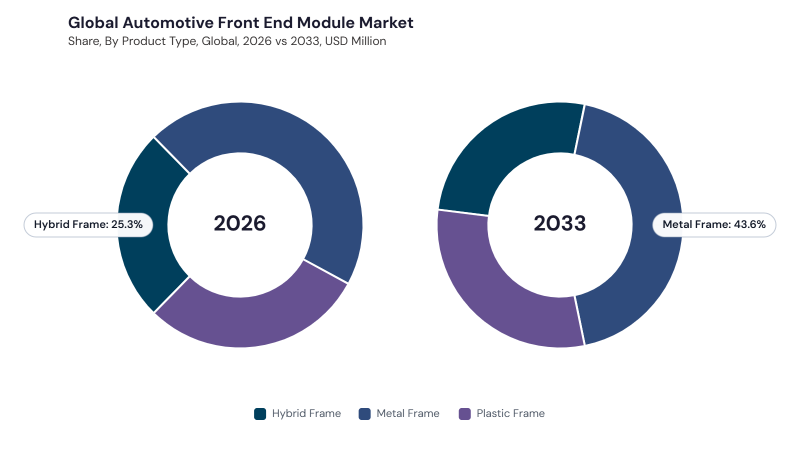
Based on Product Type, the Automotive Front End Module Market is segmented into Metal Frame, Plastic Frame, and Hybrid Frame.
The Metal Frame segment dominated the market in 2025 supported by its structural rigidity, impact resistance, and long-standing use across automotive applications requiring superior crash performance and durability. The Plastic Frame segment is witnessing strong growth owing to increasing demand for lightweight and cost-efficient front-end solutions that support improved fuel economy and simplified manufacturing processes.
The Hybrid Frame segment continues gaining traction as automakers increasingly seek to combine the structural benefits of metal with the weight reduction and design flexibility offered by plastics and composites. Hybrid frame architectures are particularly attractive for electric vehicles and advanced vehicle platforms that require multifunctional integration capabilities while maintaining performance and regulatory compliance.
Free Valuable Insights: Automotive Front End Module Market Size to reach $2,07,832.28 Million by 2033
Region-wise, the Automotive Front End Module Market is analyzed across North America, Europe, Asia Pacific, and LAMEA. Asia Pacific dominated the market in 2025 supported by strong automotive manufacturing capabilities, extensive OEM production facilities, growing vehicle demand, and rising adoption of advanced automotive technologies across China, Japan, India, and South Korea.
Europe continues witnessing strong growth driven by technological advancements, stringent vehicle safety regulations, and significant investments in electric vehicle development. North America remains an important market supported by growing demand for advanced safety systems, increasing vehicle electrification, and strong presence of leading automotive manufacturers and technology suppliers. The LAMEA region is gradually expanding due to increasing automotive production activities, infrastructure development, and growing adoption of advanced vehicle components across emerging markets.
Automotive Front End Module Market Coverage:
| Report Attribute | Details |
|---|---|
| Market size value in 2026 | USD 1,38,843.16 Million |
| Market size forecast in 2033 | USD 2,07,832.28 Million |
| Base Year | 2025 |
| Historical period | 2022 to 2024 |
| Forecast Period | 2026 to 2033 |
| Revenue Growth Rate | CAGR of 5.9% from 2026 to 2033 |
| Number of Pages | 745 |
| Tables | 870 |
| Report Coverage | Market Trends, Revenue Estimation and Forecast, Segmentation Analysis, Regional and Country Breakdown, Competitive Landscape, Market Share Analysis, Company Profiling, Companies Strategic Developments, SWOT Analysis, Winning Imperatives |
| Segments Covered | End Use, Vehicle Type, Raw Material, Application, Product Type, Region |
| Country Scope |
|
| Companies Included | OPmobility SE, Magna International Inc., Hyundai Mobis Co., Ltd., Forvia SE, Motherson Group, Valeo SA, Denso Corporation, Marelli Holdings Co., Ltd., Flex-N-Gate Group, AISIN CORPORATION |
By End Use
By Raw Material
By Product Type
By Geography
Expected to reach USD 207,832.3 million by 2033, growing at 5.9% CAGR during 2026-2033.
OEM segment leads, projected to achieve USD 183,359.0 million by 2033.
OPmobility SE, Magna International Inc., Hyundai Mobis Co., Ltd., and Forvia SE are key players.
Passenger Cars segment leads, expected to reach USD 136,088.6 million by 2033.
Rising integration of advanced electronic components and increasing adoption of electric vehicles drive growth.
Sensor Integration segment grows fastest at 6.6% CAGR during 2026-2033.
Our team of dedicated experts can provide you with attractive expansion opportunities for your business.








 Unique Offerings