The sample copy of this report is available for access.
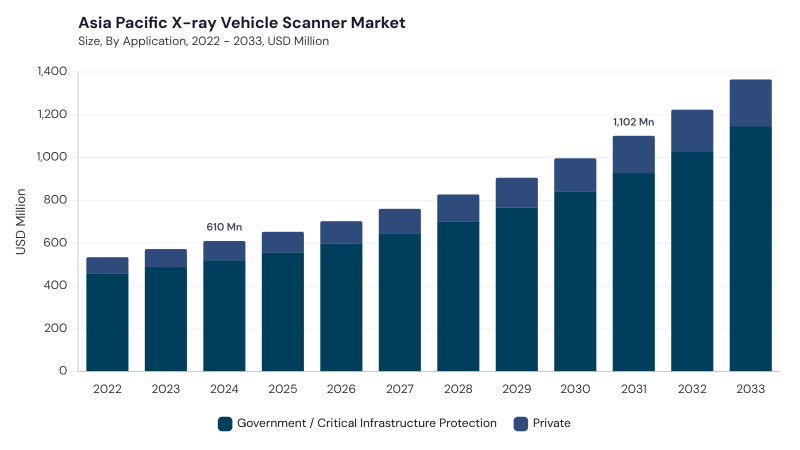
The Asia Pacific X-ray Vehicle Scanner Market is expected to reach USD 996.8 million by 2030, growing at a CAGR of 9.9% during (2026 – 2033).
The Asia Pacific X-ray Vehicle Scanner Market originated from the broader development of X-ray technology, which was first used across medical and industrial applications before being adapted for vehicle inspection. Early adoption in the region was driven by customs operations, border control, and security agencies seeking non-intrusive methods to prevent illicit trafficking and concealed threats. Over time, systems evolved from rudimentary static scanners into mobile, high-resolution, computed tomography-enabled, AI-assisted, and connected vehicle inspection platforms. Today, X-ray vehicle scanners are part of wider security suites deployed across customs, defense, transportation, logistics hubs, seaports, airports, and critical infrastructure locations.
The growing adoption of AI-powered imaging, portable scanner designs, modular platforms, real-time data sharing, remote operation, advanced imaging systems, and regulatory-compliant scanning technologies is shaping the next phase of market growth across Asia Pacific. Vendors are increasingly investing in AI algorithms, sensor technologies, carbon nanotube-based X-ray tubes, high-resolution imaging, automated threat recognition, centralized monitoring, secure data handling, remote diagnostics, and localized service centers to improve detection accuracy, inspection speed, and operational continuity. Rising port infrastructure, cross-border trade, customs modernization, airport security upgrades, defense spending, urban security needs, and strategic asset protection are also supporting improved scalability, service quality, and market expansion.
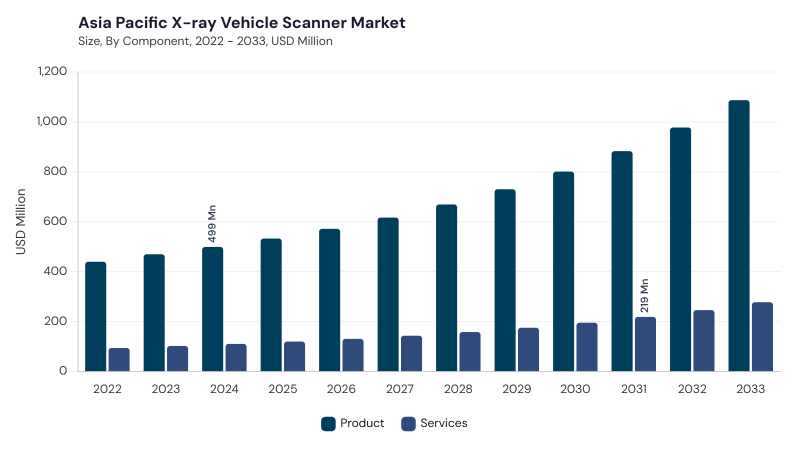
Based on Component, the market is segmented into Product and Services. The Product market dominated the Asia Pacific X-ray Vehicle Scanner Market by Component in 2025, and would continue to be a dominant market till 2033; thereby, achieving a market value of USD 801.1 million by 2030, growing at a CAGR of 9.6 % during the forecast period. The Services market is expected to witness a CAGR of 11.3% during (2026 - 2033).
Product leads the market due to procurement of scanner units, X-ray imaging systems, detector arrays, gantry assemblies, shielding structures, operator stations, control software, traffic monitoring equipment, mobile scanners, fixed scanners, drive-through portals, cargo vehicle inspection systems, and integrated security scanning platforms. Product demand is reinforced by investments in ports, border checkpoints, airports, military sites, customs facilities, industrial zones, logistics corridors, and critical infrastructure locations where high-capacity vehicle screening is required. Services also hold an important position as installation, commissioning, maintenance, calibration, technical repair, software upgrades, spare parts, operator training, lifecycle support, remote diagnostics, cybersecurity support, and AI model updates are needed to maintain system availability and inspection quality.
Based on Type, the market is segmented into Fixed and Portable. The Fixed market dominated the Asia Pacific X-ray Vehicle Scanner Market by Type in 2025, and would continue to be a dominant market till 2033; thereby, achieving a market value of USD 701.6 million by 2030, growing at a CAGR of 9.7 % during the forecast period. The Portable market is expected to witness a CAGR of 10.6% during (2026 - 2033).
Fixed scanners lead the market due to deployment at permanent inspection locations such as seaports, airports, border crossings, customs terminals, defense facilities, government premises, large logistics gateways, ports, and major checkpoints. These systems are favored where vehicle traffic is steady and inspection capacity must remain continuous, offering robust imaging performance, higher throughput, stable operating conditions, and deeper linkage with access control, cargo documentation, surveillance, radiation monitoring, traffic barriers, and central security rooms. Portable scanners are also gaining demand across mobile enforcement, temporary inspection points, roadside checks, special events, remote border areas, emergency deployments, military field operations, and locations where movable inspection coverage is required.
Based on Application, the market is segmented into Government / Critical Infrastructure Protection and Private. Government / Critical Infrastructure Protection leads the market due to strong demand from customs agencies, border authorities, port operators, airport security organizations, defense departments, police agencies, correctional facilities, government complexes, power plants, oil and gas assets, transportation hubs, military bases, and public infrastructure sites.
This segment is supported by customs enforcement, border management, counter-smuggling activity, port security, airport protection, military readiness, public facility security, and strategic infrastructure protection. Private applications are also expanding across logistics parks, warehouses, manufacturing facilities, mines, private terminals, data centers, event venues, commercial compounds, and high-value industrial sites where buyers focus on asset protection, cargo control, theft prevention, safe vehicle access, business continuity, ease of operation, and practical deployment costs.
Free Valuable Insights: The Global X-ray Vehicle Scanner Market will hit USD 4.3 Billion billion by 2033, at a CAGR of 9.4%
Based on Country, the market is segmented into China, Japan, India, South Korea, Singapore, Malaysia, and Rest of Asia Pacific. The China market dominated the Asia Pacific X-ray Vehicle Scanner Market by Country in 2025, and would continue to be a dominant market till 2033; thereby, achieving a market value of USD 293.5 million by 2030, growing at a CAGR of 8.1 % during the forecast period. The Japan market is expected to witness a CAGR of 9% during (2026 - 2033). Additionally, The India market is expected to witness a CAGR of 10.7% during (2026 - 2033).
China leads through government security needs, customs screening, mobile units, AI-based image recognition, digital detectors, IoT connectivity, and localized production. Japan is growing with customs inspection, advanced digital imaging, CT systems, microfocus X-ray systems, 3D imaging, and mobile scanner deployment. India is supported by border security, port screening, anti-smuggling initiatives, high-energy X-rays, dual-energy imaging, portable scanners, and Make in India localization. South Korea, Singapore, Malaysia, and Rest of Asia Pacific add growth through security upgrades, customs modernization, and port inspection infrastructure.

By Component
By Type
By Application
By Country
Set to reach USD 996.8 million by 2033, growing at 9.9% CAGR during 2026-2033.
China leads with USD 293.5 million by 2030, growing at 8.1% CAGR during the forecast period.
Rising demand for advanced security solutions boosts growth, with the Services segment at 11.3% CAGR during 2026-2033.
Product segment dominates, reaching USD 801.1 million by 2030, growing at 9.6% CAGR during the forecast period.
India market is expected to witness a CAGR of 10.7% during 2026-2033.
Portable segment is expected to witness a CAGR of 10.6% during 2026-2033.
Our team of dedicated experts can provide you with attractive expansion opportunities for your business.




 Unique Offerings