The sample copy of this report is available for access.
The Asia Pacific Underground Cables Market is expected to reach USD 38.0 billion by 2030, growing at a CAGR of 4.4% during (2026 – 2033).
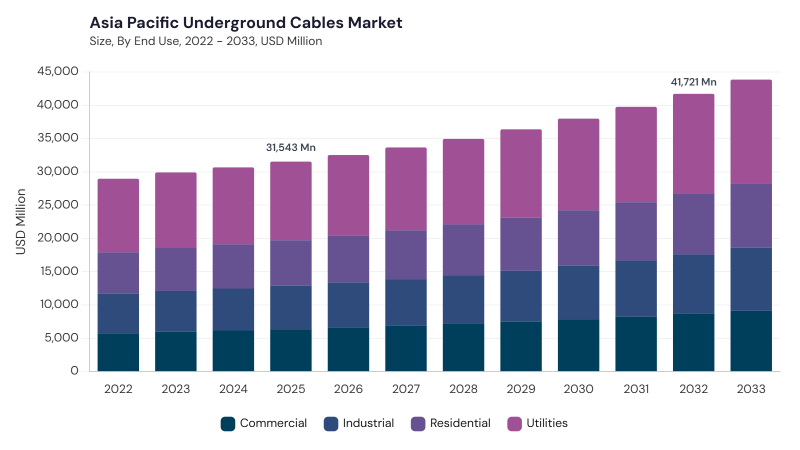
The Asia Pacific Underground Cables Market developed from the need to improve power distribution, telecom connectivity, and infrastructure safety across densely populated cities and expanding industrial zones. Early systems relied on basic insulated copper cables used to reduce exposure to weather disruptions, urban congestion, and overhead-line hazards. Over time, improvements in cable design, XLPE insulation, protective sheathing, and fiber optic integration enabled higher voltage handling, longer service life, and stronger network performance. Rapid urbanization, industrialization, electrification programs, and smart grid investments accelerated the shift toward underground infrastructure.
The Asia Pacific Underground Cables Market is being shaped by urban infrastructure expansion, renewable energy deployment, data center growth, smart grid adoption, and stricter safety and environmental requirements. Utilities and infrastructure developers are deploying underground cables to support dense cities, metro rail systems, airports, commercial districts, smart communities, and rural electrification programs. Manufacturers are focusing on higher-capacity cables, advanced insulation, AI-enabled monitoring, fiber optic sensing, predictive maintenance, and sustainable materials suited to harsh regional conditions. Demand is also rising from offshore wind, EV charging, 5G networks, cloud infrastructure, and industrial corridors.
Based on Type, the market is segmented into Low Voltage Cables, Medium Voltage Cables, and High Voltage Cables. The Low Voltage Cables market dominated the Asia Pacific Underground Cables Market by Type in 2025, and would continue to be a dominant market till 2033; thereby, achieving a market value of USD 17.5 billion by 2030, growing at a CAGR of 3.8 % during the forecast period. The Medium Voltage Cables market is expected to witness a CAGR of 4.7% during (2026 - 2033). Additionally, The High Voltage Cables market is expected to witness highest CAGR of 5% during (2026 - 2033).
Low Voltage Cables lead due to wide deployment across housing projects, commercial buildings, street lighting, local distribution networks, smart neighborhoods, and rural electrification programs. These cables are essential for safe end-user power delivery and support expanding residential and urban infrastructure across emerging economies. Medium Voltage Cables remain important for distribution feeders, industrial corridors, renewable energy parks, commercial hubs, substations, and smart grid upgrades. High Voltage Cables hold a smaller but strategic role in bulk power transmission, offshore renewable connections, ultra-high-voltage corridors, and cross-regional grid expansion in countries such as China, India, Japan, and South Korea.
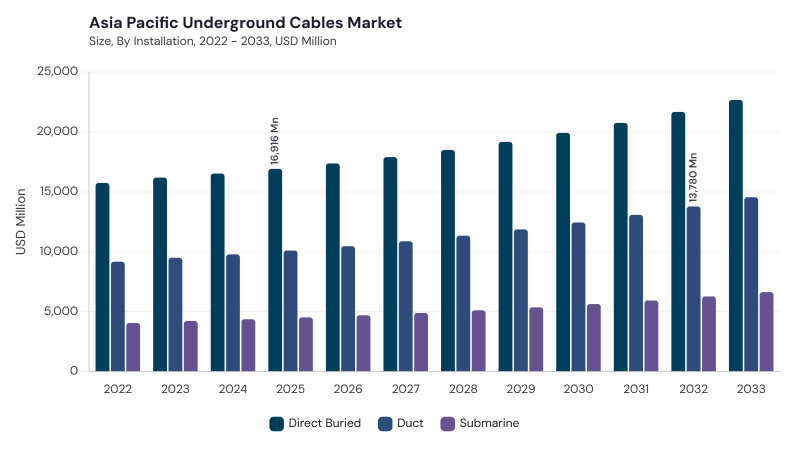
Based on Installation, the market is segmented into Direct Buried, Duct, and Submarine. The Direct Buried market dominated the Asia Pacific Underground Cables Market by Installation in 2025, and would continue to be a dominant market till 2033; thereby, achieving a market value of USD 19.9 billion by 2030, growing at a CAGR of 3.9 % during the forecast period. The Duct market is expected to witness a CAGR of 4.8% during (2026 - 2033). Additionally, The Submarine market is expected to witness highest CAGR of 5.1% during (2026 - 2033).
Direct Buried installation leads due to cost-effective deployment, extensive utility expansion, rural electrification, suburban development, and large-scale infrastructure projects where straightforward trenching is feasible. This method remains attractive in developing markets because it supports faster rollout of underground power and communication networks. Duct installation is gaining importance in dense cities, metro projects, airports, smart cities, telecom networks, and areas where cable protection, maintenance access, and future upgrades are priorities. Submarine installation remains specialized, supported by offshore renewable energy projects, island electrification, subsea power links, and high-capacity data connectivity between regional economies.
Based on End Use, the market is segmented into Utilities, Residential, Industrial, and Commercial. Utilities lead due to transmission and distribution expansion, grid modernization, national electrification programs, renewable energy integration, and rising electricity consumption across the region. Utility operators require underground cables that provide high reliability, strong insulation, fault resistance, and resilience against environmental stressors such as moisture, soil acidity, flooding, and seismic activity.
Residential demand is supported by housing construction, smart home adoption, rooftop solar, safer neighborhood wiring, and underground distribution in new communities. Industrial and Commercial applications add demand through manufacturing hubs, mining sites, industrial parks, business districts, hospitals, retail complexes, data centers, and smart building projects.
Free Valuable Insights: Underground Cables Market is Predicted to reach USD 113.4 Billion billion by 2033, at a CAGR of 4.0%
Based on Country, the market is segmented into China, Japan, India, South Korea, Singapore, Malaysia, and Rest of Asia Pacific. The China market dominated the Asia Pacific Underground Cables Market by Country in 2025, and would continue to be a dominant market till 2033; thereby, achieving a market value of USD 13.1 billion by 2030, growing at a CAGR of 2.9 % during the forecast period. The Japan market is expected to witness a CAGR of 3.5% during (2026 - 2033). Additionally, The India market is expected to witness a CAGR of 5% during (2026 - 2033).
China leads due to rapid urban modernization, ultra-high-voltage corridors, smart grid deployment, renewable integration, fiber optic expansion, and strong domestic cable manufacturing capacity. Japan supports market growth through resilient urban networks, fiber optic deployment, superconducting cable development, seismic-ready infrastructure, and smart monitoring systems. India is advancing through undergrounding of overhead lines, smart grid projects, urban infrastructure expansion, hybrid power-fiber cables, and Make in India-linked localization. South Korea, Singapore, and Malaysia add momentum through smart cities, underground substations, AI-powered predictive maintenance, high-voltage systems, and regional energy interconnection projects, while Rest of Asia Pacific benefits from digital grid upgrades and expanding telecom connectivity.

By Type
By Installation
By End Use
By Country
Set to reach $38.0 Billion by 2030, growing at 4.4% CAGR during 2026-2033.
China leads with $13.1 billion by 2030, growing at a CAGR of 2.9% during the forecast period.
High Voltage Cables segment sees highest growth with 5% CAGR during 2026-2033.
Low Voltage Cables to reach $17.5 billion by 2030, growing at a CAGR of 3.8% during the forecast period.
Japan market is expected to witness a CAGR of 3.5% during 2026-2033.
Submarine installation type is expected to grow at the highest CAGR of 5.1% during 2026-2033.
Our team of dedicated experts can provide you with attractive expansion opportunities for your business.




 Unique Offerings