The Asia Pacific System in Package (SiP) Technology Market is expected to reach $12.85 billion by 2029 and would witness market growth of 9.6% CAGR during the forecast period (2025-2032).
The China market dominated the Asia Pacific System in Package (SiP) Technology Market by Country in 2024, and would continue to be a dominant market till 2032; thereby, achieving a market value of $4,989.5 million by 2032. The Japan market is showcasing a CAGR of 8.9% during (2025 - 2032). Additionally, The India market would register a CAGR of 11.1% during (2025 - 2032). The China and Japan led the Asia Pacific System in Package (SiP) Technology Market by Country with a market share of 32.8% and 17.2% in 2024. The South Korea market is expected to witness a CAGR of 11% during throughout the forecast period.
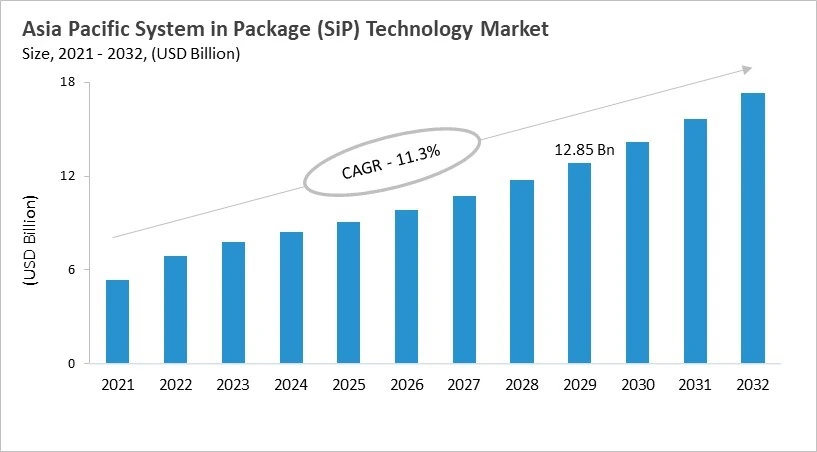
The Asia Pacific System in Package (SiP) Technology Market started with improvements in semiconductor packaging that made it possible to fit several ICs and passive components into one small module. SiP adoption started out because of the need for smaller sizes and better electrical performance. It picked up speed as mobile devices, consumer electronics, and automotive electronics grew quickly. The market got a lot stronger thanks to technological breakthroughs like wafer-level packaging, 2.5D/3D integration, and heterogeneous integration. Big investments by semiconductor companies in Taiwan and South Korea helped SiP go from a niche technology to a mainstream solution. This helped IoT devices, wearable technologies, and new 5G applications grow. The market today shows that the ecosystem is mature, with packaging houses and foundries working closely together to improve system integration and performance.
Some of the most important trends affecting the market are the rise of heterogeneous integration for multifunctional devices, the use of smart manufacturing and digital transformation in OSAT facilities, and the standardization of regulations across Asia Pacific, which helps trade and innovation. The best companies are working on next-generation SiP solutions that use new materials like gallium nitride and silicon carbide, as well as 3D stacking and wafer-level chip-scale packaging. Strategic partnerships between design firms, foundries, and OSAT providers speed up the process of bringing new ideas to market. Companies are also expanding localized manufacturing and putting money into digital and automated production systems. Overall, competition in the region strikes a balance between cost-effectiveness and differentiation based on innovation. This strengthens Asia Pacific's status as a global center for advanced SiP manufacturing and technology development.
Based on Packaging Method, the market is segmented into Wire Bond and Flip Chip. The Wire Bond market segment dominated the China System in Package (SiP) Technology Market by Packaging Method is expected to grow at a CAGR of 7.4 % during the forecast period thereby continuing its dominance until 2032. Also, The Flip Chip market is anticipated to grow as a CAGR of 8.5 % during the forecast period during (2025 - 2032).
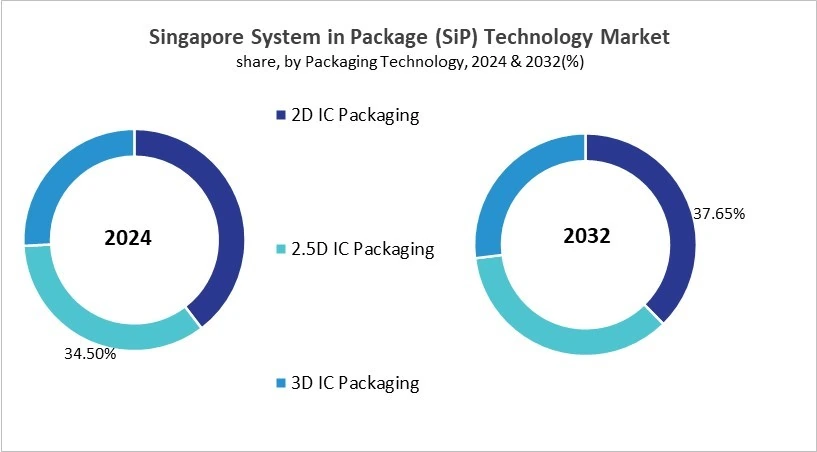
Based on Packaging Technology, the market is segmented into 2D IC Packaging, 2.5D IC Packaging and 3D IC Packaging. Among various Singapore System in Package (SiP) Technology Market by Packaging Technology; The 2D IC Packaging market achieved a market size of USD $441.9 Million in 2024 and is expected to grow at a CAGR of 10.7 % during the forecast period. The 3D IC Packaging market is predicted to experience a CAGR of 12% throughout the forecast period from (2025 - 2032).
Free Valuable Insights: System in Package (SiP) Technology Market is Predicted to reach USD 39.29 billion by 2032, at a CAGR of 9.3%
The China System in Package (SiP) Technology Market is divided into different groups based on application, integration type, and end-use industry. Each of these groups affects how people use the technology and what kinds of technology they need. Consumer electronics, automotive electronics, telecommunications, and industrial equipment are some of the most important uses. Consumer electronics are the most important because people want small, multifunctional devices like smartphones and wearables. The automotive and telecom industries are quickly adopting SiP for ADAS systems, EV power management, and 5G infrastructure that needs to be very reliable and process data quickly. The market is also divided into types of integration, such as heterogeneous integration, which combines logic, memory, RF, and sensors, and homogeneous integration, which combines similar parts, like memory chips. Heterogeneous SiP is growing faster because it can support more advanced multifunctional systems. End-use industries like consumer electronics, automotive, healthcare, telecommunications, and industrial automation increase demand even more because they have their own needs for performance, reliability, and miniaturization.

By Packaging Method
By Packaging Technology
By End User
By Country
Market will reach $12.85 billion by 2029, growing at 9.6% CAGR during 2025-2032.
China dominates with 32.8% market share in 2024, reaching $4,989.5 million by 2032.
India leads growth at 11.1% CAGR during 2025-2032, followed by South Korea at 11% CAGR.
Japan holds 17.2% regional market share and grows at 8.9% CAGR during 2025-2032.
Wire Bond segment leads the China SiP market across packaging method categories.
Our team of dedicated experts can provide you with attractive expansion opportunities for your business.




 Unique Offerings