The sample copy of this report is available for access.
The Asia Pacific Smart Watch is projected to reach USD 23,181.68 million by 2030, growing at a CAGR of 16.1% during 2026 - 2033.
The Asia Pacific Smart Watch Market has evolved from the early adoption of wearable technologies focused primarily on fitness tracking and smartphone notifications into a highly sophisticated ecosystem of connected devices. Initially, smart watches were embraced mainly by technology enthusiasts in developed economies such as Japan, South Korea, and Australia. However, continuous improvements in sensor technologies, battery efficiency, wireless connectivity, and mobile operating systems significantly expanded their capabilities.
The widespread deployment of 4G and 5G infrastructure, coupled with growing consumer awareness regarding preventive healthcare, transformed smart watches into multifunctional devices capable of health monitoring, communication, navigation, mobile payments, and AI-powered wellness management.
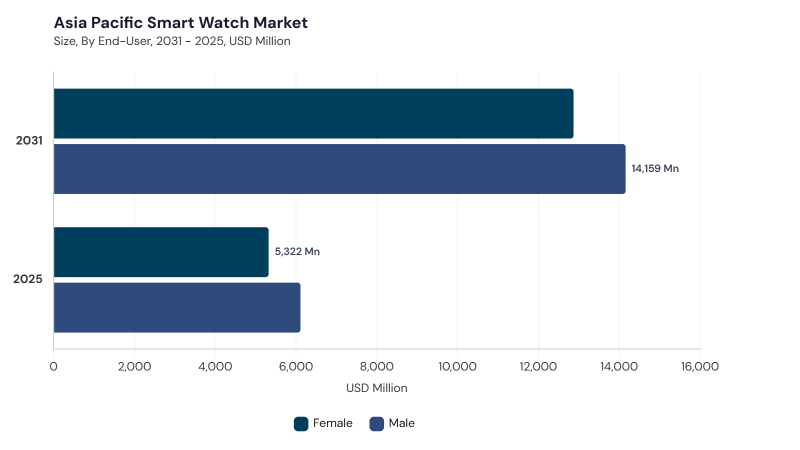
Based on End-User, the market is segmented into Male and Female. The Male market dominated the Asia Pacific Smart Watch Market by End-User in 2025, and would continue to be a dominant market till 2033; thereby, achieving a market value of USD 12,188.22 million by 2030, growing at a CAGR of 15.7 % during the forecast period. The Female market is expected to witness a CAGR of 16.5% during (2026 - 2033).
The Male segment accounted for a slightly larger share of the Asia Pacific Smart Watch Market in 2025. Adoption among male consumers is largely driven by strong participation in fitness activities such as running, cycling, gym workouts, outdoor recreation, and sports performance monitoring. Smart watches are widely used for GPS navigation, heart-rate tracking, activity monitoring, productivity alerts, and connected-device management. The Female segment represents a rapidly expanding consumer base supported by increasing demand for wellness monitoring, sleep analysis, menstrual health tracking, stress management, safety features, and fashion-oriented wearable devices. The narrowing gap between both segments reflects the growing mainstream acceptance of smart watches as everyday lifestyle and health-management tools across Asia Pacific.
Based on Operating System, the market is segmented into iOS, Android, and Other Operating Systems. The iOS market dominated the Asia Pacific Smart Watch Market by Operating System in 2025, and would continue to be a dominant market till 2033; thereby, achieving a market value of USD 10,899.97 million by 2030, growing at a CAGR of 15.6 % during the forecast period. The Android market is expected to witness a CAGR of 16.3% during (2026 - 2033).
The iOS segment maintains a strong presence in premium markets due to seamless integration with Apple's ecosystem, advanced health-tracking capabilities, strong app support, and high customer loyalty. The Android segment dominates the broader market owing to the large number of manufacturers, extensive device variety, wider pricing spectrum, and compatibility with multiple smartphone brands. Android smart watches are particularly popular across emerging markets where affordability and flexibility are critical purchasing factors.
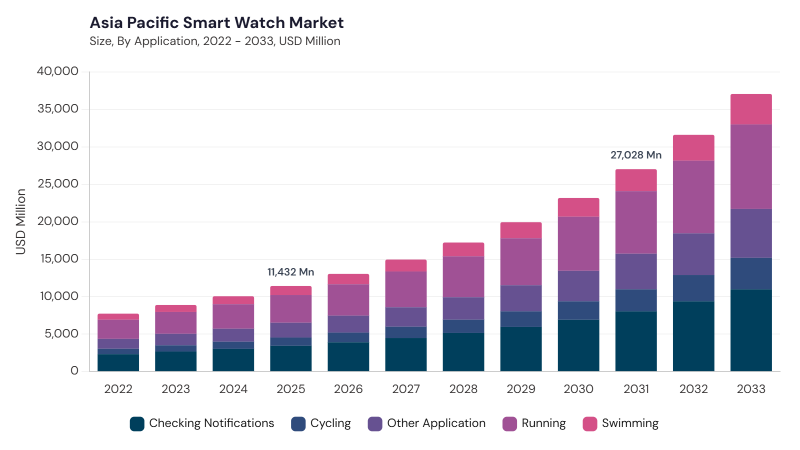
Based on Application, the market is segmented into Running, Checking Notifications, Swimming, Cycling, and Other Applications. The Running market dominated the Asia Pacific Smart Watch Market by Application in 2025, and would continue to be a dominant market till 2033; thereby, achieving a market value of USD 7,226.88 million by 2030, growing at a CAGR of 15.2 % during the forecast period. The Checking Notifications market is expected to witness a CAGR of 15.9% during (2026 - 2033).
Running remains the largest application segment due to growing participation in fitness activities, increasing health awareness, urban wellness trends, and demand for performance-tracking features such as GPS monitoring, pace analysis, calorie tracking, and heart-rate measurement. Checking Notifications represents one of the most frequently used smartwatch functions, enabling users to manage calls, messages, emails, reminders, and application alerts efficiently without accessing smartphones. Swimming and Cycling applications continue to gain popularity as sports participation increases across the region. Other Applications include sleep monitoring, stress management, blood oxygen tracking, ECG monitoring, contactless payments, music control, navigation services, safety alerts, and broader health and wellness management capabilities.
Free Valuable Insights: Smart Watch Market is Predicted to reach USD 1,17,376.5 Million billion by 2033, at a CAGR of 15.3%
Based on Country, the market is segmented into China, Japan, India, South Korea, Singapore, Malaysia, and Rest of Asia Pacific. The China and Japan led the Asia Pacific Smart Watch Market by Country with a market share of 35.9% and 15.1% in 2025.The Singapore market is expected to witness a CAGR of 18.8% during throughout the forecast period.
China accounts for the largest share of the regional market, supported by strong domestic manufacturing capabilities, widespread smartphone adoption, expanding digital health initiatives, and a highly competitive wearable ecosystem. Japan benefits from strong consumer demand for health-monitoring technologies, premium wearable devices, and advanced healthcare integration. India represents one of the fastest-growing markets due to increasing smartphone penetration, affordability-focused product offerings, expanding digital infrastructure, and growing health awareness. South Korea leverages its advanced telecommunications infrastructure and AI innovation capabilities to drive smartwatch adoption. Singapore and Malaysia continue to witness steady growth through rising digitalization, wellness-focused lifestyles, and expanding connected-device ecosystems.

By End-User
By Operating System
By Application
By Country
Set to reach $23,181.68 Million by 2030, growing at a CAGR of 16.1% during 2026-2033.
China and Japan lead with market shares of 35.9% and 15.1% in 2025.
Rising demand in the Male segment, expected to reach $12,188.22 million by 2030.
iOS segment to achieve $10,899.97 million by 2030, growing at a CAGR of 15.6% during 2026-2033.
The Singapore market is expected to witness a CAGR of 18.8% throughout the forecast period.
Running segment to reach $7,226.88 million by 2030, with a CAGR of 15.2% during 2026-2033.
Our team of dedicated experts can provide you with attractive expansion opportunities for your business.




 Unique Offerings