The sample copy of this report is available for access.
The Asia Pacific Pet Meal Kit Delivery Services Market is expected to reach USD 1,342.58 million by 2030, growing at a CAGR of 12% during 2026 - 2033.
The Asia Pacific Pet Meal Delivery Services Market has emerged as one of the fastest-growing segments within the regional pet care industry, driven by rising pet ownership, increasing pet humanization, and growing demand for premium nutrition solutions. Initially dominated by traditional packaged pet food, the market has evolved toward subscription-based meal delivery services offering fresh, customized, and nutritionally balanced meals tailored to individual pet requirements. Technological advancements in digital ordering platforms, AI-driven nutrition planning, cold-chain logistics, and last-mile delivery networks have significantly enhanced service efficiency and customer experience.
Furthermore, increasing awareness regarding pet health, rising disposable incomes, and the growing adoption of e-commerce channels have accelerated market penetration across major Asia Pacific countries. As consumers increasingly treat pets as family members, demand for personalized, convenient, and high-quality meal solutions continues to strengthen the market's long-term growth prospects.
Based on Pet Type, the market is segmented into Dog and Cat. The Dog segment accounted for the largest revenue share in 2025 due to strong dog ownership across major Asia Pacific countries and growing demand for customized nutrition solutions. Pet owners are increasingly seeking meal plans tailored to breed, age, activity levels, and specific health conditions, supporting adoption of subscription-based meal delivery services. The Cat segment also represents a significant market opportunity, supported by increasing urbanization, rising cat ownership, and growing awareness regarding feline nutrition requirements. Demand for protein-rich, fresh, and specialized meal options continues to support growth within the segment.
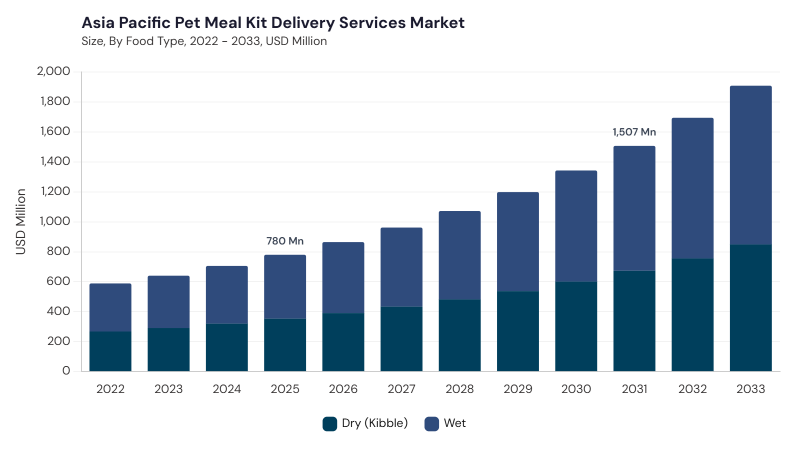
Based on Food Type, the market is segmented into Wet and Dry (Kibble). The Wet market dominated the Asia Pacific Pet Meal Kit Delivery Services Market by Food Type in 2025, and would continue to be a dominant market till 2033; thereby, achieving a market value of USD 741.80 million by 2030, growing at a CAGR of 12.2 % during the forecast period. The Dry (Kibble) market is expected to witness a CAGR of 11.7% during (2026 - 2033).
The Wet segment dominated the Asia Pacific Pet Meal Delivery Services Market in 2025, supported by growing consumer preference for fresh, minimally processed, and moisture-rich nutrition solutions. Wet meals are increasingly perceived as healthier alternatives that improve hydration and palatability while aligning with premium pet care trends. The Dry (Kibble) segment maintained a substantial market share owing to its affordability, convenience, ease of storage, and widespread acceptance among pet owners. Continuous innovations in ingredient quality, functional nutrition, and premium formulations continue to support segment expansion.
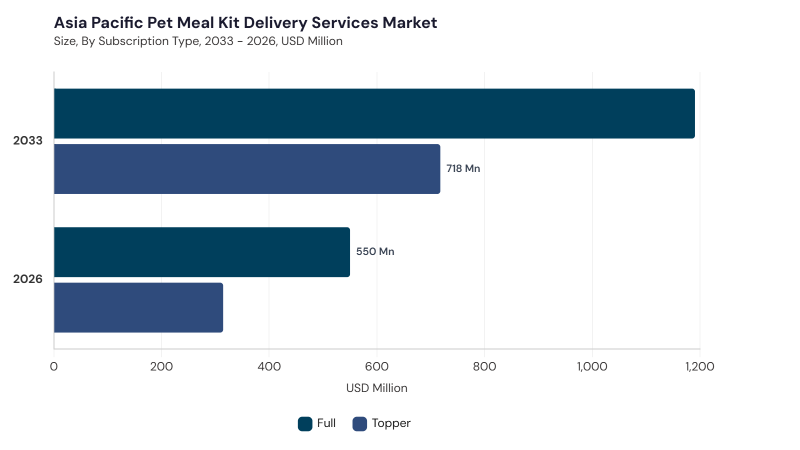
Based on Subscription Type, the market is segmented into Full and Topper. The Full market dominated the Asia Pacific Pet Meal Kit Delivery Services Market by Subscription Type in 2025, and would continue to be a dominant market till 2033; thereby, achieving a market value of USD 844.62 million by 2030, growing at a CAGR of 11.7% during the forecast period. The Topper market is expected to witness a CAGR of 12.5% during (2026 - 2033).
The Full subscription segment generated the highest revenue share in 2025 as consumers increasingly adopted complete meal plans that provide balanced nutrition, convenience, and personalized feeding schedules. Growing pet humanization and premiumization trends have further strengthened demand for comprehensive meal delivery solutions. The Topper segment continues to gain momentum as pet owners increasingly use supplementary meal additions to improve taste, nutritional content, and dietary variety. Rising awareness regarding functional nutrition and hybrid feeding practices supports ongoing growth within this segment.
Free Valuable Insights: Pet Meal Kit Delivery Services Market is Predicted to reach USD 7,868.6 Million billion by 2033, at a CAGR of 11.4%
Based on Country, the market is segmented into China, Japan, India, South Korea, Singapore, Malaysia, and Rest of Asia Pacific. The China and Japan led the Asia Pacific Pet Meal Kit Delivery Services Market by Country with a market share of 33% and 22.2% in 2025.The Malaysia market is expected to witness a CAGR of 15.7% during throughout the forecast period.
China accounted for a significant share of the Asia Pacific Pet Meal Delivery Services Market due to its large pet population, expanding middle-class consumer base, and rapidly growing e-commerce ecosystem. Japan remains a mature market characterized by strong demand for premium and health-focused pet nutrition solutions. India is witnessing rapid growth supported by increasing pet adoption, urbanization, and growing awareness of pet wellness. South Korea continues to benefit from high digital adoption and increasing preference for personalized pet care services. Singapore and Malaysia are experiencing growing demand for premium subscription-based meal delivery services driven by rising disposable incomes and convenience-focused lifestyles. The Rest of Asia Pacific region presents substantial growth opportunities as pet ownership rates increase and digital commerce platforms continue to expand across emerging economies.

By Pet Type
By Food Type
By Subscription Type
By Country
Set to reach $1,342.58 Million by 2030, growing at 12% CAGR during 2026-2033.
China and Japan lead with a market share of 33% and 22.2% in 2025.
Wet food segment to reach $741.80 million by 2030, growing at 12.2% CAGR during the forecast period.
Malaysia market is expected to witness a CAGR of 15.7% throughout the forecast period.
Full subscription type to achieve $844.62 million by 2030, growing at 11.7% CAGR during the forecast period.
Our team of dedicated experts can provide you with attractive expansion opportunities for your business.




 Unique Offerings