The sample copy of this report is available for access.
The Asia Pacific Personal Finance Software Market is expected to reach USD 942.2 million by 2030, growing at a CAGR of 12.1% during (2026 - 2033).
The Asia Pacific Personal Finance Software Market evolved from basic desktop budgeting and ledger tools into advanced cloud-based and mobile financial management platforms. Early solutions focused on manual expense tracking, while rising internet connectivity and smartphone adoption enabled real-time financial monitoring and banking integration. AI-driven analytics, machine learning, multi-currency support, multilingual functionality, and cloud synchronization further expanded software capabilities. The market has consequently shifted from isolated expense management toward comprehensive financial ecosystems supporting budgeting, investments, savings, debt, and broader personal wealth management across diverse regional economies.
Digital banking integration, AI-driven personalization, regulatory compliance, cloud computing, and mobile-first financial management are shaping current market development. Open banking and API-based connectivity are improving account aggregation and interoperability across financial institutions, while predictive analytics support automated budgeting, cash-flow forecasting, risk assessment, and personalized financial recommendations. Stronger encryption, authentication, and RegTech capabilities are becoming essential as regional data-protection requirements evolve. Multi-currency management, localization, digital financial literacy, embedded finance, fintech partnerships, and integration with regional payment ecosystems are further broadening adoption across Asia Pacific.
Based on Type, the market is segmented into Desktop-based and Mobile-based. The Desktop-based market dominated the Asia Pacific Personal Finance Software Market by Type in 2025, and would continue to be a dominant market till 2033; thereby, achieving a market value of USD 527.7 million by 2030, growing at a CAGR of 11.7 % during the forecast period. The Mobile-based market is expected to witness a CAGR of 12.6% during (2026 - 2033).
Desktop-based software supports comprehensive budgeting, investment tracking, tax planning, financial reporting, reconciliation, and detailed management of larger financial datasets, making it relevant for users seeking advanced analytics and greater control. Cloud integration and hybrid synchronization increasingly extend desktop functionality across multiple devices. Mobile-based software emphasizes continuous expense tracking, bill reminders, account connectivity, digital wallet integration, financial alerts, and real-time decision support. AI-driven insights, biometric security, gamification, multilingual interfaces, and integration with regional banking and payment platforms are strengthening mobile adoption across highly smartphone-oriented markets.
Based on Deployment, the market is segmented into Cloud and On-premise. The Cloud market dominated the Asia Pacific Personal Finance Software Market by Deployment in 2025, and would continue to be a dominant market till 2033; thereby, achieving a market value of USD 543.4 million by 2030, growing at a CAGR of 12.3 % during the forecast period. The On-premise market is expected to witness a CAGR of 11.8% during (2026 - 2033).
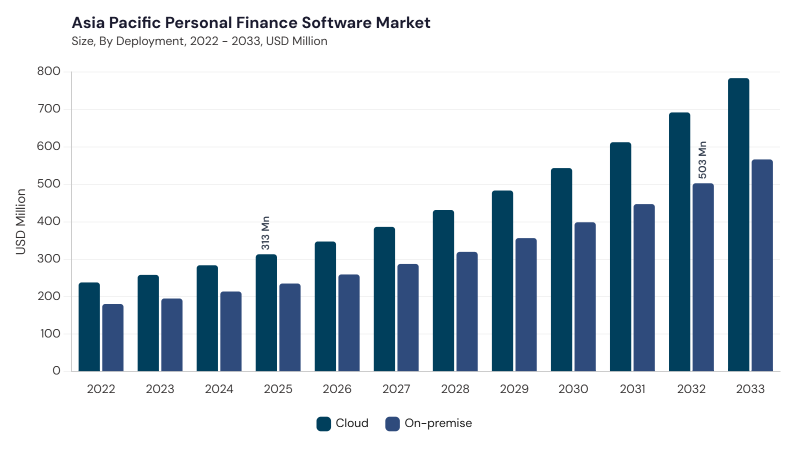
Cloud deployment enables multi-device access, real-time synchronization, automatic updates, scalable storage, fintech integration, and AI-driven analytics while reducing the need for extensive local infrastructure. It is particularly suitable for digitally active consumers and small businesses seeking flexible, subscription-based financial management. On-premise deployment provides greater control over financial data, offline functionality, localized record storage, customized installations, and alignment with specific data-governance requirements. This model remains relevant in markets or user groups prioritizing data sovereignty, security, legacy-system compatibility, or uninterrupted access independent of internet availability.
Based on End Use, the market is segmented into Individuals and Small Businesses. Individuals use personal finance software for budgeting, bill management, investment tracking, debt monitoring, tax planning, savings goals, and financial decision support. Mobile accessibility, AI-based guidance, digital banking integration, multi-currency support, and personalized financial insights are increasing adoption across diverse consumer groups.
Small Businesses use these platforms for bookkeeping, invoicing, payroll-related functions, cash-flow forecasting, expense management, tax compliance, and short-term financial planning. Cloud-based delivery, SaaS pricing, embedded payment functionality, and support for multiple currencies are improving accessibility for startups, microenterprises, and growing SMEs.
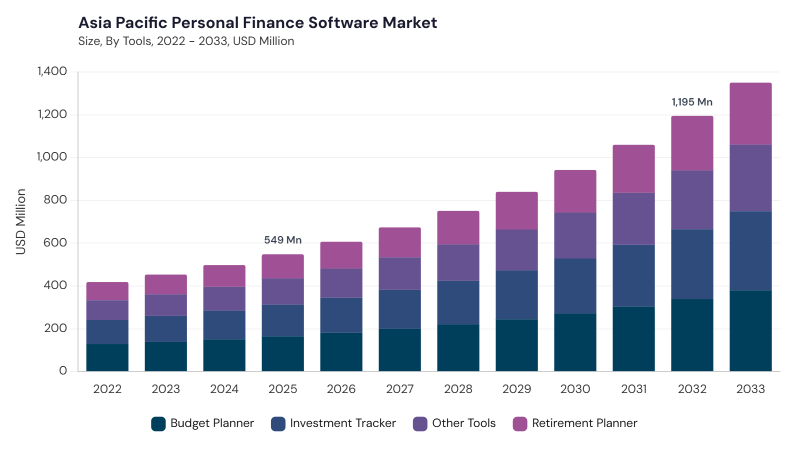
Based on Tools, the market is segmented into Budget Planner, Investment Tracker, Retirement Planner, and Other Tools. Budget Planner tools support expense categorization, spending limits, bill reminders, savings objectives, cash-flow visualization, and everyday financial discipline. Investment Tracker tools provide portfolio monitoring, performance analytics, asset-allocation visibility, market information, and support for diversified investments such as stocks, mutual funds, and other financial assets.
Retirement Planner tools enable pension tracking, retirement corpus estimation, scenario-based savings planning, healthcare-cost forecasting, and long-term wealth preparation. Other Tools include debt management, tax planning, credit monitoring, insurance organization, financial goal tracking, loan calculators, and net-worth dashboards addressing specialized financial requirements across the region.
Free Valuable Insights: Personal Finance Software Market is Predicted to reach USD 4383.8 Million billion by 2033, at a CAGR of 11.6%
Based on Country, the market is segmented into China, Japan, India, South Korea, Singapore, Malaysia, and Rest of Asia Pacific. The China market dominated the Asia Pacific Personal Finance Software Market by Country in 2025, and would continue to be a dominant market till 2033; thereby, achieving a market value of USD 254.7 million by 2030, growing at a CAGR of 10.1 % during the forecast period. The Japan market is expected to witness a CAGR of 11.5% during (2026 - 2033). Additionally, The India market is expected to witness a CAGR of 13% during (2026 - 2033).
Across Asia Pacific, personal finance software adoption is being shaped by AI personalization, mobile-first banking, open banking, cybersecurity, fintech integration, and regional localization. China emphasizes AI-driven financial advice, super-app ecosystems, open banking, cloud platforms, and intelligent wealth management, while Japan focuses on AI-assisted planning, cashless payments, secure cloud infrastructure, bank integration, and strong data protection. India is advancing mobile-first finance, multi-account aggregation, localized interfaces, AI-based insights, fintech partnerships, and broader financial ecosystems, whereas South Korea emphasizes AI-powered advisors, integrated financial platforms, regulatory transparency, cloud scalability, and cybersecurity. Singapore focuses on multi-currency management, AI analytics, open banking, mobile access, and ecosystem integration, while Malaysia is strengthening embedded finance, personalized analytics, bank partnerships, multilingual interfaces, and cloud-based delivery. Rest of Asia Pacific continues to develop AI-enabled financial guidance, open banking connectivity, regional customization, cybersecurity, mobile-first platforms, and multi-currency financial management.

By Type
By Deployment
By End Use
By Tools
By Country
Set to reach $942.2 Million by 2030, growing at 12.1% CAGR during 2026-2033.
China leads with a market value of $254.7 million by 2030, growing at a 10.1% CAGR during 2026-2033.
The rise in mobile-based software, expected to grow at a 12.6% CAGR during 2026-2033, drives growth.
Desktop-based segment to achieve $527.7 million by 2030, with an 11.7% CAGR during 2026-2033.
India's market is expected to grow at a 13% CAGR during 2026-2033.
Cloud deployment segment to reach $543.4 million by 2030, growing at a 12.3% CAGR during 2026-2033.
Our team of dedicated experts can provide you with attractive expansion opportunities for your business.




 Unique Offerings