The sample copy of this report is available for access.
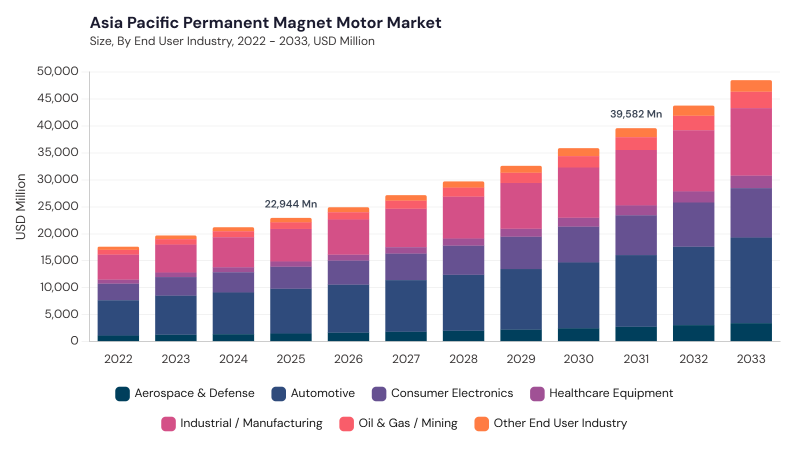
The Asia Pacific Permanent Magnet Motor Market would witness market growth of 10.0% CAGR during the forecast period (2026-2033) and is expected to attain a market size of USD 39,582.0 Million by 2031.
The China market dominated the Asia Pacific Permanent Magnet Motor Market by Country in 2025 and would continue to be a dominant market till 2033; thereby, achieving a market value of USD 18781.6 million by 2031. The Japan market is anticipated to grow at a CAGR of 8.9% during (2026-2033). Additionally, the India market would witness a CAGR of 11.1% during (2026-2033).
The Asia Pacific Permanent Magnet Motor Market is expanding rapidly due to accelerating industrial automation, rising electric vehicle production, and increasing investments in renewable energy infrastructure. Permanent magnet motors are witnessing strong demand across automotive systems, industrial machinery, robotics, HVAC equipment, and consumer electronics because of their superior efficiency, compact design, and enhanced torque performance. Countries across the region are increasingly focusing on energy-efficient technologies and industrial modernization, thereby supporting long-term market growth.
Government initiatives promoting electrification, smart manufacturing, and industrial energy conservation continue to strengthen market adoption throughout Asia Pacific. Expanding EV manufacturing ecosystems in China, Japan, South Korea, and India are significantly increasing the deployment of permanent magnet motors in traction and propulsion systems. In addition, the growing penetration of Industry 4.0 technologies, automation equipment, and renewable energy installations is accelerating the requirement for high-performance motor systems across industrial applications.
Based on Motor Type, the market is segmented into Permanent Magnet Synchronous Motor (PMSM), Brushless DC Motor (BLDC), and Brushed Permanent Magnet DC Motor. The Permanent Magnet Synchronous Motor (PMSM) segment dominated the Asia Pacific Permanent Magnet Motor Market in 2025 and would continue to be a dominant segment till 2033; thereby, achieving a market value of USD 20,070.3 million by 2031. Increasing deployment of PMSMs across electric vehicles, robotics, industrial automation systems, and high-efficiency machinery continues to support segment growth. Superior operational efficiency, high torque density, and lower energy losses are further accelerating adoption across advanced industrial applications.
Based on Power Rating, the market is segmented into Up to 4 kW, 4–22 kW, 22–75 kW, and Above 75 kW. The Up to 4 kW segment dominated the Asia Pacific Permanent Magnet Motor Market in 2025 and would continue to be a dominant segment till 2033; thereby, achieving a market value of USD 13,999.56 million by 2031. Strong utilization across HVAC systems, household appliances, compact industrial equipment, pumps, and consumer electronics is driving segment expansion. Rising preference for compact energy-efficient motors across residential and commercial applications continues to strengthen demand.
Based on Magnetic Material Type, the market is segmented into Neodymium Iron Boron (NdFeB), Ferrite, and Samarium Cobalt (SmCo). The Neodymium Iron Boron (NdFeB) segment dominated the Asia Pacific Permanent Magnet Motor Market in 2025 and would continue to be a dominant segment till 2033; thereby, achieving a market value of USD 25,858.7 million by 2031. The segment benefits from superior magnetic strength, enhanced energy efficiency, and increasing deployment in EV powertrains, robotics, and industrial automation systems. Growing investments in electric mobility and advanced manufacturing technologies are further contributing to segment dominance.
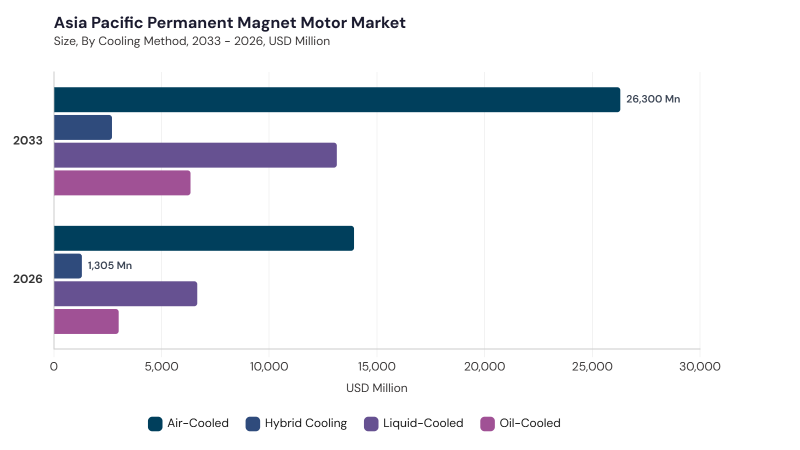
Based on Cooling Method, the market is segmented into Air-Cooled, Liquid-Cooled, Oil-Cooled, and Hybrid Cooling. The Air-Cooled segment dominated the Asia Pacific Permanent Magnet Motor Market in 2025 and would continue to be a dominant segment till 2033; thereby, achieving a market value of USD 21,662.6 million by 2031. Lower maintenance requirements, simple operational structure, and widespread applicability across industrial and automotive systems continue to support market demand. Increasing adoption of cost-efficient and lightweight cooling solutions is further strengthening segment growth across the region.
Based on End User Industry, the market is segmented into Automotive, Industrial / Manufacturing, Consumer Electronics, Aerospace & Defense, Oil & Gas / Mining, Healthcare Equipment, and Other End User Industry. The Automotive segment dominated the Asia Pacific Permanent Magnet Motor Market in 2025 and would continue to be a dominant segment till 2033; thereby, achieving a market value of USD 13,312.6 million by 2031. Rising electric vehicle production, increasing government incentives for EV adoption, and expanding battery manufacturing infrastructure across Asia Pacific continue to accelerate demand for permanent magnet motors within the automotive sector.
Free Valuable Insights: Permanent Magnet Motor Market is Predicted to reach USD 115,806.4 Million billion by 2033, at a CAGR of 9.6%
China remains the leading market in Asia Pacific due to its dominant electric vehicle manufacturing industry, large-scale industrial production capabilities, and extensive investments in renewable energy technologies. Japan continues to witness strong demand driven by advancements in robotics, automotive electronics, and factory automation systems. India is emerging as a high-growth market supported by industrial expansion, smart manufacturing initiatives, and increasing electrification projects. Other Asia Pacific countries are also accelerating adoption through energy-efficiency regulations, infrastructure modernization programs, and rising deployment of automation technologies across manufacturing industries.

By Motor Type
By Power Rating
By Magnetic Material Type
By Cooling Method
By End User Industry
By Country
Set to reach USD 39,582.0 million by 2033, growing at 10.0% CAGR during 2026-2033.
China leads with USD 18,781.6 million by 2031.
Rising electric vehicle production and government incentives for EV adoption are key growth drivers.
Expected to reach USD 20,070.3 million by 2031.
Japan market grows at 8.9% CAGR during 2026-2033.
Neodymium Iron Boron segment reaches USD 25,858.7 million by 2031.
Our team of dedicated experts can provide you with attractive expansion opportunities for your business.




 Unique Offerings