The sample copy of this report is available for access.
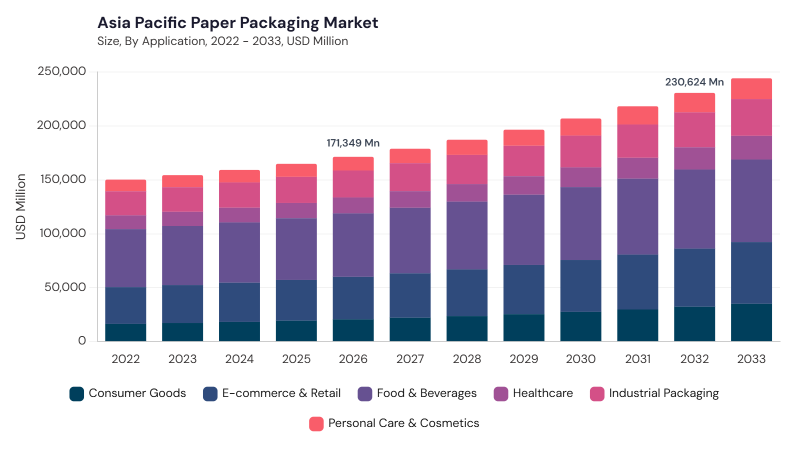
The Asia Pacific Paper Packaging Market is expected to reach USD 206.8 billion by 2030, growing at a CAGR of 5.2% during (2026 - 2033).
Paper packaging across Asia Pacific evolved from conventional kraft paper and cardboard formats into a diversified packaging ecosystem supported by advanced pulp processing, coatings, printing, and automated manufacturing technologies. Industrialization, urbanization, and expanding consumer goods production initially strengthened demand, while environmental concerns later accelerated adoption of recyclable and biodegradable fiber-based formats. Improvements in durability, printability, and functional performance broadened paper packaging use across numerous industries. The market now combines traditional manufacturing capabilities with sustainable materials, digital printing, intelligent packaging, and increasingly sophisticated production systems.
Sustainability, digitalization, e-commerce, and automation are reshaping paper packaging development across the region. Manufacturers are increasing recycled fiber use, alternative raw materials, compostable structures, and circular packaging designs in response to environmental policies and changing consumer expectations. Digital printing and automated production enable customized, lower-waste manufacturing, while QR codes, NFC markers, sensors, and smart features improve traceability and consumer interaction. Rapid e-commerce expansion is also strengthening demand for lightweight, durable, protective, and efficiently designed paper packaging suitable for complex regional logistics networks.
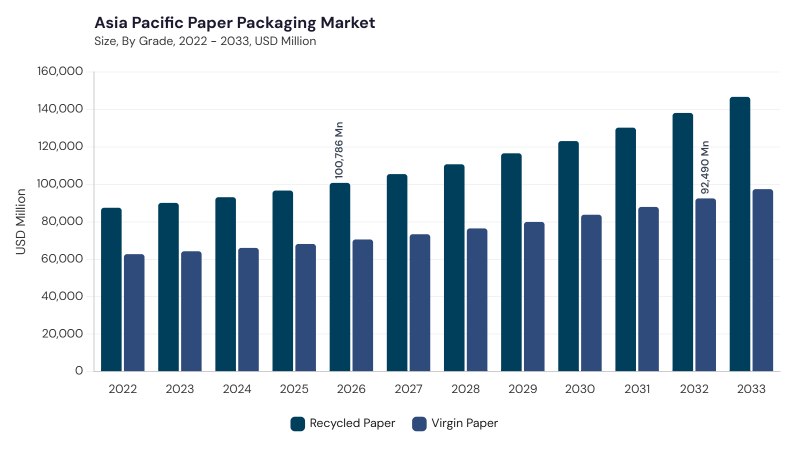
Based on Grade, the market is segmented into Recycled Paper and Virgin Paper. The Recycled Paper market dominated the Asia Pacific Paper Packaging Market by Grade in 2025, and would continue to be a dominant market till 2033; thereby, achieving a market value of USD 123.1 billion by 2030, growing at a CAGR of 5.5 % during the forecast period. The Virgin Paper market is expected to witness a CAGR of 4.7% during (2026 - 2033).
Recycled Paper is increasingly used in corrugated boxes, secondary packaging, retail bags, and consumer packaging where circularity and cost efficiency are important. Improvements in fiber recovery, deinking, recycling infrastructure, and certification are enhancing quality and broader application potential. Virgin Paper remains important for applications requiring superior burst strength, hygienic properties, refined printability, and dependable performance during challenging transportation conditions. It is particularly relevant for primary food packaging, pharmaceuticals, luxury products, electronics, and other applications where consistent material quality and structural reliability are essential.
Based on Product, the market is segmented into Corrugated Boxes, Folding Cartons, Paper Bags & Sacks, Liquid Packaging Cartons, and Other Product. The Corrugated Boxes market dominated the Asia Pacific Paper Packaging Market by Product in 2025, and would continue to be a dominant market till 2033; thereby, achieving a market value of USD 83.8 billion by 2030, growing at a CAGR of 4.1 % during the forecast period. The Folding Cartons market is expected to witness a CAGR of 5.4% during (2026 - 2033). Additionally, The Paper Bags & Sacks market is expected to witness highest CAGR of 6% during (2026 - 2033).
Corrugated Boxes provide lightweight, durable, recyclable, and customizable protection for e-commerce, electronics, FMCG, and industrial distribution. Folding Cartons support packaged food, pharmaceuticals, cosmetics, and other consumer products through strong printability, compact design, and retail presentation. Paper Bags & Sacks are expanding across foodservice, retail, agriculture, and takeaway applications as plastic-reduction initiatives strengthen. Liquid Packaging Cartons serve dairy, juice, nutritional beverages, and shelf-stable products through barrier performance and aseptic capabilities, while Other Product includes molded fiber trays, paper wraps, inserts, and specialized protective structures developed to replace conventional packaging materials.
Based on Application, the market is segmented into Food & Beverages, E-commerce & Retail, Industrial Packaging, Healthcare, Personal Care & Cosmetics, and Consumer Goods. Food & Beverages uses cartons, trays, wraps, and coated paper structures that combine convenience, hygiene, sustainability, and product protection. E-commerce & Retail relies heavily on corrugated cartons, mailers, protective wraps, and branded paper formats suited to high parcel volumes and rapid delivery networks.
Industrial Packaging supports electronics, automotive, machinery, chemicals, and export manufacturing through durable fiber-based transport solutions, while Healthcare requires secure, hygienic, traceable, and compliant packaging. Personal Care & Cosmetics emphasizes premium presentation, printing quality, and sustainable materials, whereas Consumer Goods relies on adaptable paper formats for household products, electronics accessories, toys, apparel, and lifestyle merchandise.
Free Valuable Insights: Paper Packaging Market is Predicted to reach USD 602.7 Billion billion by 2033, at a CAGR of 4.8%
Based on Country, the market is segmented into China, Japan, India, South Korea, Singapore, Malaysia, and Rest of Asia Pacific. The China market dominated the Asia Pacific Paper Packaging Market by Country in 2025, and would continue to be a dominant market till 2033; thereby, achieving a market value of USD 77.2 billion by 2030, growing at a CAGR of 3.8 % during the forecast period. The Japan market is expected to witness a CAGR of 4.2% during (2026 - 2033). Additionally, The India market is expected to witness a CAGR of 5.9% during (2026 - 2033).
Across Asia Pacific, paper packaging development is being influenced by sustainability regulation, e-commerce, digital manufacturing, localization, and material innovation. China is advancing recyclable materials, smart packaging, digital printing, and e-commerce-oriented designs, while Japan emphasizes biodegradable formats, automated production, functional coatings, and advanced barrier properties. India is strengthening sustainable paper substitutes, flexible formats, digital printing, and localized manufacturing, whereas South Korea focuses on recyclable packaging, bio-based coatings, e-commerce solutions, and technology-driven product development. Singapore is advancing biodegradable barriers, smart packaging, local production, and traceability, while Malaysia emphasizes recycled content, digital printing, automation, and e-commerce-ready structures. Rest of Asia Pacific continues to develop alternative fibers, compostable solutions, smart packaging, localized designs, and automated production capabilities.

By Grade
By Product
By Application
By Country
Set to reach $206.8 Billion by 2030, growing at 5.2% CAGR during 2026-2033.
China leads with a market value of $77.2 billion by 2030, growing at 3.8% CAGR during 2026-2033.
Recycled paper dominates, reaching $123.1 billion by 2030 at 5.5% CAGR during 2026-2033.
Corrugated boxes will achieve $83.8 billion by 2030, growing at 4.1% CAGR during 2026-2033.
India's market is expected to grow at a 5.9% CAGR during 2026-2033.
The paper bags and sacks segment is expected to witness the highest CAGR of 6% during 2026-2033.
Our team of dedicated experts can provide you with attractive expansion opportunities for your business.




 Unique Offerings