The sample copy of this report is available for access.
The Asia Pacific Organic Snacks Market size is expected to reach USD 5,620.2 million by 2030, rising at a market growth of 11.0% CAGR during the forecast period.
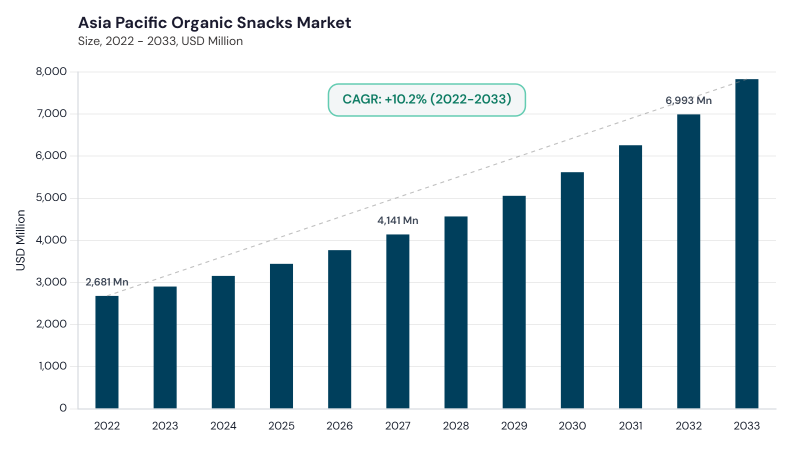
The China market dominated the Asia Pacific Organic Snacks Market by Country in 2025 and would continue to be a dominant market till 2030, thereby achieving a market value of USD 1,570.6 million by 2030. The Japan market is expected to witness a CAGR of 10.3% during (2026 - 2033). Additionally, the India market is expected to witness a CAGR of 11.8% during (2026 – 2033).
The Asia Pacific organic snacks market is witnessing substantial growth driven by rapid urbanization, changing dietary preferences, increasing health consciousness, and rising disposable income across major economies including China, Japan, India, South Korea, Singapore, Malaysia, and other Asia Pacific countries. Consumers in the region are increasingly shifting toward healthier and organic food products due to rising awareness regarding nutrition, clean-label products, and sustainable food sourcing.
The market is experiencing strong demand for snack bars, fruit & vegetable snacks, grain-based snacks, nut & seed-based snacks, bakery snacks, frozen snacks, and meat snacks. Increasing penetration of e-commerce platforms, supermarkets, convenience stores, and specialty organic food retailers is significantly improving product accessibility. In addition, growing vegan and plant-based food trends, government support for organic agriculture, and rising adoption of premium food products are contributing to sustained market growth across the region.
Based on Product, the market is segmented into Snack Bars, Fruit & Vegetable Snacks, Grain-Based Snacks, Nut & Seed-Based Snacks, Bakery Snacks, Frozen Snacks, and Meat Snacks. The Snack Bars segment dominated the Asia Pacific Organic Snacks Market with a market value of USD 857.9 million in 2025 and is expected to reach USD 1,284.9 million by 2030. The Fruit & Vegetable Snacks segment is expected to witness a CAGR of 10.0% during the forecast period. Additionally, the Grain-Based Snacks segment is expected to witness a CAGR of 10.5% during (2026 - 2033).
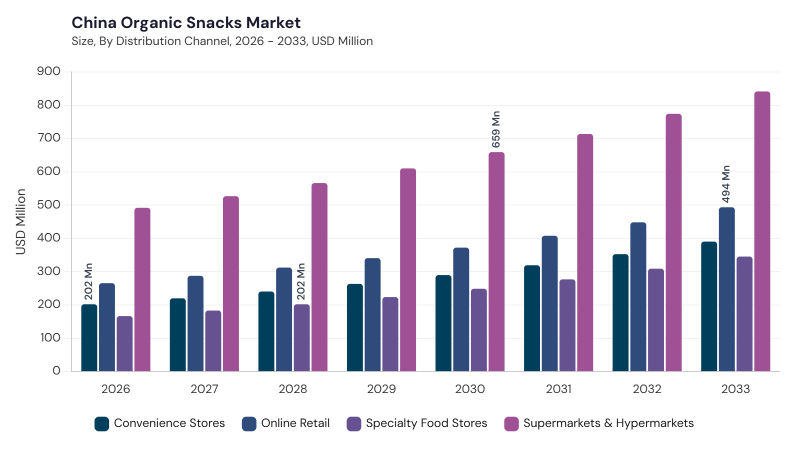
Based on Distribution Channel, the market is segmented into Supermarkets & Hypermarkets, Online Retail, Convenience Stores, and Specialty Food Stores. The Supermarkets & Hypermarkets segment dominated the Asia Pacific Organic Snacks Market with a market value of USD 1,525.1 million in 2025 and is expected to reach USD 2,373.7 million by 2030. The Online Retail segment is expected to witness a CAGR of 11.3% during the forecast period.
Free Valuable Insights: Organic Snacks Market is Predicted to reach USD 33,137.3 Million billion by 2033, at a CAGR of 10.3%
China remains the leading market for organic snacks in Asia Pacific due to increasing middle-class population, rising disposable income, expanding urban retail infrastructure, and growing demand for premium healthy food products. The country is witnessing rapid growth in online grocery shopping and adoption of organic packaged foods.
Japan is experiencing strong demand for organic and functional snack products due to increasing health awareness, aging population, and preference for high-quality packaged foods. India is emerging as one of the fastest-growing markets owing to rising health-conscious consumers, increasing organic food penetration, and growing modern retail and e-commerce sectors.

By Product
By Distribution Channel
By Country
Market will reach USD 5,620.2 million by 2030, growing at 11.0% CAGR during 2026-2033.
China dominates the regional market and will achieve USD 1,570.6 million by 2030.
India market will grow at 11.8% CAGR during 2026-2033.
Japan market will witness 10.3% CAGR during 2026-2033.
Market includes snack bars, fruit & vegetable snacks, grain-based snacks, nut & seed-based snacks, bakery snacks, and frozen snacks.
Products are sold through supermarkets & hypermarkets, online retail, convenience stores, and specialty food stores.
Our team of dedicated experts can provide you with attractive expansion opportunities for your business.




 Unique Offerings