The sample copy of this report is available for access.
The Asia Pacific Moringa Ingredients Market is expected to reach USD 5.6 billion by 2030, growing at a CAGR of 11.3% during (2026 – 2033).
Moringa ingredients across Asia Pacific evolved from long-established nutritional and medicinal use of Moringa oleifera into a diversified commercial ingredient category serving food, beverages, nutraceuticals, cosmetics, and wellness products. Early usage centered on locally consumed leaves, seeds, and pods, while improvements in solvent extraction, ultrasonic-assisted processing, drying, and formulation enhanced bioactive yield, purity, and stability. Growing scientific validation of moringa’s nutritional and functional properties accelerated its transition from traditional applications toward standardized commercial ingredients.
Natural nutrition, advanced extraction technologies, sustainable cultivation, and localized product development are increasingly shaping regional market growth. Rising health awareness is encouraging greater use of moringa in plant-based functional foods, dietary supplements, beverages, and personal care formulations, while manufacturers are refining extraction and encapsulation techniques to improve potency, bioavailability, shelf life, and sensory performance. Organic farming, traceable sourcing, and environmentally responsible cultivation are also becoming more important as consumers and regulators place greater emphasis on ingredient transparency.
Based on Origin, the market is segmented into Conventional and Organic. The Conventional market dominated the Asia Pacific Moringa Ingredients Market by Origin in 2025, and would continue to be a dominant market till 2033; thereby, achieving a market value of USD 2.9 billion by 2030, growing at a CAGR of 10.9 % during the forecast period. The Organic market is expected to witness a CAGR of 11.7% during (2026 - 2033).
Conventional moringa ingredients support large-scale manufacturing through comparatively affordable sourcing, broader availability, and established cultivation systems across the region. Powders, extracts, oils, and other conventional derivatives are widely used in functional foods, supplements, animal nutrition, cosmetics, and traditional wellness formulations. Organic moringa represents a premium and expanding category supported by consumer interest in pesticide-free, sustainably cultivated, traceable, and clean-label ingredients. Certified organic production is particularly relevant for premium supplements, natural cosmetics, superfoods, and export-oriented applications, although higher cultivation costs, certification requirements, and limited scalable supply can constrain broader adoption.
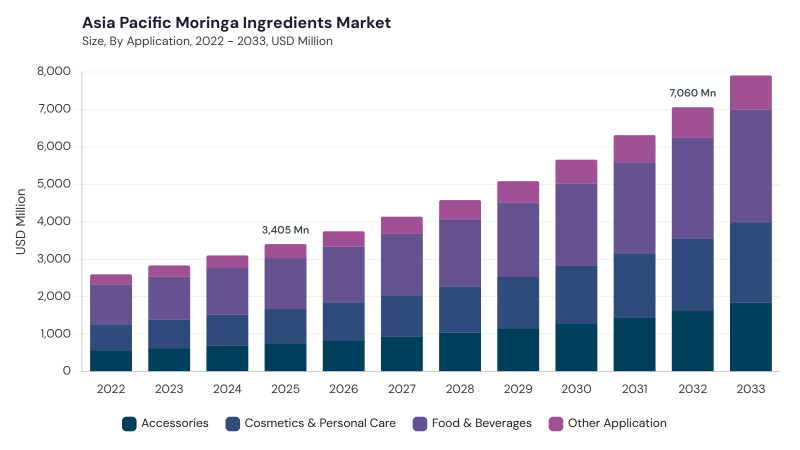
Based on Application, the market is segmented into Food & Beverages, Cosmetics & Personal Care, Accessories, and Other Application. The Food & Beverages market dominated the Asia Pacific Moringa Ingredients Market by Application in 2025, and would continue to be a dominant market till 2033; thereby, achieving a market value of USD 2.1 billion by 2030, growing at a CAGR of 10.6 % during the forecast period. The Cosmetics & Personal Care market is expected to witness a CAGR of 11.5% during (2026 - 2033). The Other Application market is expected to witness a CAGR of 12% during (2026 - 2033).
Food & Beverages utilize moringa in teas, smoothies, fortified snacks, nutrition bars, health drinks, supplements, and other functional formulations designed around plant-based nutrition and preventive wellness. Cosmetics & Personal Care increasingly incorporates moringa extracts and seed oils into facial creams, serums, hair oils, body lotions, and natural beauty products due to their antioxidant, moisturizing, and skin-supportive properties. Accessories includes herbal wellness kits, spa products, massage items, botanical self-care packs, aromatherapy products, and other lifestyle-oriented moringa offerings. Other Application includes animal feed supplements, traditional medicine, pharmaceutical preparations, agricultural products, and other specialized uses that leverage moringa’s nutritional and bioactive properties.
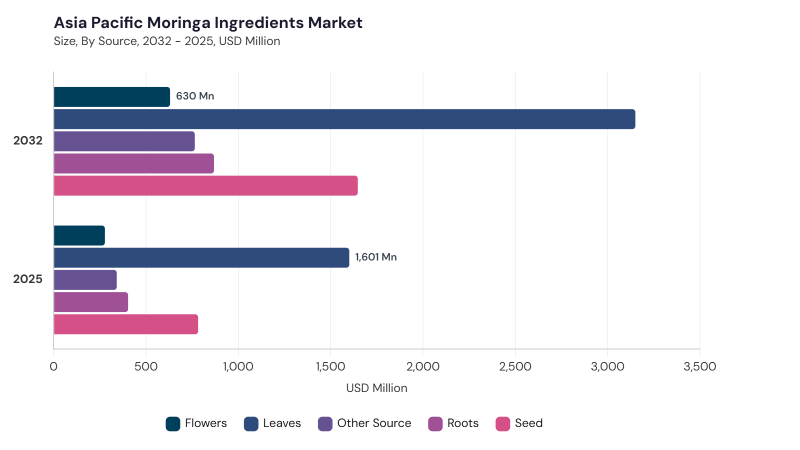
Based on Source, the market is segmented into Leaves, Seed, Roots, Flowers, and Other Source. Leaves remain the principal moringa source because of their rich vitamin, mineral, antioxidant, and protein content and their suitability for powders, extracts, teas, supplements, and fortified foods. Seed-derived ingredients, particularly moringa oil, are increasingly used in cosmetics, edible oils, specialty food products, water purification, animal feed, and circular-economy applications.
Roots retain a more specialized role in traditional medicinal preparations and herbal formulations, with adoption influenced by sustainability and regulatory considerations. Flowers are gaining traction in herbal teas, functional beverages, culinary applications, and specialty botanical formulations, while Other Source includes pods, bark, stems, and other plant materials explored for nutraceutical, agricultural, traditional medicine, fiber, dye, and zero-waste applications.
Free Valuable Insights: Moringa Ingredients Market is Predicted to reach USD 19.3 Billion billion by 2033, at a CAGR of 10.9%
Based on Country, the market is segmented into China, Japan, India, South Korea, Singapore, Malaysia, and Rest of Asia Pacific. The India market dominated the Asia Pacific Moringa Ingredients Market by Country in 2025, and would continue to be a dominant market till 2033; thereby, achieving a market value of USD 1.8 billion by 2030, growing at a CAGR of 11.6 % during the forecast period. The China market is expected to witness a CAGR of 8.6% during (2026 - 2033). Additionally, The Japan market is expected to witness a CAGR of 10% during (2026 - 2033).
Across Asia Pacific, moringa ingredient adoption is increasingly shaped by natural nutrition, advanced processing, sustainable cultivation, regulatory alignment, and localized product development. China is strengthening scientific cultivation, extraction quality, digital traceability, and standardized ingredient processing, while Japan is emphasizing premium functional foods, advanced extraction, ingredient stability, sustainability, and strict quality control. India combines deep traditional familiarity with large-scale cultivation, precision agriculture, standardized extracts, advanced processing, and strong export orientation, whereas South Korea is advancing high-purity formulations, clean-label products, sustainable sourcing, and customized applications for functional foods and personal care. Singapore is progressing through high-pressure processing, encapsulation, traceability, and premium ingredient positioning, while Malaysia is emphasizing supercritical extraction, value-added manufacturing, certified supply chains, digital quality control, and international market access.

By Origin
By Application
By Source
By Country
Set to reach $5.6 Billion by 2030, growing at 11.3% CAGR during 2026–2033.
India leads with a market value of USD 1.8 billion by 2030, growing at 11.6% CAGR during the forecast period.
Rising demand in the Food & Beverages segment, reaching USD 2.1 billion by 2030 at a 10.6% CAGR.
The Conventional segment will reach USD 2.9 billion by 2030, growing at a 10.9% CAGR during the forecast period.
The China market is expected to witness a CAGR of 8.6% during 2026–2033.
The Organic segment is expected to witness a CAGR of 11.7% during 2026–2033.
Our team of dedicated experts can provide you with attractive expansion opportunities for your business.




 Unique Offerings