The sample copy of this report is available for access.
The Asia Pacific Large Language Models In Healthcare Market is expected to reach USD 982.6 million by 2030, growing at a CAGR of 32.9% during (2026 – 2033).
The Asia Pacific Large Language Models In Healthcare Market developed from early healthcare digitization, rule-based natural language processing, and basic machine learning tools used for medical record management. Initial adoption focused on documentation support, patient data handling, and clinical text processing with limited contextual understanding. Over time, transformer architectures, stronger computing power, electronic health records, and cloud infrastructure enabled LLMs to interpret complex medical language and generate clinically useful outputs. The market progressed as healthcare providers, research institutions, and life sciences companies moved from isolated pilots to more practical LLM deployments.
The Asia Pacific Large Language Models In Healthcare Market is being shaped by healthcare digitization, rising patient volumes, aging populations, growing AI infrastructure investment, and demand for personalized medicine. Healthcare organizations are using LLMs to automate documentation, improve diagnosis support, assist patient communication, analyze medical literature, and optimize administrative workflows. Demand is supported by government digital health initiatives, expanding cloud platforms, telehealth growth, and collaborations between technology providers and healthcare systems. Vendors are focusing on localized language models, secure deployment, explainability, healthcare data governance, EHR integration, and region-specific clinical adaptation.
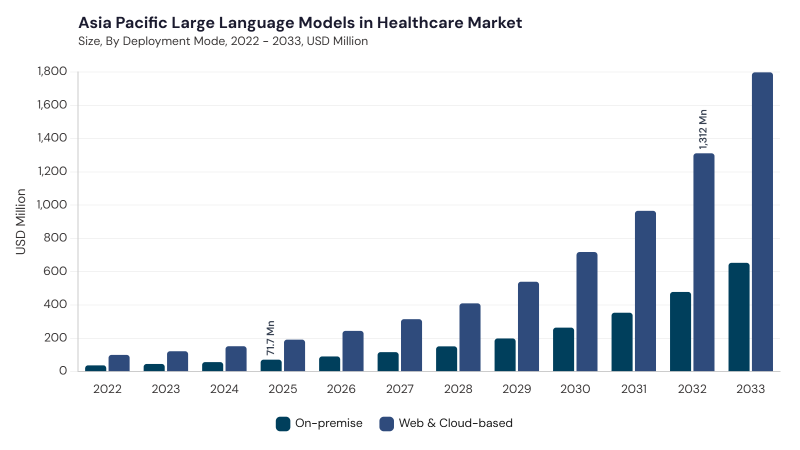
Based on Deployment Mode, the market is segmented into Web & Cloud-based and On-premise. The Web & Cloud-based market dominated the Asia Pacific Large Language Models In Healthcare Market by Deployment Mode in 2025, and would continue to be a dominant market till 2033; thereby, achieving a market value of USD 718.4 million by 2030, growing at a CAGR of 33 % during the forecast period. The On-premise market is expected to witness a CAGR of 32.5% during (2026 - 2033).
Web & Cloud-based deployment leads due to scalable infrastructure, faster implementation, flexible access, lower upfront investment, and strong suitability for diverse healthcare systems across the region. Cloud-based LLMs support clinical documentation, patient virtual assistants, medical coding automation, decision support, research collaboration, and EHR-connected workflows across hospitals and clinics. This model is especially important for digital health providers, telemedicine platforms, and healthcare organizations seeking rapid AI adoption without heavy internal infrastructure. On-premise deployment remains relevant for hospitals, research centers, government healthcare agencies, and institutions requiring stronger data residency, patient privacy, proprietary system integration, low-latency access, and tighter control over sensitive clinical information.
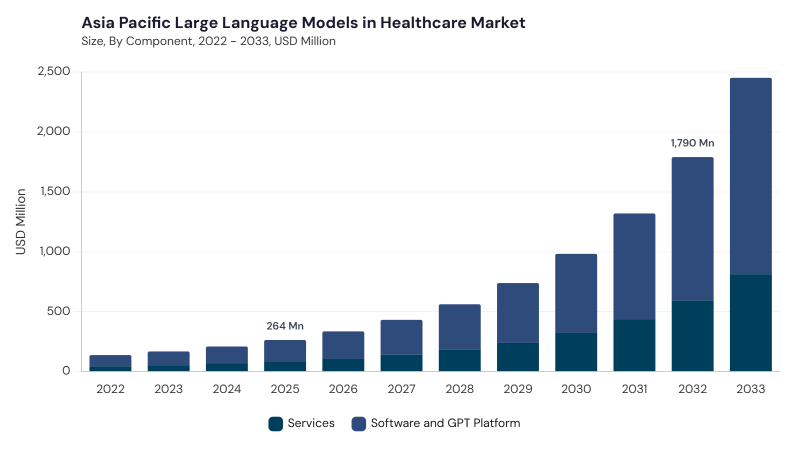
Based on Component, the market is segmented into Software and GPT Platform and Services. The Software and GPT Platform market dominated the Asia Pacific Large Language Models In Healthcare Market by Component in 2025, and would continue to be a dominant market till 2033; thereby, achieving a market value of USD 660.1 million by 2030, growing at a CAGR of 32.6 % during the forecast period. The Services market is expected to witness a CAGR of 33.3% during (2026 - 2033).
Software and GPT Platform leads due to rising adoption of healthcare-specific LLM platforms, medical NLP engines, GPT-based clinical tools, documentation assistants, and AI-enabled diagnostic support applications. These platforms help healthcare organizations automate clinical notes, interpret unstructured medical text, support patient communication, improve coding accuracy, and retrieve medical insights from large datasets. Services remain important as providers require consulting, implementation, integration, customization, training, technical support, and compliance assistance. Service providers also help manage model fine-tuning, workflow redesign, staff adoption, data governance, performance monitoring, and localization across Asia Pacific’s varied clinical and regulatory environments.
Based on End-use, the market is segmented into Hospitals, Pharmaceutical & Biotech Companies, Physician Practices & Ambulatory Clinics, Payer, and Other End-use. The Hospitals market dominated the Asia Pacific Large Language Models In Healthcare Market by End-use in 2025, and would continue to be a dominant market till 2033; thereby, achieving a market value of USD 394.0 million by 2030, growing at a CAGR of 32 % during the forecast period. The Pharmaceutical & Biotech Companies market is expected to witness a CAGR of 32.2% during (2026 - 2033). Additionally, The Physician Practices & Ambulatory Clinics market is expected to witness highest CAGR of 33.4% during (2026 - 2033).
Hospitals lead due to broad use of LLMs in clinical documentation, decision support, patient data interpretation, diagnostic workflows, telehealth support, and operational optimization. These tools help hospitals reduce clinician workload, manage expanding patient volumes, improve documentation quality, and support evidence-based care delivery. Pharmaceutical & Biotech Companies use LLMs to accelerate literature review, drug discovery, clinical trial design, biomedical data analysis, and regulatory documentation. Physician Practices & Ambulatory Clinics, Payer, and Other End-use areas add demand through visit summaries, patient communication, claims processing, member engagement, public health analytics, medical education, diagnostic support, research workflows, and AI-enabled healthcare innovation.
Based on Application, the market is segmented into Clinical Documentation & Ambient AI, Clinical Decision Support, Drug Discovery & Life Sciences, Patient Engagement & Virtual Assistants, Administrative & Revenue Cycle Management, and Other Application. Clinical Documentation & Ambient AI leads due to strong demand for automated note creation, patient encounter summarization, speech-to-text transcription, EHR updates, and reduced administrative burden. These tools improve documentation accuracy, support clinician productivity, and help healthcare providers manage growing workloads with greater consistency.
Clinical Decision Support follows as LLMs help analyze patient data, interpret medical literature, generate diagnostic hypotheses, support treatment planning, and assist risk assessment. Drug Discovery & Life Sciences, Patient Engagement & Virtual Assistants, Administrative & Revenue Cycle Management, and Other Application areas add demand through biomedical research, patient education, appointment support, billing automation, claims processing, clinical research mining, medical training, and specialized healthcare automation.
Free Valuable Insights: Large Language Models In Healthcare Market is Predicted to reach USD 12.3 Billion billion by 2033, at a CAGR of 31.9%
Based on Country, the market is segmented into China, Japan, India, South Korea, Singapore, Malaysia, and Rest of Asia Pacific. The China market dominated the Asia Pacific Large Language Models In Healthcare Market by Country in 2025, and would continue to be a dominant market till 2033; thereby, achieving a market value of USD 269.4 million by 2030, growing at a CAGR of 30.5 % during the forecast period. The Japan market is expected to witness a CAGR of 32.1% during (2026 - 2033). Additionally, The India market is expected to witness a CAGR of 33.7% during (2026 - 2033).
China leads due to strong AI investment, large healthcare datasets, Mandarin medical model development, hospital digitization, and expanding use of LLMs in diagnosis support and patient communication. Japan supports market growth through Japanese-language healthcare models, aging population needs, telemedicine integration, clinical workflow automation, and focus on explainable AI. India is advancing through healthcare digitization, regional language models, telehealth expansion, EHR integration, and demand for affordable AI-enabled clinical support. South Korea, Singapore, and Malaysia add momentum through government-backed digital health programs, privacy-focused deployment, localized models, cloud infrastructure, and AI-enabled precision care, while Rest of Asia Pacific benefits from healthcare modernization and multilingual AI adoption.

By Deployment Mode
By Component
By End-use
By Application
By Country
Set to reach $982.6 Million by 2030, growing at 32.9% CAGR during 2026-2033.
China leads with a market value of USD 269.4 million by 2030, growing at a CAGR of 30.5% during the forecast period.
Rising adoption of Web & Cloud-based solutions, projected to reach USD 718.4 million by 2030 at 33% CAGR.
Expected to achieve USD 660.1 million by 2030, growing at a CAGR of 32.6% during the forecast period.
India market is expected to witness a CAGR of 33.7% during 2026-2033.
Physician Practices & Ambulatory Clinics segment is expected to witness the highest CAGR of 33.4% during 2026-2033.
Our team of dedicated experts can provide you with attractive expansion opportunities for your business.




 Unique Offerings