The Asia Pacific Drone Services Market is expected to reach $20.47 billion by 2029 and would witness market growth of 27.2% CAGR during the forecast period (2025-2032).
The China market dominated the Asia Pacific Drone Services Market by Country in 2024, and would continue to be a dominant market till 2032; thereby, achieving a market value of $12,153.7 million by 2032. The Japan market is registering a CAGR of 26% during (2025 - 2032). Additionally, The India market would showcase a CAGR of 28% during (2025 - 2032). The China and India led the Asia Pacific Drone Services Market by Country with a market share of 31.9% and 17.6% in 2024. The Singapore market is expected to witness a CAGR of 29.2% during throughout the forecast period.
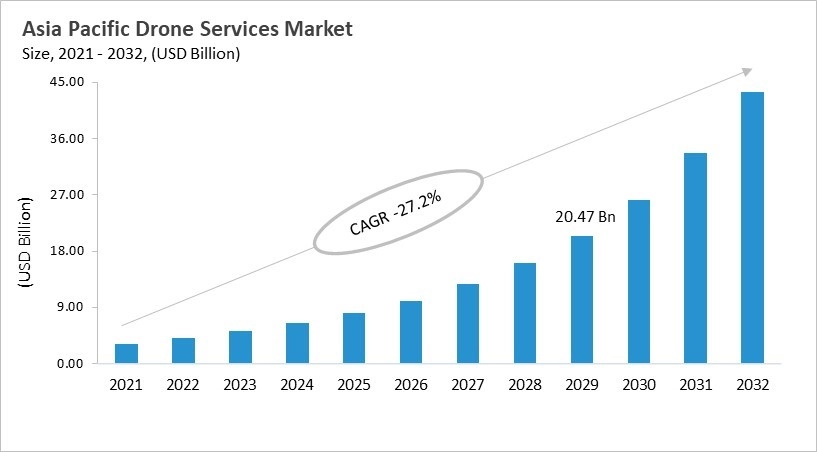
The Asia Pacific drone services market has become a dynamic place on a global scale, thanks to the fast adoption of new technologies, strong manufacturing ecosystems, and active government involvement. The market started out with defense research, remote sensing, and academic use. It became commercially viable as sensors, navigation, batteries, and affordable platforms from major OEMs improved. At first, aerial photography and surveying were the main uses. Later, they grew to include construction, mining, agriculture, and infrastructure monitoring. China, Japan, South Korea, and Singapore were important because they combined new ideas with well-organized rules. One of the main reasons for growth has been the government's recognition of drones as tools for productivity, digital transformation, and national competitiveness.
In the last few years, the market has moved toward data-driven drone service models that focus on analytics, AI, and cloud-based insights instead of just flying the drones. High-impact applications now include precision agriculture, disaster response, environmental monitoring, and infrastructure inspection, which make all sectors more efficient and safe. Government involvement through certification systems, test zones, and innovation sandboxes is still helping to make adoption more widespread. Regulatory expertise, localization, partnerships, and analytics capability, not hardware differentiation, are what shape competitive dynamics. As a result, service providers that follow the rules, make solutions that fit the needs of each region, and give useful information have a big edge over their competitors in the Asia Pacific drone services market.
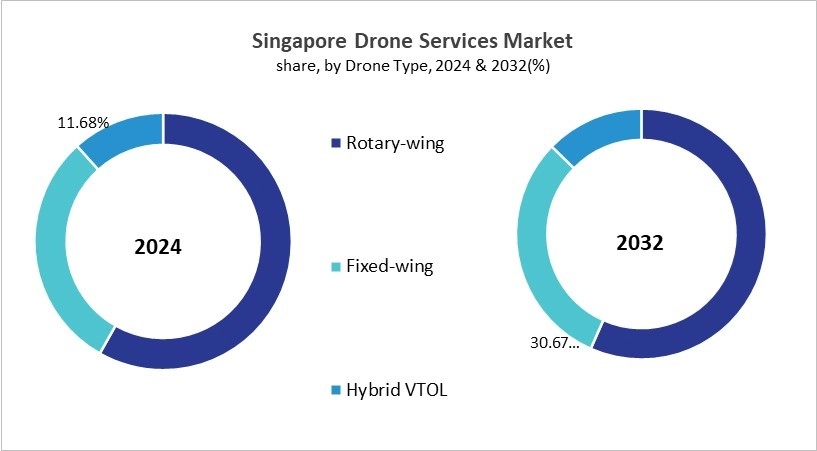
Based on Drone Type, the market is segmented into Rotary-wing, Fixed-wing, and Hybrid VTOL. The Rotary-wing market segment dominated the Singapore Drone Services Market by Drone Type is expected to grow at a CAGR of 28.7 % during the forecast period thereby continuing its dominance until 2032. Also, The Hybrid VTOL market is anticipated to grow as a CAGR of 30.6 % during the forecast period during (2025 - 2032).
Based on End-User Industry, the market is segmented into Energy & Utilities, Construction & Infrastructure, Agriculture & Forestry, Law Enforcement & Public Safety, Medical & Parcel Delivery, and Other End-User Industry. Among various China Drone Services Market by End-User Industry; The Energy & Utilities market achieved a market size of USD $623.9 Million in 2024 and is expected to grow at a CAGR of 24.1 % during the forecast period. The Law Enforcement & Public Safety market is predicted to experience a CAGR of 26.8% throughout the forecast period from (2025 - 2032).
Free Valuable Insights: Drone Services Market is Predicted to reach USD 151.08 billion by 2032, at a CAGR of 26.3%
The Chinese drone services market is becoming an important strategic area, thanks to strong government support for integrating civil aviation, being a leader in technology, and keeping the airspace safe. The Civil Aviation Administration of China (CAAC) oversees the market. It has a strict set of rules that include real-name drone registration, flight approvals, altitude limits, and no-fly zones to keep things safe while allowing them to be used quickly. China's strong manufacturing ecosystem, the leadership of domestic OEMs like DJI, and the integration of unmanned aerial systems into national aviation infrastructure, driven by policy, are all important factors. Market trends show that more businesses are using drones for logistics, infrastructure inspection, agriculture, and emergency response. This is made possible by pilot programs and conditional approvals for operations that go beyond the visual line of sight. Competition is good for domestic service providers who are well-regulated and have a strong supply chain. Foreign companies usually enter the market through partnerships. In general, China's continued growth in scalable and advanced drone services is due to the maturation of regulations and cooperation between regulators, OEMs, and operators.

By Service Type
By Drone Type
By Operating Range
By End-User Industry
By Country
Our team of dedicated experts can provide you with attractive expansion opportunities for your business.




 Unique Offerings