The Asia Pacific Digital Inspection Market would witness market growth of 6.8% CAGR during the forecast period (2025-2032).
The China market dominated the Asia Pacific Digital Inspection Market by Country in 2024, and would continue to be a dominant market till 2032; thereby, achieving a market value of $3,340.5 million by 2032. The Japan market is registering a CAGR of 6.1% during (2025 - 2032). Additionally, The India market would showcase a CAGR of 7.5% during (2025 - 2032). The China and Japan led the Asia Pacific Digital Inspection Market by Country with a market share of 32.8% and 19.2% in 2024. The South Korea market is expected to witness a CAGR of 8.7% during throughout the forecast period.
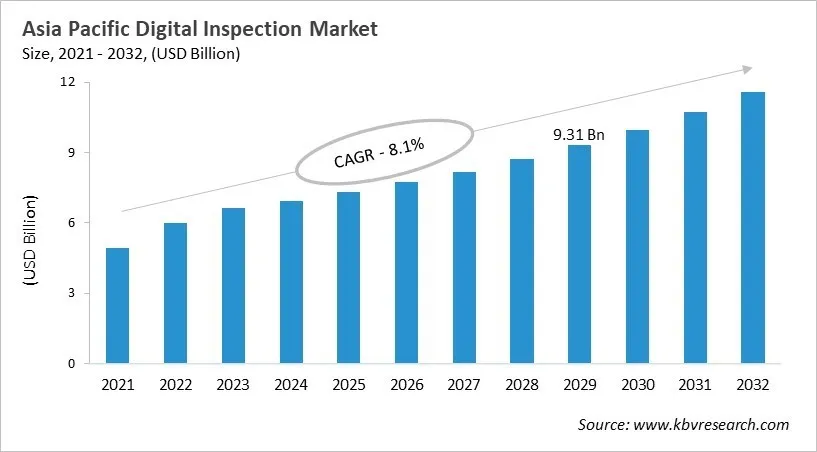
The Asia Pacific Digital Inspection Market has changed from quality checks that were done by hand and relied on people to highly automated, data-driven inspection systems that help with modern manufacturing and infrastructure monitoring. Manufacturers in the automotive, electronics, aerospace, energy, and consumer goods sectors are increasingly using machine vision, metrology, NDT, and advanced imaging systems. This is because of industrial automation goals, smart factory projects, and higher export-quality standards. Combining AI, machine learning, and Industry 4.0 frameworks has made it possible to find defects in real time, predict quality control, and standardize inspections in high-volume production settings. Government-backed industrial policies and innovation led by OEMs have sped up adoption even more. They have replaced manual processes that couldn't be scaled with intelligent, traceable, and safety-focused inspection solutions.
Three main trends are changing the market: AI-driven inspection under Industry 4.0, IoT-enabled and remote inspection capabilities, and moving beyond manufacturing to include safety and infrastructure monitoring. OEMs and integrators compete with each other by constantly coming up with new technologies, using localization strategies, designing modular systems, and providing good customer service after the sale. Strategic partnerships with regional players make it possible to customize deployments in a wide range of industrial settings. Cloud-connected analytics also help with multi-site quality benchmarking and predictive maintenance. All of these factors put the Asia Pacific at the forefront of digital inspection adoption, which helps with zero-defect manufacturing, following the rules, and long-term industrial resilience.
Based on Dimension, the market is segmented into 2D, and 3D. The 2D market segment dominated the China Digital Inspection Market by Dimension is expected to grow at a CAGR of 4.6 % during the forecast period thereby continuing its dominance until 2032. Also, The 3D market is anticipated to grow as a CAGR of 5.7 % during the forecast period during (2025 - 2032).
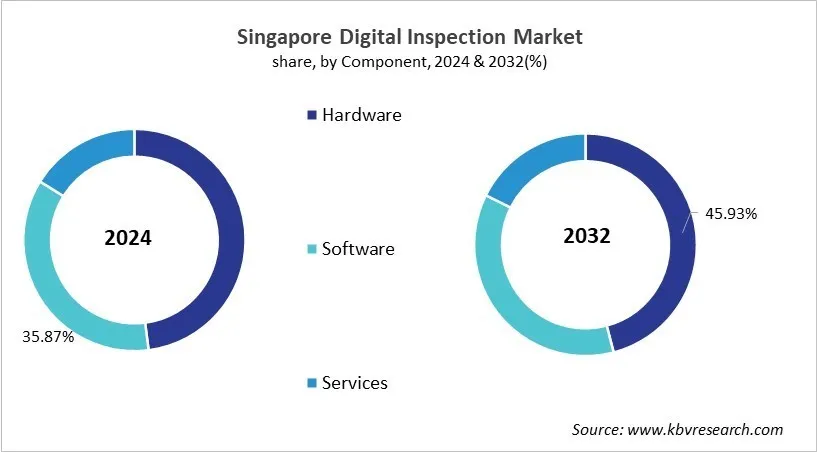
Based on Component, the market is segmented into Hardware, Software, and Services. The Hardware market segment dominated the Singapore Digital Inspection Market by Component is expected to grow at a CAGR of 7.9 % during the forecast period thereby continuing its dominance until 2032. Also, The Services market is anticipated to grow as a CAGR of 9.7 % during the forecast period during (2025 - 2032).
Free Valuable Insights: The Digital Inspection Market is Predicted to reach USD 36.15 Billion by 2032, at a CAGR of 6.3%
China is the leader in the Asia Pacific digital inspection market because its large manufacturing ecosystem is highly automated. Machine vision, automated sensors, non-destructive testing, and real-time analytics are some examples of digital inspection technologies that are very important for quality control, compliance, and productivity in fields like electronics, cars, infrastructure, and energy. Strong government-backed programs that encourage digitization in industry, along with the growing use of industrial robots and AI-driven automation, are speeding up the use of smart inspection systems. The growth of IoT infrastructure and real-time monitoring makes inspections more accurate and processes more visible. At the same time, strict rules and export standards force widespread use. Competitive dynamics show a mix of global tech companies and skilled domestic integrators offering scalable, smart inspection platforms that fit with China's goals for smart factories and Industry 4.0.

By Dimension
By Technology
By Component
By Vertical
By Country
Our team of dedicated experts can provide you with attractive expansion opportunities for your business.








 Unique Offerings