The sample copy of this report is available for access.
The Asia Pacific Apple Cider Vinegar Market is expected to reach USD 211.3 Million by 2030, growing at a CAGR of 7% during (2026 – 2033).
The Asia Pacific Apple Cider Vinegar Market originated from traditional vinegar usage, where apple-based fermentation was used for culinary, preservation, and household applications. Early production was largely local and small-scale, with limited commercial distribution across regional communities. Over time, improved fermentation, filtration, extraction, and bottling technologies enhanced quality, shelf life, and scalability. Rising awareness of apple cider vinegar’s perceived health benefits helped shift the product from a basic condiment to a wellness ingredient. The market now reflects a mix of traditional production heritage and modern health-focused commercialization.
The current Asia Pacific Apple Cider Vinegar Market is shaped by rising health consciousness, e-commerce growth, organized retail expansion, and demand for functional food products. Consumers are increasingly adopting raw, unfiltered, organic, flavored, and supplement-based apple cider vinegar formats. Digital marketing, wellness influencers, and online marketplaces are improving product awareness across emerging and developed economies. Manufacturers are also focusing on sustainable sourcing, local apple procurement, improved packaging, and quality transparency. These trends are supporting broader adoption across urban, semi-urban, and health-conscious consumer groups.
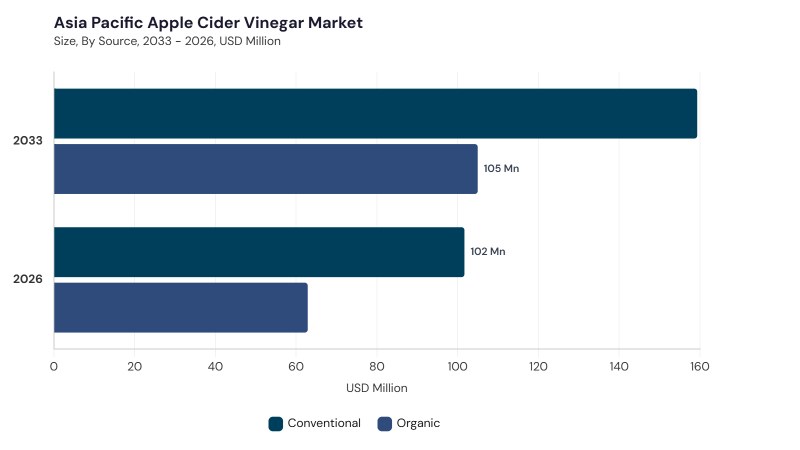
Based on Source, the market is segmented into Conventional and Organic. The Conventional market dominated the Asia Pacific Apple Cider Vinegar Market by Source in 2025, and would continue to be a dominant market till 2033; thereby, achieving a market value of USD 128.8 Million by 2030, growing at a CAGR of 6.6 % during the forecast period. The Organic market is expected to witness a CAGR of 7.6% during (2026 - 2033).
The Conventional segment leads due to cost-effective production, wider product availability, strong retail reach, and broad use across foodservice, household, and wellness applications. It remains important in price-sensitive economies where consumers seek functional benefits at affordable prices. The Organic segment is gaining traction as urban consumers show stronger preference for chemical-free, clean-label, and sustainably produced products. Organic certification, premium positioning, and wider online access are helping this segment expand across developed and emerging Asia Pacific markets.
Based on Form, the market is segmented into Liquid and Capsules/Tablets. The Liquid market dominated the Asia Pacific Apple Cider Vinegar Market by Form in 2025, and would continue to be a dominant market till 2033; thereby, achieving a market value of USD 156.1 Million by 2030, growing at a CAGR of 6.6 % during the forecast period. The Capsules/Tablets market is expected to witness a CAGR of 8% during (2026 - 2033).
The Liquid segment dominates due to traditional consumer familiarity, versatile culinary use, broad household acceptance, and suitability for beverages, dressings, marinades, and wellness routines. It is also preferred by consumers seeking natural and minimally processed vinegar formats. Capsules and tablets are growing as buyers look for convenience, controlled dosage, portability, and reduced exposure to strong vinegar taste. This format is gaining relevance among urban consumers, supplement users, and online health product buyers.
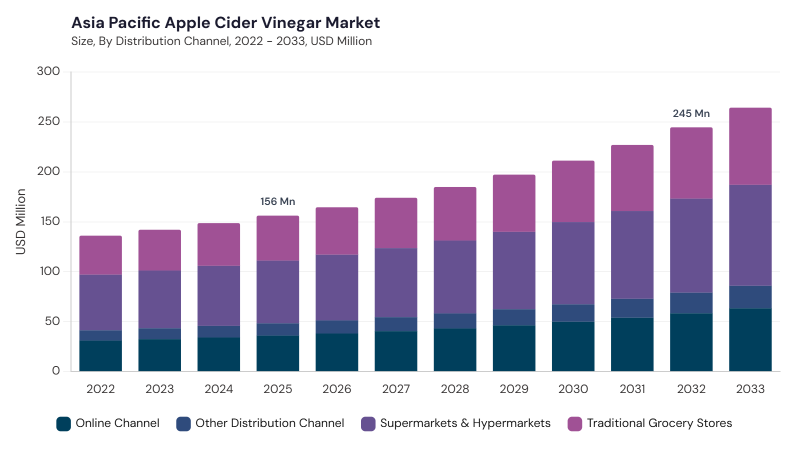
Based on Distribution Channel, the market is segmented into Supermarkets & Hypermarkets, Traditional Grocery Stores, Online Channel, and Other Distribution Channel. Supermarkets and hypermarkets dominate due to expanding organized retail infrastructure, wide product assortments, promotional activity, and consumer preference for modern shopping formats.
Traditional grocery stores remain important across semi-urban and rural markets because of neighborhood access, affordability, and local consumer trust. The Online Channel is expanding rapidly due to rising smartphone penetration, digital payments, product reviews, and doorstep delivery. Other channels, including health stores, pharmacies, specialty wellness outlets, and independent retailers, support premium and health-focused demand.
Free Valuable Insights: The Global Apple Cider Vinegar Market will hit USD 1.0 Billion billion by 2033, at a CAGR of 6.1%
Based on Country, the market is segmented into China, Japan, India, South Korea, Singapore, Malaysia, and Rest of Asia Pacific. The China market dominated the Asia Pacific Apple Cider Vinegar Market by Country in 2025, and would continue to be a dominant market till 2033; thereby, achieving a market value of USD 79.1 Million by 2030, growing at a CAGR of 5.6 % during the forecast period. The Japan market is expected to witness a CAGR of 6.1% during (2026 - 2033). Additionally, The India market is expected to witness a CAGR of 7.7% during (2026 - 2033).
China supports regional growth through large consumer reach, rising wellness awareness, digital retail growth, and demand for functional food formats. Japan contributes through mature fermentation culture, ready-to-drink vinegar beverages, and strong quality expectations. India is expanding through natural health adoption, Ayurvedic positioning, and e-commerce-led consumer education. South Korea, Singapore, and Malaysia are driven by functional food trends, premium wellness products, and convenience formats, while Rest of Asia Pacific adds demand from emerging retail and health-focused consumers.

By Source
By Form
By Distribution Channel
By Country
Set to reach USD 211.3 Million by 2033, growing at 7% CAGR during 2026-2033.
China leads with USD 79.1 Million by 2030, growing at 5.6% CAGR during 2026-2033.
Rising demand for organic products, with the organic segment growing at 7.6% CAGR during 2026-2033.
Liquid segment reaches USD 156.1 Million by 2030, growing at 6.6% CAGR during 2026-2033.
India's market is expected to grow at 7.7% CAGR during 2026-2033.
Capsules/Tablets segment is expected to witness an 8% CAGR during 2026-2033.
Our team of dedicated experts can provide you with attractive expansion opportunities for your business.




 Unique Offerings