The sample copy of this report is available for access.
The Asia Pacific AI Productivity Tools Market is expected to reach USD 10.0 billion by 2030, growing at a CAGR of 25.8% during (2026 – 2033).
The Asia Pacific AI Productivity Tools Market developed from the region’s wider digital transformation push, where early automation and analytics tools were used to improve enterprise efficiency. Initial adoption was concentrated among large organizations in manufacturing, telecom, IT services, and financial operations, where rule-based automation helped reduce repetitive work. Over time, machine learning, natural language processing, cloud computing, and generative AI expanded the role of AI from basic task support to intelligent workplace enablement. The market advanced as enterprises began embedding AI into communication, analytics, document handling, workflow management, and knowledge-sharing systems.
The Asia Pacific AI Productivity Tools Market is being shaped by rapid cloud adoption, digital workplace modernization, workforce skill gaps, SME digitization, and rising enterprise demand for measurable productivity gains. Organizations are using AI tools to automate routine tasks, generate content, support customer service, manage documents, improve decision-making, and enhance software development workflows. Demand is supported by government-backed AI initiatives, regional AI hubs, expanding cloud infrastructure, digital commerce growth, and strong technology adoption across developed and emerging economies. Vendors are focusing on generative AI, multimodal models, regional language support, intelligent automation, secure deployment, and workflow-specific AI productivity platforms.
Based on Deployment, the market is segmented into Cloud and On-Premise. The Cloud market dominated the Asia Pacific AI Productivity Tools Market by Deployment in 2025, and would continue to be a dominant market till 2033; thereby, achieving a market value of USD 5.1 billion by 2030, growing at a CAGR of 26 % during the forecast period. The On-Premise market is expected to witness a CAGR of 25.7% during (2026 - 2033).
Cloud leads due to scalable access, flexible pricing, reduced infrastructure costs, faster deployment, and strong suitability for distributed teams across diverse Asia Pacific economies. Cloud-based AI productivity tools support virtual assistants, document automation, analytics, workflow management, AI-as-a-Service, and collaboration functions without requiring heavy internal IT investments. This model is particularly important for SMEs, startups, digital-first businesses, and enterprises seeking rapid productivity improvements across multiple locations. On-Premise deployment remains relevant for banks, government agencies, healthcare providers, and large enterprises that require stronger control over sensitive data, regulatory compliance, proprietary workflows, low-latency processing, and customized AI environments.
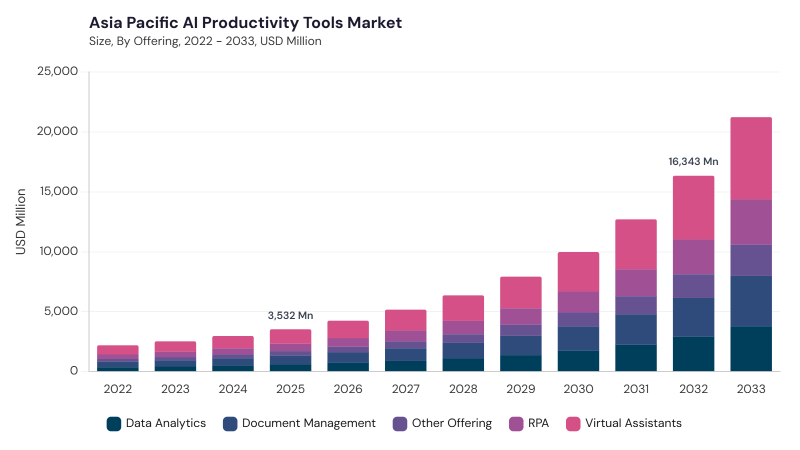
Based on Offering, the market is segmented into Virtual Assistants, Document Management, RPA, Data Analytics, and Other Offering. The Virtual Assistants market dominated the Asia Pacific AI Productivity Tools Market by Offering in 2025, and would continue to be a dominant market till 2033; thereby, achieving a market value of USD 3.3 billion by 2030, growing at a CAGR of 24.9 % during the forecast period. The Document Management market is expected to witness a CAGR of 25.1% during (2026 - 2033). Additionally, The RPA market is expected to witness highest CAGR of 26.3% during (2026 - 2033).
Virtual Assistants lead due to widespread adoption of conversational AI, generative AI copilots, multilingual interfaces, intelligent scheduling, task support, and customer interaction automation. These tools help employees manage communication, search information, summarize content, respond to queries, automate reminders, and improve workplace productivity with reduced manual effort. Document Management is gaining momentum as enterprises digitize records and use AI for classification, indexing, OCR, secure sharing, content extraction, and compliance-related document workflows. RPA, Data Analytics, and Other Offering areas add demand through repetitive task automation, predictive insights, real-time monitoring, content generation, knowledge management, project collaboration, and customized AI tools for sector-specific productivity requirements.
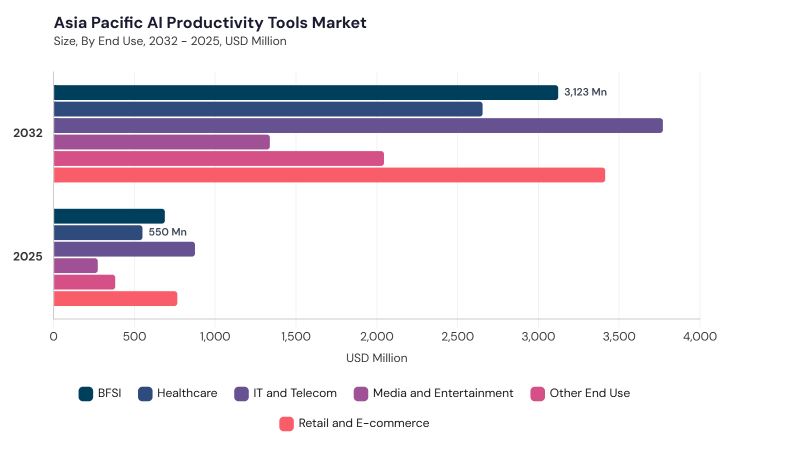
Based on End Use, the market is segmented into IT and Telecom, Retail and E-commerce, BFSI, Healthcare, Media and Entertainment, and Other End Use. IT and Telecom leads due to extensive adoption of AI productivity tools in software development, network optimization, IT operations, customer support, automated testing, and real-time data analytics. Retail and E-commerce adoption is supported by personalized recommendations, demand forecasting, inventory optimization, customer service chatbots, fraud prevention, and omnichannel workflow automation.
BFSI uses AI productivity tools for fraud detection, underwriting support, regulatory compliance, intelligent document processing, and customer advisory services. Healthcare, Media and Entertainment, and Other End Use areas add demand through clinical documentation, patient data management, AI-assisted content creation, localization, audience analytics, manufacturing automation, education support, government services, and logistics optimization.
Free Valuable Insights: AI Productivity Tools Market is Predicted to reach USD 66.4 Billion billion by 2033, at a CAGR of 25.3%
Based on Country, the market is segmented into China, Japan, India, South Korea, Singapore, Malaysia, and Rest of Asia Pacific. The China market dominated the Asia Pacific AI Productivity Tools Market by Country in 2025, and would continue to be a dominant market till 2033; thereby, achieving a market value of USD 2.7 billion by 2030, growing at a CAGR of 23.6 % during the forecast period. The Japan market is expected to witness a CAGR of 25.1% during (2026 - 2033). Additionally, The India market is expected to witness a CAGR of 26.6% during (2026 - 2033).
China leads due to strong AI infrastructure, generative AI adoption, data center expansion, enterprise automation, localized AI models, and broad use of predictive analytics across industrial and service sectors. Japan supports market growth through AI tools designed for labor shortage mitigation, workflow automation, document processing, Japanese-language productivity support, and strong governance requirements. India is advancing through cloud-based AI adoption, affordable productivity platforms, regional language tools, SME digitization, IT services demand, and strong engineering talent availability. South Korea, Singapore, and Malaysia add momentum through government-backed AI programs, smart enterprise adoption, cloud infrastructure, localized AI applications, and compliance-focused deployment, while Rest of Asia Pacific benefits from AI democratization and digital transformation.

By Deployment
By Offering
By End Use
By Country
Set to reach $10.0 Billion by 2030, growing at 25.8% CAGR during 2026-2033.
China leads with a market value of USD 2.7 billion by 2030, growing at 23.6% CAGR during the forecast period.
Rising enterprise cloud adoption and AI-driven workloads are the main catalysts.
Cloud segment hits $5.1 billion by 2030, growing at 26% CAGR during the forecast period.
India is expected to witness a CAGR of 26.6% during 2026-2033.
RPA segment expected to witness highest CAGR of 26.3% during 2026-2033.
Our team of dedicated experts can provide you with attractive expansion opportunities for your business.




 Unique Offerings