“Global API Security Testing Software Market to reach a market value of USD 7189.56 Million by 2033 growing at a CAGR of 21.4%”
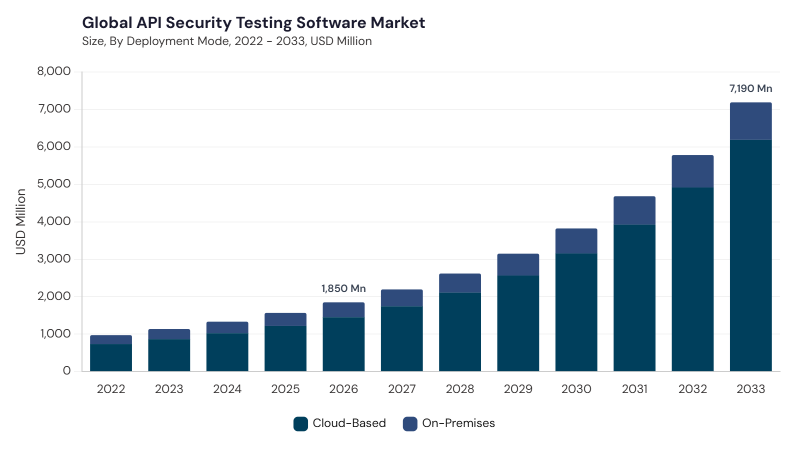
The global API security testing software market is estimated at USD 1.9 billion in 2026 and is projected to reach USD 7.2 billion by 2033, growing at a CAGR of 21.4% from 2026 to 2033.
API security testing software helps development and application security teams identify weaknesses in application programming interfaces (APIs). Within web API security, these tools review API specifications, assess the behavior of running APIs and support repeatable checks as applications change. The market covers software for security assessment, remediation follow-up and retesting. It excludes general API functional testing, API management and runtime traffic protection. For broader API security platforms, the market covers the security testing component.
A web API can behave differently across user roles, endpoints and application states. This matters for REST API security, where the behavior of a running service helps teams assess whether access controls work as designed. Common areas for review include authentication and object-level authorization, both covered in the . Testing teams can use that reference to prioritize the risks relevant to the application.
New endpoints, schema revisions and authentication changes can make earlier findings incomplete. Teams can run automated API security tests in continuous integration and delivery (CI/CD) workflows to reassess changed services and retest resolved findings. The value of automation depends on which endpoints and user roles it covers, how reliably it runs and whether findings reach the teams responsible for remediation.
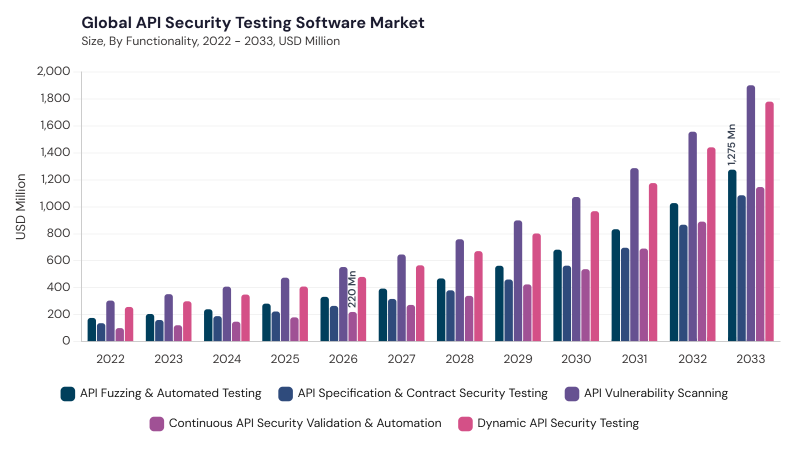
By functionality, the market covers API Vulnerability Scanning, Dynamic API Security Testing, API Fuzzing & Automated Testing, API Specification & Contract Security Testing, and Continuous API Security Validation & Automation. API Vulnerability Scanning led in 2025 and is projected to reach USD 1.9 billion by 2033, at a CAGR of 19.3%. Continuous API Security Validation & Automation has the highest projected CAGR, at 26.6%.
The functionality categories address different points in the development and release cycle. Specification and contract testing assesses the documented interface, while dynamic testing evaluates the running service. Vulnerability scanning helps identify issues for review. Continuous validation supports recurring checks and retesting as teams release changes. Buyers comparing standalone API security testing tools and broader API security platforms can assess coverage, integration with release workflows and how each product tracks findings through remediation.
By deployment mode, the market covers Cloud-Based and On-Premises software. Cloud-Based deployment led in 2025 and is projected to reach USD 6.2 billion by 2033, at the highest deployment-mode CAGR of 23.0%.
Cloud-based API security testing can give teams a shared environment for managing checks and reviewing results. On-premises deployment can suit organizations that need to keep test data and results in a controlled environment. In either model, buyers need to assess which internal APIs the software can reach and where it stores test results.
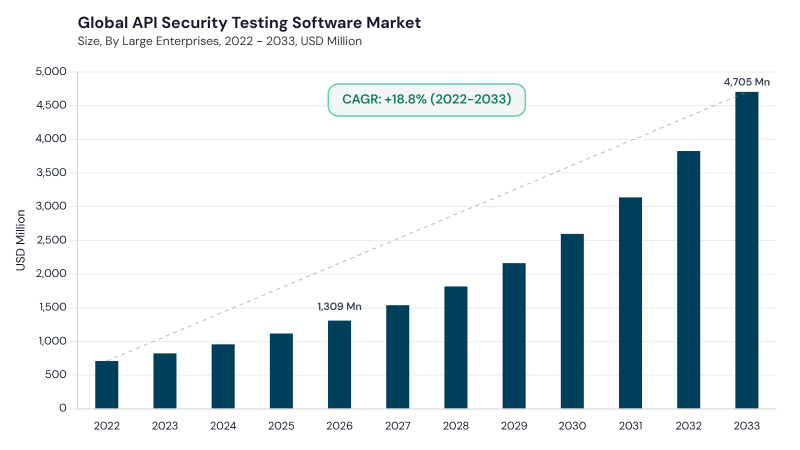
By enterprise size, the market covers Large Enterprises and Small & Medium Enterprises (SMEs). Large Enterprises led in 2025 and are projected to reach USD 4.7 billion by 2033, at a CAGR of 20.1%. SMEs have the highest projected enterprise-size CAGR, at 24.3%.
An enterprise API security program may need centralized reporting and clear ownership of findings across multiple development teams. Smaller organizations may prioritize quick setup and checks that their existing teams can maintain. Integration with current release workflows affects how broadly either group can use the software.
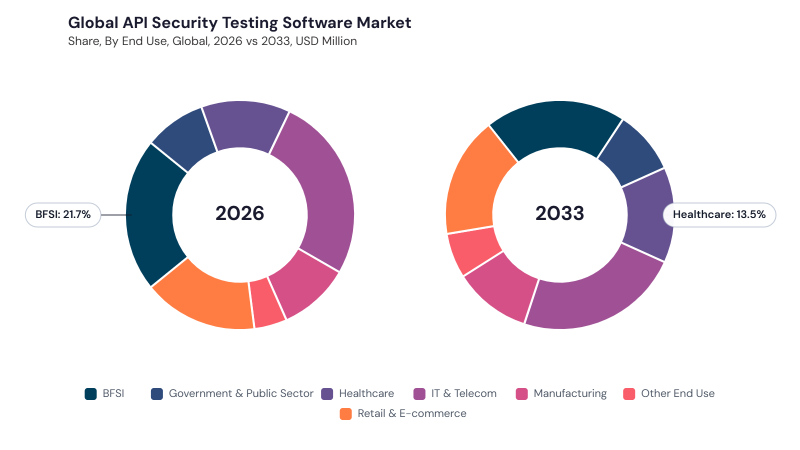
By end use, the market covers IT & Telecom, BFSI, Retail & E-commerce, Healthcare, Manufacturing, Government & Public Sector, and Other End Use. IT & Telecom led in 2025 and is projected to reach USD 1.7 billion by 2033, at a CAGR of 19.4%. Other End Use has the highest projected CAGR, at 27.0%.
Use cases vary with the data and workflows an API supports. IT and telecom teams can apply testing to services used by internal teams and external partners. Financial services teams may assess access controls on account and payment APIs, while retailers may prioritize checkout, order and customer-facing integrations.
Free Valuable Insights: API Security Testing Software Market Size to reach $7.2 Billion by 2033
The report covers North America, Europe, Asia Pacific and Latin America, the Middle East and Africa (LAMEA). North America led in 2025 and is projected to reach USD 2.5 billion by 2033, at a CAGR of 19.3%. Projected CAGRs are 19.5% for Europe, 23.8% for Asia Pacific and 28.4% for LAMEA.
North America has the largest 2025 market, while LAMEA has the fastest projected growth rate. The regional and country breakdowns allow readers to compare the scale of each market alongside its pace of growth.
By Functionality
By Deployment Mode
By Enterprise Size
By End Use
By Geography
| Report Attribute | Details |
|---|---|
| Market size value in 2026 | USD 1.9 billion |
| Market size forecast in 2033 | USD 7.2 billion |
| Base Year | 2025 |
| Historical Period | 2022 to 2024 |
| Forecast Period | 2026 to 2033 |
| Revenue Growth Rate | CAGR of 21.4% from 2026 to 2033 |
| Number of Tables | 630 |
| Number of Figures | 105 |
| Report Coverage | Market Trends, Revenue Estimation and Forecast, Segmentation Analysis, Regional and Country Breakdown, Competitive Landscape |
| Segments Covered | Functionality, Deployment Mode, Enterprise Size, End Use and Geography |
| Country Scope |
|
By Geography
Expected to reach USD 7.2 billion by 2033, growing at 21.4% CAGR during 2026-2033.
API Vulnerability Scanning leads, achieving USD 1.9 billion by 2033.
Top companies include Cisco, IBM, Microsoft, and Google.
Cloud-Based leads with USD 6.2 billion by 2033, representing 79.20% in 2025.
North America leads with USD 2.5 billion by 2033.
Security testing of running APIs and recurring endpoint changes are key growth drivers.
Our team of dedicated experts can provide you with attractive expansion opportunities for your business.