“Global AI Inference Market to reach a market value of USD 349.53 Billion by 2032 growing at a CAGR of 17.9%”
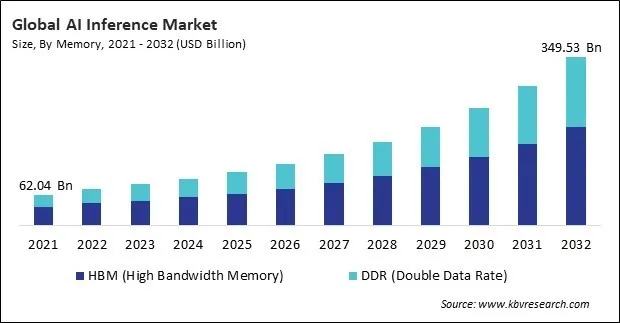
The Global AI Inference Market size is expected to reach $349.53 billion by 2032, rising at a market growth of 17.9% CAGR during the forecast period.
In recent years, the adoption of HBM in AI inference has been characterized by a shift towards more complex and resource-intensive neural networks, necessitating memory solutions that can keep pace with the growing computational demands. HBM’s unique ability to provide ultra-high bandwidth while maintaining a compact physical footprint is enabling the deployment of larger models and faster inference times, particularly in data center environments.
The major strategies followed by the market participants are Product Launches as the key developmental strategy to keep pace with the changing demands of end users. For instance, Two news of any two random companies apart from leaders and key innovators. In October, 2024, Advanced Micro Devices, Inc. unveiled Ryzen AI PRO 300 Series processors, delivering up to 55 TOPS of AI performance, which are tailored for enterprise PCs to accelerate on-device AI inference tasks. With advanced NPUs and extended battery life, they support AI-driven features like real-time translation and image generation, marking a significant stride in the market. Additionally, In May, 2025, Intel Corporation unveiled new Arc Pro B60 and B50 GPUs and Gaudi 3 AI accelerators, enhancing AI inference capabilities for workstations and data centers. These advancements offer scalable, cost-effective solutions for professionals and enterprises, strengthening Intel's position in the market.
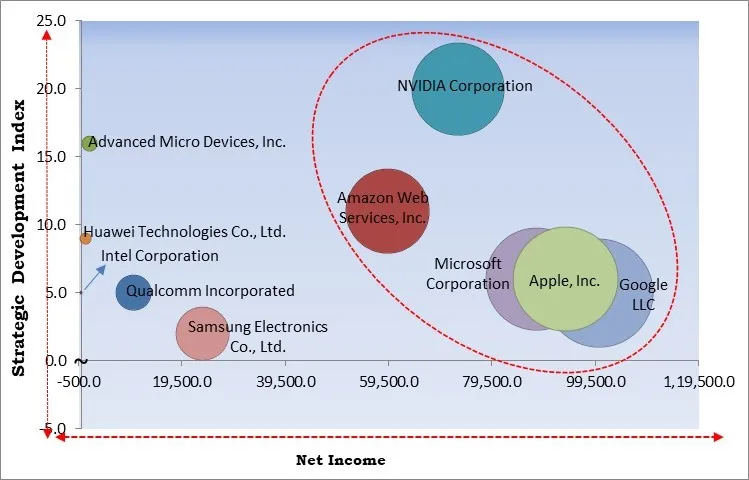
Based on the Analysis presented in the KBV Cardinal matrix; NVIDIA Corporation, Amazon Web Services, Inc., Google LLC, Microsoft Corporation, and Apple, Inc. are the forerunners in the Market. In May, 2025, NVIDIA Corporation unveiled DGX Spark and DGX Station personal AI supercomputers, powered by the Grace Blackwell platform, bringing data center-level AI inference capabilities to desktops. Collaborating with global manufacturers like ASUS, Dell, and HP, these systems enable developers and researchers to perform real-time AI inference locally, expanding the market. Companies such as Samsung Electronics Co., Ltd., Qualcomm Incorporated, and Advanced Micro Devices, Inc. are some of the key innovators in Market.
During the initial phases of the pandemic, several industries scaled back their technology investments due to uncertainty, supply chain disruptions, and budget constraints. Many ongoing projects were either delayed or put on hold, and companies focused on maintaining business continuity rather than new AI deployments. As a result, the growth rate of the market slowed during 2020, compared to previous forecasts. Thus, the COVUD-19 pandemic had a slightly negative impact on the market.

The rapid proliferation of edge computing and Internet of Things (IoT) devices has become one of the foremost drivers shaping the market. As the world moves towards increased digitalization, billions of devices—from smartphones and smart cameras to industrial sensors and autonomous vehicles—are generating massive streams of data at the edge of networks. Traditional cloud-based AI processing models, while powerful, face critical limitations in bandwidth, latency, and privacy when handling this deluge of real-time information. In conclusion, the convergence of edge computing and AI is unlocking unprecedented potential for real-time, decentralized intelligence, cementing this trend as a pivotal driver for the expansion of the market.
Additionally, another critical driver fueling the market is the continuous advancement in AI hardware accelerators. As AI models become increasingly complex, the demand for specialized hardware capable of executing high-speed inference computations efficiently and at scale has intensified. Traditional CPUs, while versatile, are not optimized for the parallelized workloads characteristic of modern neural networks. Hence, relentless advancements in AI hardware accelerators are transforming the economics, efficiency, and scalability of AI inference, firmly positioning hardware innovation as a cornerstone in the growth trajectory of this market.
However, one of the most significant restraints hampering the widespread adoption of AI inference technologies is the high cost and complexity associated with advanced hardware required for efficient inference processing. AI inference, especially for deep learning models, demands specialized hardware such as Graphics Processing Units (GPUs), Tensor Processing Units (TPUs), Application-Specific Integrated Circuits (ASICs), and Field-Programmable Gate Arrays (FPGAs). Therefore, the prohibitive cost and complexity of advanced AI inference hardware act as a formidable restraint, restricting the democratization and scalable adoption of AI inference solutions worldwide.
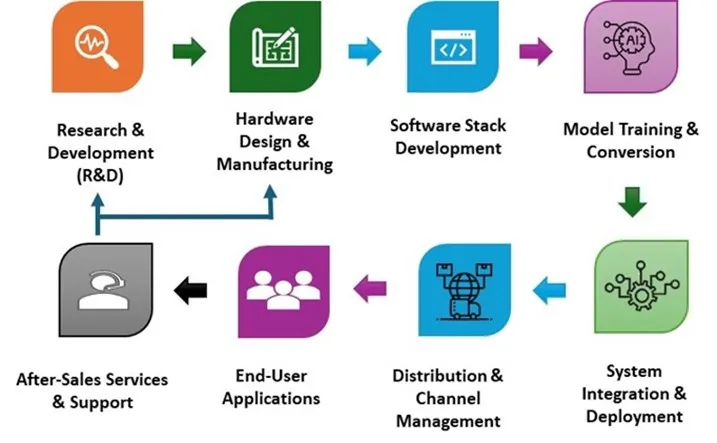
The value chain of the market begins with Research & Development (R&D), which drives innovation in AI algorithms, model optimization, and hardware efficiency. This stage lays the groundwork for subsequent phases. Following this, Hardware Design & Manufacturing involves creating specialized chips and devices tailored for inference workloads, ensuring high performance and low latency. Software Stack Development supports these hardware components with tools, frameworks, and APIs that enable seamless execution of AI models. In the Model Training & Conversion stage, trained models are optimized and converted into formats suitable for deployment in real-time environments. Next, System Integration & Deployment ensures these models and technologies are embedded effectively into user environments. Distribution & Channel Management plays a critical role in delivering these solutions to the market through strategic partnerships and logistics. These solutions are then used in End-User Applications across industries such as healthcare, automotive, and finance. Finally, After-Sales Services & Support provide ongoing assistance and maintenance, generating valuable feedback that informs future R&D and sustains innovation.
Free Valuable Insights: Global AI Inference Market size to reach USD 349.53 Billion by 2032
Based on memory, the market is characterized into HBM (High Bandwidth Memory) and DDR (Double Data Rate). The DDR (Double Data Rate) segment garnered 40% revenue share in the market in 2024. The DDR (Double Data Rate) segment also holds a significant position in the market. DDR memory is known for its widespread availability, cost-effectiveness, and dependable performance across a broad spectrum of AI applications.
| Category | Details |
|---|---|
| Use Case Title | Confidential |
| Date | 2025 |
| Entities Involved | Confidential |
| Objective | To deploy cost-effective, AI-driven medical diagnostic solutions at hospital edge locations using DDR memory, enabling accessible and accurate real-time patient screening. |
| Context and Background | By 2025, healthcare providers in emerging markets required scalable and affordable AI solutions to deliver diagnostic services at the point of care. High-end AI hardware was cost-prohibitive for many hospitals and clinics. Medtronic partnered with Dell to create an AI diagnostic platform for edge servers and embedded devices utilizing DDR-based memory, balancing performance and affordability. |
| Description | Dell deployed its PowerEdge edge servers, equipped with standard DDR5 memory and x86 CPUs/GPUs, in over 500 hospital locations worldwide. The solution featured:
|
| Key Capabilities Deployed |
|
| Benefits |
|
| Source | Confidential |
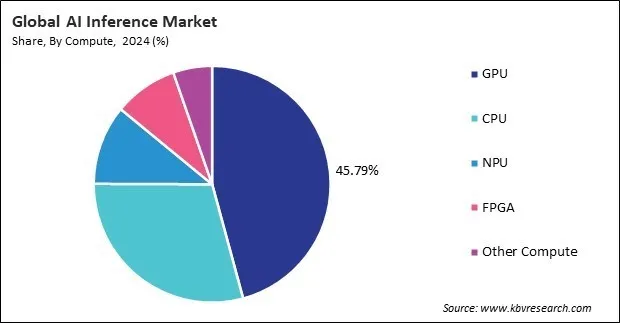
On the basis of compute, the market is classified into GPU, CPU, NPU, FPGA, and others. The CPU segment recorded 29% revenue share in the market in 2024. CPUs remain a critical component of the AI inference landscape, offering a balance of flexibility, compatibility, and accessibility. Unlike highly specialized processors, CPUs are designed for general-purpose computing and can efficiently execute a wide range of AI algorithms and workloads.
By application, the market is divided into machine learning, generative AI, natural language processing (NLP), computer vision, and others. The generative AI segment garnered 27% revenue share in the market in 2024. The generative AI segment is rapidly emerging as a major force in the market. Generative AI technologies are capable of producing new content such as images, text, audio, and video, opening up a wide array of possibilities for creative, commercial, and industrial uses.
Based on end use, the market is segmented into IT & Telecommunications, BFSI, healthcare, retail & e-commerce, automotive, manufacturing, security, and others. The BFSI segment acquired 16% revenue share in the market in 2024. The banking, financial services, and insurance (BFSI) sector is increasingly utilizing AI inference to streamline operations, enhance risk management, and improve customer engagement. AI-powered inference models assist in detecting fraudulent transactions, automating loan approvals, enabling real-time credit scoring, and delivering personalized financial products.
Region-wise, the market is analyzed across North America, Europe, Asia Pacific, and LAMEA. The North America segment recorded 37% revenue share in the market in 2024. North America stands as a prominent region in the market, supported by the presence of leading technology companies, substantial investment in AI research and development, and robust digital infrastructure. The region’s dynamic innovation ecosystem drives the adoption of advanced AI solutions across industries such as healthcare, finance, telecommunications, and automotive.
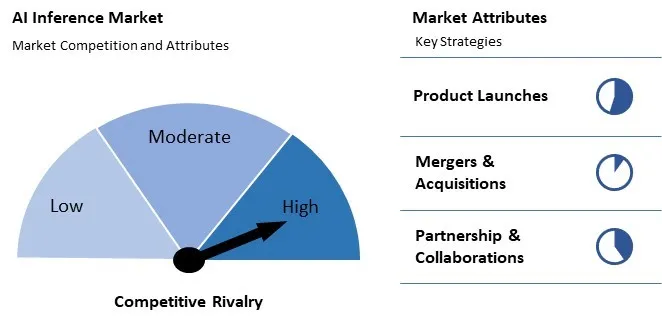
The Market remains highly competitive with a growing number of startups and mid-sized companies driving innovation. These players focus on specialized hardware, efficient algorithms, and niche applications to gain market share. Open-source frameworks and lower entry barriers further intensify competition, fostering rapid technological advancements and diversified solutions across industries like healthcare, automotive, and finance.
| Report Attribute | Details |
|---|---|
| Market size value in 2024 | USD 96.64 Billion |
| Market size forecast in 2032 | USD 349.53 Billion |
| Base Year | 2024 |
| Historical Period | 2021 to 2023 |
| Forecast Period | 2025 to 2032 |
| Revenue Growth Rate | CAGR of 17.9% from 2025 to 2032 |
| Number of Pages | 487 |
| Number of Tables | 536 |
| Report coverage | Market Trends, Revenue Estimation and Forecast, Segmentation Analysis, Regional and Country Breakdown, Competitive Landscape, Porter’s 5 Forces Analysis, Company Profiling, Companies Strategic Developments, SWOT Analysis, Winning Imperatives |
| Segments covered | Memory, Compute, Application, End Use, Region |
| Country scope |
|
| Companies Included | Intel Corporation, NVIDIA Corporation, Qualcomm Incorporated (Qualcomm Technologies, Inc.), Amazon Web Services, Inc. (Amazon.com, Inc.), Google LLC (Alphabet Inc.), Huawei Technologies Co., Ltd. (Huawei Investment & Holding Co., Ltd.), Microsoft Corporation, Samsung Electronics Co., Ltd. (Samsung Group), Advanced Micro Devices, Inc., and Apple, Inc. |
By Memory
By Compute
By Application
By End Use
By Geography
This Market size is expected to reach $349.53 billion by 2032.
Proliferation of Edge Computing and IoT Devices are driving the Market in coming years, however, High Cost and Complexity of Advanced AI Inference Hardware restraints the growth of the Market.
Intel Corporation, NVIDIA Corporation, Qualcomm Incorporated (Qualcomm Technologies, Inc.), Amazon Web Services, Inc. (Amazon.com, Inc.), Google LLC (Alphabet Inc.), Huawei Technologies Co., Ltd. (Huawei Investment & Holding Co., Ltd.), Microsoft Corporation, Samsung Electronics Co., Ltd. (Samsung Group), Advanced Micro Devices, Inc., and Apple, Inc.
The expected CAGR of this Market is 17.9% from 2023 to 2032.
The HBM (High Bandwidth Memory) segment captured the maximum revenue in the Market by Memory in 2024, thereby, achieving a market value of $203.81 billion by 2032.
The North America region dominated the Market by Region in 2024, thereby, achieving a market value of $122.31 billion by 2032.
Our team of dedicated experts can provide you with attractive expansion opportunities for your business.











 Unique Offerings