“Global AI In Software Development Market to reach a market value of 10.04 Billion by 2032 growing at a CAGR of 41.2%”
The Global AI In Software Development Market size is estimated at $898.05 million in 2025 and is expected to reach $10.04 billion by 2032, rising at a market growth of 41.2% CAGR during the forecast period (2025-2032). The rapid growth of the AI in software development market is driven by increasing adoption of generative AI, automation tools, and machine learning technologies that improve coding efficiency and software quality. Rising demand for faster development cycles, cloud-based AI platforms, and intelligent debugging tools is encouraging organizations to invest heavily in AI-driven development solutions, supporting strong market expansion through 2032.
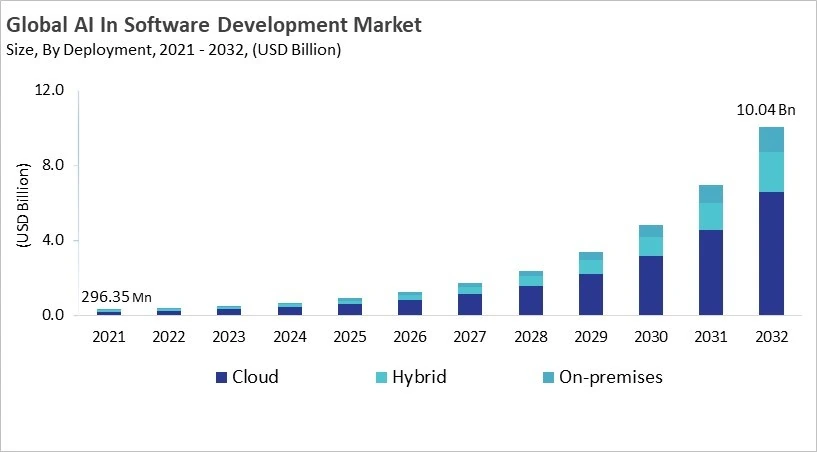
AI has become a crucial technology in modern software development, allowing computers to perform tasks that previously required human intelligence, such as natural language processing, pattern recognition, and decision-making. As machine learning capabilities and computing power advanced in the 2000s, technology providers began integrating AI into development tools that could identify programming patterns, analyze large code repositories, and provide coding recommendations. The 2010s further surged this evolution with the advent of cloud computing and deep learning, allowing the development of AI-powered coding assistants that support tasks like debugging, code completion, vulnerability detection, and software architecture recommendations.
The growth of generative AI and large language models has substantially transformed software development practices by allowing tools that can generate entire code blocks and support developers in understanding complex frameworks. AI-assisted coding tools enhance productivity by providing real-time coding suggestions and automating repetitive tasks, enabling developers to focus on complex design challenges. Furthermore, AI is largely used in quality assurance and software testing, where machine learning systems automatically detect defects, generate test cases, and predict areas that require further testing. The deployment of AI with cloud-based development platforms further improves accessibility and scalability, allowing developers to efficiently build smart applications. Major technology vendors continue investing in research, developer ecosystems, and platform integration to strengthen AI capabilities, making the AI-based software development ecosystem highly competitive.
The major strategies followed by the market participants are Partnerships as the key developmental strategy to keep pace with the changing demands of end users. For instance, In May, 2025, IBM Corporation teamed up with Oracle to advance agentic AI and hybrid cloud solutions. IBM’s watsonx AI portfolio will integrate with Oracle Cloud Infrastructure to enable multi-agent workflows, improve enterprise efficiency, and offer AI-powered consulting services. This collaboration supports scalable, secure AI across hybrid and multicloud environments. Additionally, In March, 2025, SAP SE announced the partnership with NVIDIA to deliver more advanced AI that reasons, learns, and acts for business. By integrating NVIDIA’s Llama Nemotron reasoning models, SAP’s Joule agents will gain deeper decision-making and code generation capabilities, helping enterprises build smarter applications and automate complex workflows more efficiently.
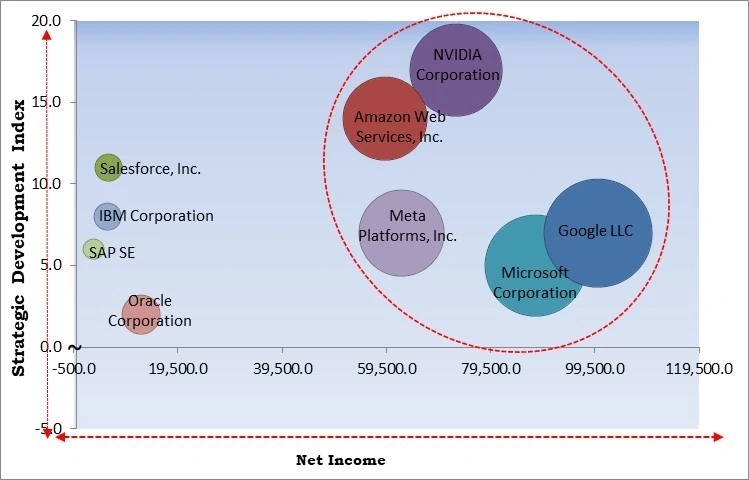
Based on the Analysis presented in the KBV Cardinal matrix; Google LLC, Microsoft Corporation, NVIDIA Corporation, Meta Platforms, Inc., and Amazon Web Services, Inc. are the forerunners in the AI In Software Development Market. Companies such as Oracle Corporation, Salesforce, Inc., and IBM Corporation are some of the key innovators in AI In Software Development Market. In July, 2025, Amazon Web Services, Inc. announced the partnership with Infor to expand generative AI across industry-specific cloud software. Building on a decade-long collaboration, the companies aim to help businesses in sectors like healthcare and manufacturing use AI tools to streamline operations, boost decision-making, and modernize their cloud environments efficiently.
The COVID-19 pandemic positively impacted AI in Software Development market as organizations accelerated digital transformation and relied more on digital platforms. This increased demand for faster and more efficient software development, driving adoption of AI-powered tools for coding, testing, debugging, and deployment. Remote work further boosted the need for collaborative and intelligent development solutions. Companies adopted AI-based code assistants and automated testing tools to maintain productivity. Investments in AI-powered DevOps, predictive analytics, and project management systems also increased. The surge in cloud computing, e-commerce, and digital services further strengthened the adoption of AI-driven software development technologies. Thus, the COVID-19 pandemic had a positive impact on the market.

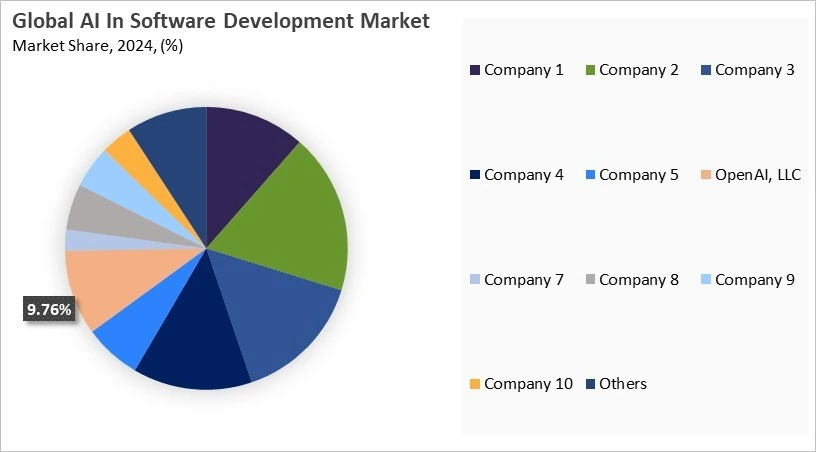
The leading players in the market are competing with diverse innovative offerings to remain competitive in the market. The above illustration shows the percentage of revenue shared by some of the leading companies in the market. The leading players of the market are adopting various strategies to cater demand coming from the different industries. The key developmental strategies in the market are Acquisitions, and Partnerships & Collaborations.
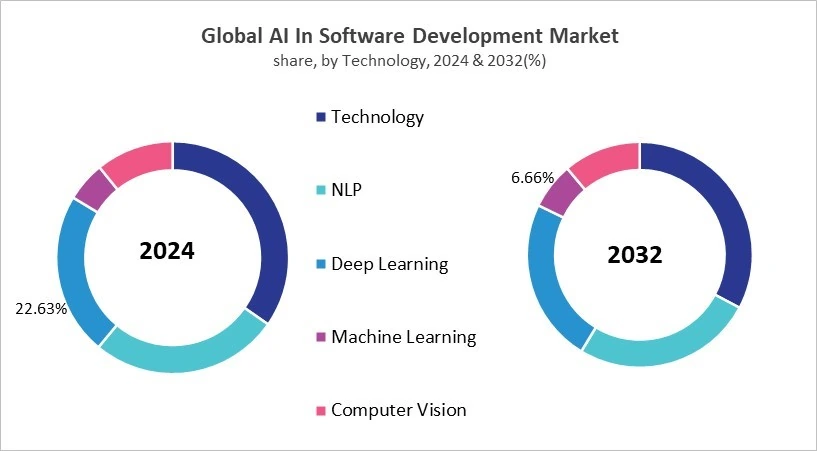
On the basis of technology, the AI In software development market is classified into NLP, deep learning, machine learning, computer vision, and other technology. The deep learning segment recorded 26% revenue share in the AI In software development market in 2024. By utilizing multi-layer neural networks, deep learning models can analyze large volumes of code, identify programming patterns, and assist in automated debugging and code optimization. These capabilities help development platforms provide accurate recommendations, detect anomalies in software structures, and improve development efficiency.
By application, the AI In software development market is divided into code generation & auto-completion, conversational AI assistants for developers, bug detection and error prediction, automated testing, project management & planning, and other application. The conversational AI assistants for developers segment recorded 19% revenue share in the AI In software development market in 2024. These AI-driven assistants enable developers to interact with development platforms using natural language queries, allowing them to receive coding guidance, troubleshooting assistance, and contextual explanations. Conversational AI tools are integrated into development environments to help developers understand complex code structures, locate documentation, and resolve programming issues more efficiently.
Free Valuable Insights: AI In Software Development Market Size to reach $10.04 by 2032
Region-wise, the AI In software development market is analyzed across North America, Europe, Asia Pacific, and LAMEA. The North America segment recorded 42% revenue share in the AI In software development market in 2024. The AI in software development market is anticipated to grow at a substantial rate in North America and Europe. The market is growing because of the strong presence of leading technology companies, high adoption of AI-powered development platforms, and advanced research ecosystems. The region plays a leading role in the market with significant investments in cloud computing infrastructure, artificial intelligence research, and developer tools supporting AI-assisted coding, DevOps optimization, and automated testing. Moreover, Europe AI in the software development market is projected to capture a noticeable share, propelled by expanding digital transformation initiatives and the presence of major software development hubs in nations like Germany, France, and the UK. Regulatory frameworks like the European Union’s AI Act and General Data Protection Regulation (GDPR) encourage the development of transparent, privacy-focused, and secure AI tools, which further support the adoption of AI in enterprise application development and software engineering.
The Asia Pacific and LAMEA regions are estimated to experience significant expansion in the AI in software development market. The Asia Pacific region is witnessing rapid expansion because of the growth of large technology ecosystems in nations like Japan, China, India, and South Korea, alongside rising investments in cloud computing, digital infrastructure, and AI research. The region further benefits from a large presence of software developers, strong government initiatives, and expanding startup ecosystems supporting artificial intelligence innovation. Furthermore, LAMEA AI in the software development market is also predicted to grow at a rapid rate. This is because enterprises are adopting AI to enhance software automation, digital transformation initiatives, and IT services. Regional nations are witnessing an accelerating demand for AI-enabled software development outsourcing and are also investing in digital economies and smart technologies to strengthen their technology sectors.
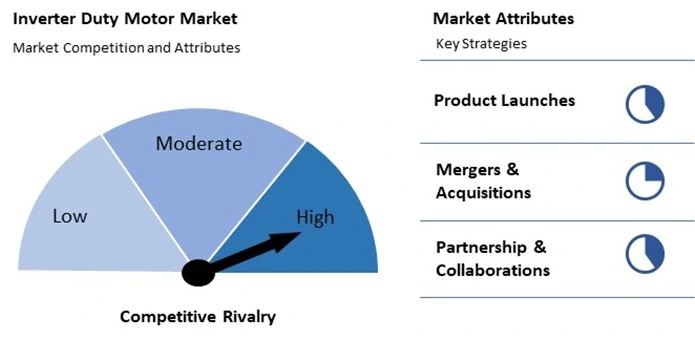
Competition in the AI in Software Development market is intense, driven by rapid technological advancements and increasing demand for automation, productivity, and faster development cycles. Major technology companies and emerging startups compete by offering AI-powered coding assistants, automated testing tools, and intelligent DevOps solutions. Continuous innovation, strategic partnerships, and integration with cloud platforms are key competitive strategies. Additionally, companies focus on improving accuracy, security, and developer productivity to differentiate their offerings in a fast-evolving and highly competitive market landscape.
| Report Attribute | Details |
|---|---|
| Market size value in 2025 | USD 898.05 Million |
| Market size forecast in 2032 | USD 10.04 Billion |
| Base Year | 2024 |
| Historical period | 2021 to 2023 |
| Forecast Period | 2025 to 2032 |
| Revenue Growth Rate | CAGR of 41.2% from 2025 to 2032 |
| Number of Pages | 706 |
| Tables | 538 |
| Report Coverage | Market Trends, Revenue Estimation and Forecast, Segmentation Analysis, Regional and Country Breakdown, Competitive Landscape, Market Share Analysis, Porter’s 5 Forces Analysis, Company Profiling, Companies Strategic Developments, SWOT Analysis, Winning Imperatives |
| Segments Covered | Deployment, Technology, Application, End User, Region |
| Country Scope |
|
| Companies Included | NVIDIA Corporation, Microsoft Corporation, Google LLC, Amazon Web Services, Inc. (Amazon.com, Inc.), IBM Corporation, OpenAI, LLC, Meta Platforms, Inc., Oracle Corporation, Salesforce, Inc. and SAP SE |
By Deployment
By Technology
By Application
By End User
By Geography
The market will reach USD 10.04 billion by 2032, growing at 41.2% CAGR during 2025-2032.
NLP dominates the technology segment, projected to achieve USD 3.29 billion by 2032.
NVIDIA Corporation, Microsoft Corporation, Google LLC, and Amazon Web Services hold dominant positions.
North America leads at USD 3.99 billion by 2032; Asia Pacific grows at 42.4% CAGR during 2025-2032.
Developer productivity needs, task automation demands, and generative AI growth fuel market expansion.
Code Generation & Auto-completion leads applications, reaching USD 3.12 billion by 2032.
Our team of dedicated experts can provide you with attractive expansion opportunities for your business.








 Unique Offerings