The sample copy of this report is available for access.
“Global AI In Media And Entertainment Market to reach a market value of USD 110,917.97 Million by 2033 growing at a CAGR of 20.1%”
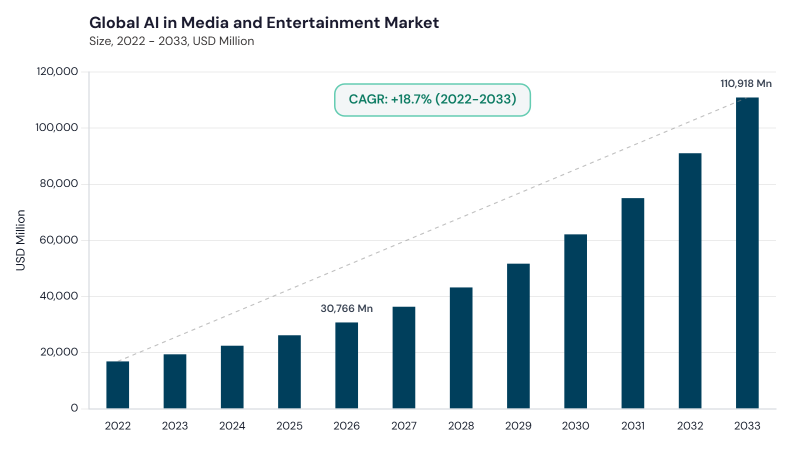
The Global AI In Media And Entertainment Market is expected to reach USD 110.9 billion by 2033, growing at a CAGR of 20.1% during (2026 - 2033).
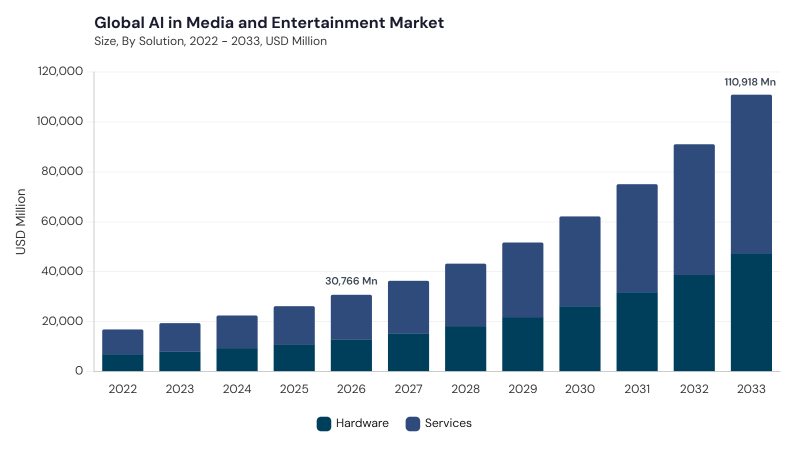
Expanding use of automated content creation, personalized audience engagement, intelligent production workflows, and data-driven decision-making is accelerating adoption of AI in media and entertainment across film, television, music, gaming, advertising, sports, digital platforms, and streaming ecosystems. Growth is further strengthened by generative AI, recommendation engines, virtual production, automated editing, predictive analytics, multilingual localization, synthetic media, intelligent asset management, and AI-assisted visual effects. The market originated from early machine learning and computer vision applications used for content recognition, audience analytics, recommendation engines, and distribution efficiency.
Growth in the AI In Media And Entertainment Market is driven by the rising need to produce more content faster, reduce operating costs, improve audience engagement, personalize media delivery, and monetize large content libraries. AI tools are increasingly used for automated editing, content tagging, real-time translation, dubbing, visual effects, recommendation systems, predictive analytics, archive discovery, ad placement, and fan engagement. As media consumption becomes more digital, on-demand, and interactive, AI is becoming an essential layer across production, distribution, personalization, marketing, and monetization workflows. The market is also benefiting from growing use of multimodal models, cloud AI platforms, accelerated computing, virtual production, and agentic AI systems that support broader media lifecycle automation.
The competitive environment is innovation-driven and moderately fragmented, with hyperscale cloud providers, creative-software vendors, accelerated-computing firms, enterprise AI companies, generative AI providers, and specialized media-technology companies competing across different parts of the value chain. Microsoft, Google, and AWS compete through scalable cloud AI ecosystems, foundation models, media workflow platforms, and enterprise-grade infrastructure. Adobe and Autodesk maintain strong relevance in creative production, VFX, video editing, and professional content workflows.
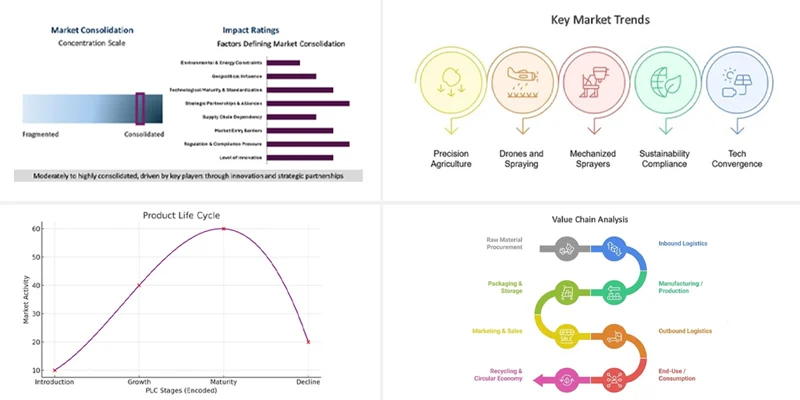

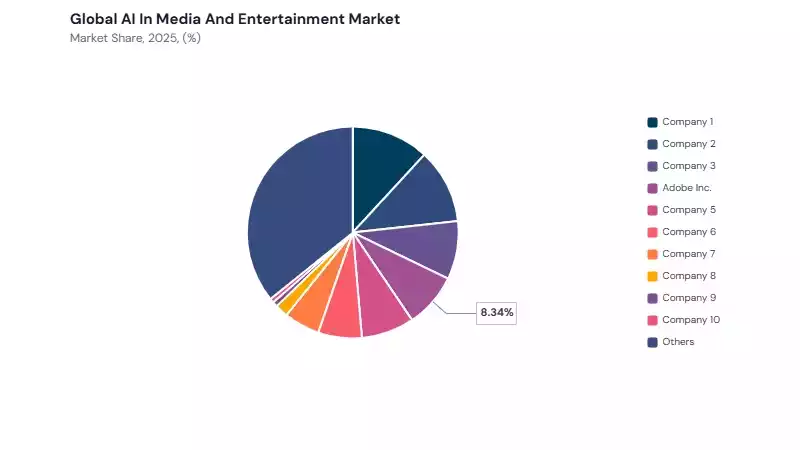
The global AI In Media And Entertainment Market reflects a moderately fragmented and innovation-led competitive structure, with participation from hyperscale cloud providers, generative AI companies, creative-software vendors, accelerated-computing providers, enterprise AI platforms, and specialized media-production technology firms. Microsoft and Google maintain near-equal leadership through Azure AI, Copilot, Gemini, Vertex AI, multimodal media workflows, and enterprise AI integration, while AWS strengthens the market through Bedrock, Nova, SageMaker, Rekognition, Personalize, and cloud-based media supply-chain solutions. Adobe and Autodesk compete through creator-facing AI workflows, Firefly, video generation, VFX, animation, and production tools. IBM, NVIDIA, OpenAI, Veritone, and Gravity Media add competitive depth through watsonx-based fan engagement, accelerated computing, multimodal foundation models, AI-powered archive monetization, and automated broadcast production.
Based on Solution, the market is segmented into Services and Hardware. The Services market dominated the Global AI In Media And Entertainment Market by Solution in 2025, and would continue to be a dominant market till 2033; thereby, achieving a market value of USD 63.5 billion by 2033, growing at a CAGR of 19.7 % during the forecast period. The Hardware market is expected to witness a CAGR of 20.6% during (2026 - 2033).
Services remain the leading solution segment as media organizations require consulting, implementation, system integration, customization, managed services, maintenance, and technical support to deploy AI across complex production and distribution workflows. Demand is supported by the growing use of machine learning, generative AI, natural language processing, computer vision, predictive analytics, content analytics, recommendation systems, and AI governance. Hardware remains essential because advanced AI workloads require GPUs, AI accelerators, high-performance servers, intelligent cameras, edge devices, storage systems, rendering platforms, and specialized processors. As high-resolution video, gaming, virtual production, generative media, and live-streaming workloads increase, hardware infrastructure continues to provide the computational foundation for scalable AI adoption.
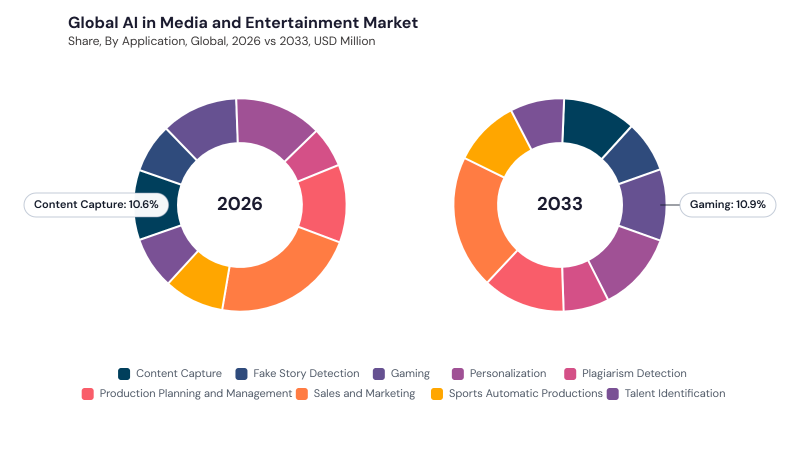
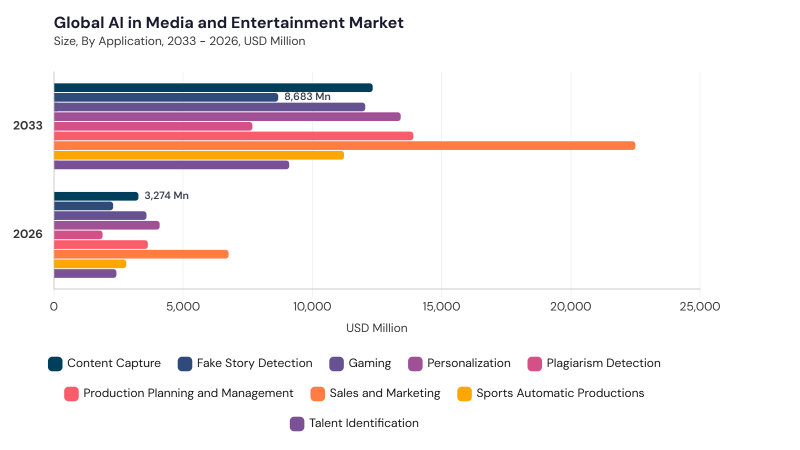
Based on Application, the market is segmented into Sales and Marketing, Personalization, Gaming, Production Planning and Management, Content Capture, Sports Automatic Productions, Fake Story Detection, Plagiarism Detection, and Talent Identification. The Sales and Marketing market dominated the Global AI In Media And Entertainment Market by Application in 2025, and would continue to be a dominant market till 2033; thereby, achieving a market value of USD 22.4 billion by 2033, growing at a CAGR of 18.7 % during the forecast period. The Personalization market is expected to witness a CAGR of 18.5% during (2026 - 2033). Additionally, The Gaming market is expected to witness highest CAGR of 18.9% during (2026 - 2033).
Sales and Marketing remains the leading application as AI supports audience segmentation, campaign optimization, targeted advertising, sentiment analysis, trend prediction, and automated promotional content. Personalization is gaining strong adoption as streaming platforms, digital publishers, music services, and OTT providers use recommendation engines and behavioral analytics to improve retention and monetization. Gaming uses AI for procedural content, NPC behavior, adaptive difficulty, player analytics, and development support. Production Planning and Management benefits from scheduling automation, resource allocation, script analysis, and workflow optimization, while Content Capture uses intelligent cameras, speech recognition, scene detection, and metadata generation. Sports Automatic Productions supports automated highlights and live-event production, Fake Story Detection and Plagiarism Detection address misinformation and IP protection, and Talent Identification uses AI-based analytics to support casting, creator discovery, and audience-fit assessment.
Free Valuable Insights: AI In Media And Entertainment Market Size to reach $110.9 Million by 2033
Region-wise, the AI In Media And Entertainment Market is analyzed across North America, Europe, Asia Pacific, and LAMEA. The Asia Pacific market dominated the Global AI In Media And Entertainment Market by Region in 2025, and would continue to be a dominant market till 2033; thereby, achieving a market value of USD 38.3 billion by 2033, growing at a CAGR of 20.6 % during the forecast period. The North America market is expected to witness a CAGR of 19.4% during (2026 - 2033). Additionally, The Europe market is expected to witness a CAGR of 19.7% during (2026 - 2033).
Asia Pacific leads the global market, supported by expanding digital content consumption, large gaming ecosystems, streaming growth, social media adoption, online advertising, AI-enabled production investment, and rising localization needs across China, Japan, India, South Korea, Singapore, and Malaysia. North America remains a highly advanced market due to strong cloud AI infrastructure, major technology companies, streaming platforms, generative AI adoption, sports media innovation, and mature digital advertising. Europe is shaped by multilingual media workflows, strong broadcasting ecosystems, AI governance, IP compliance, and demand for responsible AI deployment across Germany, the UK, France, Russia, Spain, Italy, and other countries. LAMEA is developing through mobile internet growth, OTT adoption, regional content creation, AI-powered localization, audience analytics, and expanding digital entertainment consumption across Brazil, Argentina, UAE, Saudi Arabia, South Africa, and Nigeria.
| Report Attribute | Details |
|---|---|
| Market size value in 2026 | USD 30.7 billion |
| Market size forecast in 2033 | USD 110.9 million |
| Base Year | 2025 |
| Historical Period | 2022 to 2024 |
| Forecast Period | 2026 to 2033 |
| Revenue Growth Rate | CAGR of 20.1% from 2026 to 2033 |
| Number of Pages | 518 |
| Tables | 630 |
| Report Coverage | Market Trends, Revenue Estimation and Forecast, Segmentation Analysis, Regional and Country Breakdown, Competitive Landscape, Market Share Analysis, Company Profiling, Companies Strategic Developments, SWOT Analysis, Product Life Cycle Analysis, Value Chain Analysis, Market Consolidation Analysis, Key Customer Criteria, Pandemic Impact Analysis, and Winning Imperatives |
| Segments Covered | Solution, Application, and Geography |
| Country Scope |
|
| Companies Included | Microsoft Corporation; Google LLC; Amazon Web Services, Inc.; Adobe Inc.; IBM Corporation; NVIDIA Corporation; OpenAI; Autodesk, Inc.; Veritone, Inc.; Gravity Media |
By Solution
By Application
By Geography
The market is expected to reach USD 110.9 billion by 2033, growing at a 20.1% CAGR during 2026-2033.
The Services segment leads, projected to reach USD 63.5 billion by 2033.
Microsoft, Google, Amazon Web Services, Adobe, IBM, NVIDIA, OpenAI, Autodesk, Veritone, and Gravity Media are key players.
Sales and Marketing leads, expected to hit USD 22.4 billion by 2033.
Asia Pacific leads with a market value of USD 38.3 billion by 2033.
Generative AI technologies and AI-powered automation for operational efficiency drive market growth.
Our team of dedicated experts can provide you with attractive expansion opportunities for your business.








 Unique Offerings