The sample copy of this report is available for access.
“Global AI In Interior Design Market to reach a market value of USD 14,795.62 Million by 2033 growing at a CAGR of 20.4%”
The Global AI In Interior Design Market is expected to reach USD 14.8 billion by 2033, growing at a CAGR of 20.4% during 2026 - 2033. during (2026 - 2033).

AI in interior design market is driven by rising demand for efficient, personalized, and technology-based design solutions across commercial, residential, retail and hospitality applications. The demand is also increasing as customers focus on realistic visualization, faster project execution, space planning, cost optimization, and personalized design recommendations. The market evolved from the convergence of early digital design tools with AI advancements in computer vision and machine learning. Natural language processing, AI-powered generative design, spatial analytics, and augmented reality allow enhanced personalization, faster iteration, and real-time visualization.
AI in interior design market is witnessing expansion with AI tools largely supporting automated room planning, AI-powered color and material selection, and real-time rendering. Furniture retailers, interior designers, real-estate professionals, architects, and homeowners are using these tools to shorten design cycles and enhance decision making. Increasing demand for smart furniture placement, immersive visualization, AI-assisted customer engagement, and personalized design concepts is driving adoption across consumer use cases.
Competitive landscape of the market is dynamic, rapidly evolving, and innovation driven, supported by dedicated AI design platforms, virtual-staging specialists, 3D home planning providers, and generative AI applications. Planner 5D, Coohom, and Homestyler are some of the leading market players, competing through integrated 2D and 3D design tools, cloud rendering, AI room planning, and design automation. Foyr, DecorMatters, Houzz Pro, HomeByMe, Interior AI, and RoomGPT further strengthen the market competition through visualization, AR-based design, virtual staging, and photo-based room transformation capabilities.


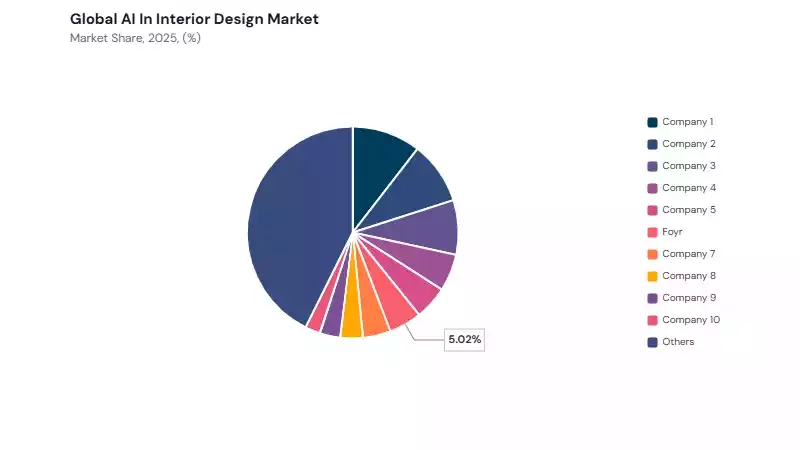
AI in interior design market represents innovation-led and competitive landscape, with Homestyler, Planner 5D, and Coohom. These market players are positioning themselves ahead in competition through automatic layouts, AI-assisted space planning, room visualization, and 3D design environments. Moreover, some market players are offering consumer-focused redesign tools, AI-native room visualization, AR features, and photo-based transformations, thereby creating lucrative growth opportunities.

Based on End-use, the market is segmented into Commercial and Residential. The Commercial market dominated the Global AI In Interior Design Market by End-use in 2025, and would continue to be a dominant market till 2033; thereby, achieving a market value of USD 8.3 billion by 2033, growing at a CAGR of 20 % during the forecast period. The Residential market is expected to witness a CAGR of 20.9% during (2026 - 2033).
Residential demand is supported by personalized home renovation, AI-assisted décor recommendations, virtual consultations, and affordable online design platforms. Homeowners are increasingly using AI tools to test room layouts, furniture placement, color combinations, and design styles before making physical investments. Growing use of generative AI, virtual staging, and mobile-based design applications is improving design accessibility and strengthening adoption across individual users and small renovation projects.
Based on Deployment, the market is segmented into Cloud and On-premises. The Cloud market dominated the Global AI In Interior Design Market by Deployment in 2025, and would continue to be a dominant market till 2033; thereby, achieving a market value of USD 10.1 billion by 2033, growing at a CAGR of 20.5 % during the forecast period. The On-premises market is expected to witness a CAGR of 20.2% during (2026 - 2033).
On-premises deployment continues to remain relevant among enterprises and design firms that prioritize data security, regulatory compliance, proprietary design protection, and integration with internal IT environments. This deployment model is especially important for high-value commercial projects, institutional clients, and organizations handling confidential design data. While cloud adoption is expanding, on-premises systems retain demand where control, customization, and privacy are central purchasing factors.
Based on Component, the market is segmented into Solution and Service. The Solution market dominated the Global AI In Interior Design Market by Component in 2025, and would continue to be a dominant market till 2033; thereby, achieving a market value of USD 8.5 billion by 2033, growing at a CAGR of 20.1 % during the forecast period. The Service market is expected to witness a CAGR of 20.8% during (2026 - 2033).
Service is gaining importance as interior design firms, real estate companies, furniture brands, and architecture studios require consulting, implementation, customization, training, integration, technical support, and maintenance. Services help users connect AI platforms with CAD, BIM, rendering software, project management tools, and customer workflows. As AI-generated interiors require professional validation for spatial accuracy and practical execution, service providers remain important adoption enablers.
Based on Application, the market is segmented into Digital Design & Visualization, Space Planning & Layout Optimization, 3D Rendering, AR/VR Walkthroughs, Design Decision Support, E-Design / Remote Design Services, and Other Applications. The Digital Design & Visualization market dominated the Global AI In Interior Design Market by Application in 2025, and would continue to be a dominant market till 2033; thereby, achieving a market value of USD 3.4 billion by 2033, growing at a CAGR of 18.3 % during the forecast period. The Space Planning & Layout Optimization market is expected to witness a CAGR of 20% during (2026 - 2033). Additionally, The 3D Rendering, AR/VR Walkthroughs market is expected to witness highest CAGR of 20.7% during (2026 - 2033).
Space Planning & Layout Optimization supports room layouts, furniture placement, circulation planning, and functional space utilization. 3D Rendering, AR/VR Walkthroughs improve immersive project visualization and reduce revisions before execution. Design Decision Support helps evaluate materials, budgets, sustainability factors, and customer preferences. E-Design / Remote Design Services supports virtual consultations and online design delivery, while Other Applications include sustainability analysis, smart home integration, material optimization, and predictive design functions.
Free Valuable Insights: AI In Interior Design Market Size to reach $14.8 Billion by 2033

Region-wise, the AI In Interior Design Market is analyzed across North America, Europe, Asia Pacific, and LAMEA.
The North America market is predicted to grow at the highest rate and dominate the market till 2033, with a market value of USD 5.4 billion by 2033, with a CAGR of 19.8%. The Europe market is anticipated to growth at a CAGR if 20.2% during the forecast period. Furthermore, APAC market is expected to gather significant market share, growing at a CAGR of 21%.
Europe market is driven by energy-efficient interior planning, sustainable building practices, regulatory focus, and adoption of AI-based visualization across professional design firms. APAC region is gaining traction because of rapid urbanization, expanding investment in AI-enabled design solutions, commercial & residential construction activity, and smart home adoption. LAMEA region is expanding rapidly through growing awareness of smart design technologies, increasing digitalization, and infrastructure growth.
| Report Attribute | Details |
|---|---|
| Market size value in 2026 | USD 4.0 billion |
| Market size forecast in 2033 | USD 14.8 billion |
| Base Year | 2025 |
| Historical Period | 2022 to 2024 |
| Forecast Period | 2026 to 2033 |
| Revenue Growth Rate | CAGR of 20.4% from 2026 to 2033 |
| Number of Pages | 617 |
| Tables | 720 |
| Report Coverage | Market Trends, Revenue Estimation and Forecast, Segmentation Analysis, Regional and Country Breakdown, Competitive Landscape, Market Share Analysis, Company Profiling, Companies Strategic Developments, SWOT Analysis, Product Life Cycle Analysis, Value Chain Analysis, Market Consolidation Analysis, Key Customer Criteria, Pandemic Impact Analysis, and Winning Imperatives |
| Segments Covered | End-use, Deployment, Component, Application, and Geography |
| Country Scope |
|
| Companies Included | Manycore Tech Inc. (Coohom); UAB Planner5D; Homestyler Co., Ltd.; Dassault Systèmes SE (HomeByMe); Houzz Inc. (Houzz Pro); Foyr; DecorMatters, Inc.; Styldod, Inc. (ReimagineHome); RoomGPT; Interior AI |
By End-use
By Deployment
By Component
By Application
By Geography
Expected to reach USD 14.8 billion by 2033, growing at 20.4% CAGR during 2026-2033.
The Commercial segment leads, projected to hit USD 8.3 billion by 2033.
Manycore Tech Inc., UAB Planner5D, Homestyler Co., Ltd., Dassault Systèmes SE, Houzz Inc., Foyr, DecorMatters, Inc., Styldod, Inc., RoomGPT, Interior AI.
Cloud deployment leads, expected to reach USD 10.1 billion by 2033.
North America leads, projected to achieve USD 5.4 billion by 2033.
Accelerated design innovation and enhanced customization through AI-driven automation and predictive analytics drive market growth.
Our team of dedicated experts can provide you with attractive expansion opportunities for your business.








 Unique Offerings