“Global 5G In Aviation Market to reach a market value of USD 21.51 Billion by 2032 growing at a CAGR of 30.8%”
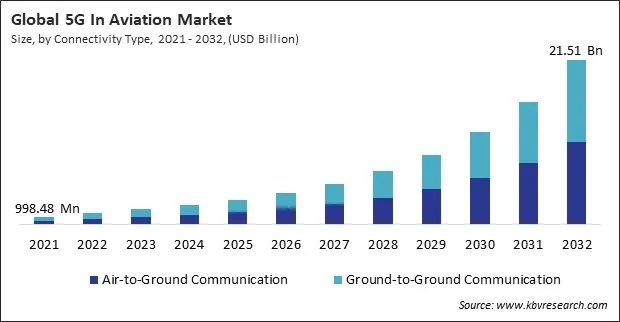
The Global 5G In Aviation Market size is expected to reach $21.51 billion by 2032, rising at a market growth of 30.8% CAGR during the forecast period.
Ultra-Reliable Low-Latency Communication (URLLC) is designed for mission-critical applications that require extremely low latency and near-instantaneous communication. In aviation, URLLC supports applications such as real-time flight control, automated aircraft landing systems, air traffic control coordination, and safety-critical operations. Its ability to provide consistent, delay-free connectivity is vital for improving operational safety and enabling advanced automation in both aircraft systems and airport infrastructure. Thus, the ultra-reliable low-latency communication (URLLC) segment garnered 26% revenue share in the market in 2024.
During the COVID-19 pandemic, the 5G in aviation market experienced considerable delays in infrastructure deployment. Travel restrictions, lockdowns, and workforce shortages significantly hindered the construction and installation of 5G infrastructure at airports and air traffic control centers. Many planned rollouts were postponed as governments and airport authorities redirected resources to manage the public health crisis rather than digital upgrades. The aviation industry's supply chain was heavily impacted during the pandemic. Thus, the COVID-19 pandemic had negative impact on the market.
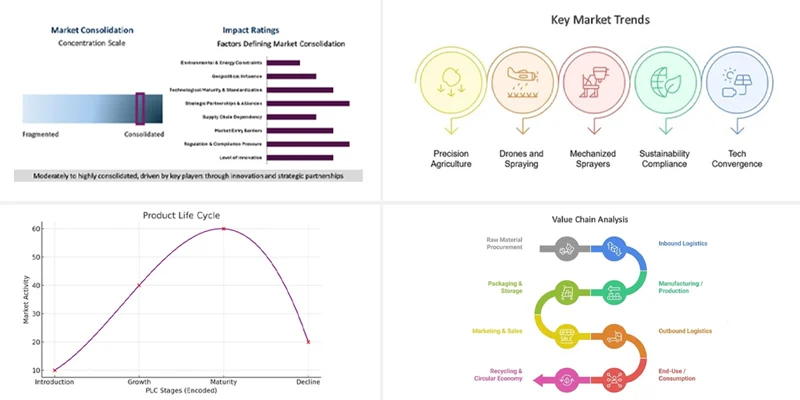

The aviation industry thrives on precision, safety, and the ability to make split-second decisions. Traditional communication networks, especially legacy satellite and 4G systems, struggle with the latency and bandwidth limitations required for today’s highly connected aircraft. The introduction of 5G, with its ultra-low latency (as low as 1 millisecond) and exceptionally high-speed data transmission, directly addresses this critical operational need. Additionally, air traffic management systems, especially with the rise of unmanned aircraft systems (UAS) and drones, demand quicker response cycles, which 5G can deliver far more effectively than existing networks.
Additionally, aircraft today are no longer standalone mechanical vehicles; they have transformed into flying digital platforms loaded with sensors, connected systems, and software-defined interfaces. This shift to "connected aircraft" is foundational to the aviation industry's digital transformation. With hundreds or even thousands of sensors embedded throughout an aircraft, continuous data collection, processing, and communication are crucial. However, managing this data explosion requires a communication network capable of high throughput, ultra-reliability, and minimal latency—qualities intrinsic to 5G.
However, one of the most significant restraints impacting the adoption of Integrated Vehicle Health Management (IVHM) systems is the high initial cost of deployment, coupled with the complexity of integration into existing vehicle platforms. Whether in commercial aviation, automotive, or defense sectors, the upfront investment required for IVHM implementation can be substantial. This includes costs associated with advanced sensors, embedded systems, data processing infrastructure, cloud and edge computing capabilities, and the development or acquisition of custom algorithms and software platforms. In conclusion, the high initial cost and multifaceted complexity of IVHM implementation remain key barriers to its widespread adoption, particularly in cost-sensitive or infrastructure-constrained sectors.
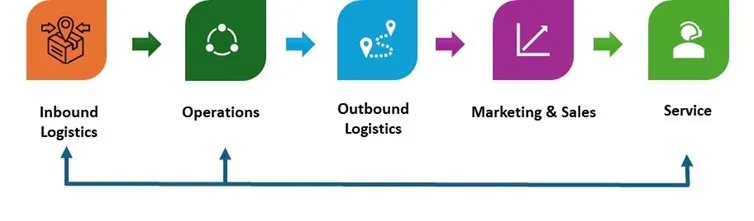
The value chain of the 5G in Aviation Market begins with Inbound Logistics, where airlines and airports procure 5G hardware like antennas, routers, and chips from telecom and equipment vendors. In the Operations phase, these components are integrated into systems to enable smart maintenance, autonomous ground operations, and real-time monitoring. Outbound Logistics involves delivering 5G-enabled services such as enhanced in-flight entertainment, seamless passenger connectivity, and cargo tracking. Marketing & Sales focuses on promoting the benefits of 5G—like high-speed, low-latency communication—to aviation stakeholders. Finally, the Service stage ensures ongoing support, system optimization, and network reliability post-deployment.
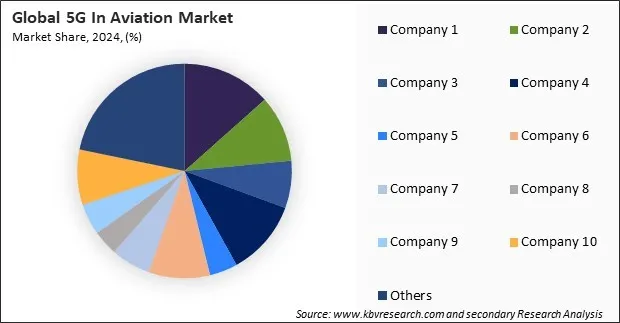
The leading players in the market are competing with diverse innovative offerings to remain competitive in the market. The above illustration shows the percentage of revenue shared by some of the leading companies in the market. The leading players of the market are adopting various strategies in order to cater demand coming from the different industries. The key developmental strategies in the market are Acquisitions, and Partnerships & Collaborations.
Based on connectivity type, the 5G in aviation market is characterized into air-to-ground communication and ground-to-ground communication. The ground-to-ground communication segment procured 48% revenue share in the 5G in aviation market in 2024. Ground-to-ground communication involves the use of 5G networks to facilitate data exchange between various ground-based entities within the aviation ecosystem. This includes communication between airports, air traffic control towers, maintenance facilities, and airline operations centers. The application of 5G in this segment enhances real-time coordination, improves airport logistics, enables remote diagnostics and predictive maintenance of aircraft, and supports automation and AI-driven operations.
| Category | Details |
|---|---|
| Use Case Title | Confidential |
| Date | 2025 |
| Entities Involved | Confidential |
| Objective | Streamline airport ground operations including baggage handling, aircraft refueling, and catering through ultra-reliable 5G ground connectivity and smart IoT devices. |
| Context and Background | Airport ramp areas are among the most dynamic and congested operational zones, involving multiple equipment types and personnel. Poor coordination in ground operations often leads to delays, safety hazards, and costly mismanagement. Conventional wireless systems lack the bandwidth, latency, and reliability required for seamless orchestration. 5G ground networks offer a transformative solution by enabling synchronized, data-driven decision-making for ground services. |
| Description | Delta Air Lines partnered with AT&T Business to deploy a private 5G network at its primary hub in Atlanta. The deployment empowered real-time coordination across ground support teams and equipment. Smart baggage carts and tugs were fitted with 5G telemetry modules, enabling constant tracking and status updates. Maintenance teams were equipped with AR headsets to receive real-time visual guidance and digital checklists. TSA operations integrated live-stream inspection tools that ensured compliance and reduced hold-ups. Gate areas were modeled as digital twins for predictive coordination of aircraft readiness. The solution not only accelerated turnaround but also enhanced overall ramp safety and visibility. |
| Key Capabilities Deployed |
|
| Regions Covered |
|
| Benefits |
|
| Source | Confidential |
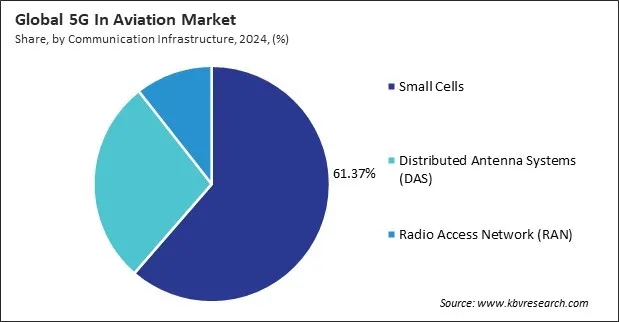
On the basis of communication infrastructure, the 5G in aviation market is classified into small cells, distributed antenna systems (DAS), and radio access network (RAN). The radio access network (RAN) segment held 11% revenue share in the 5G in aviation market in 2024. Radio Access Network (RAN) refers to the part of the telecommunications system that connects individual devices to the core network via radio connections. In the aviation industry, RAN infrastructure is essential for enabling the 5G network to handle vast amounts of data generated by aircraft systems, passenger devices, and airport operations.
By technology, the 5G in aviation market is divided into enhanced mobile broadband (eMBB), ultra-reliable low-latency communication (URLLC), and massive machine-type communication (mMTC). Massive machine-type communication (mMTC) segment held 15% revenue share in the market in 2024. Massive Machine-Type Communication (mMTC) facilitates the connection of many devices, sensors, and machines with minimal human intervention. In the aviation context, mMTC is instrumental in supporting the Internet of Things (IoT) ecosystem across airports and aircraft.
Based on end use, the 5G in aviation market is segmented into aircraft and airport. The aircraft segment procured 52% revenue share in the 5G in aviation market in 2024. The aircraft segment leverages 5G technology to enhance both onboard services and operational efficiency. High-speed connectivity enables improved in-flight entertainment, real-time communication, and live data streaming for passengers and crew.
Free Valuable Insights: Global 5G In Aviation Market size to reach USD 21.51 Billion by 2032
Region-wise, the 5G in aviation market is analyzed across North America, Europe, Asia Pacific, and LAMEA. The North America segment recorded 35% revenue share in the 5G in aviation market in 2024. North America represents a leading region in the adoption of 5G technology within the aviation sector, driven by significant investments in advanced infrastructure and a strong focus on innovation. The presence of major airlines, aircraft manufacturers, and technology companies has facilitated the rapid deployment of 5G for both airborne and ground-based applications.
| Report Attribute | Details |
|---|---|
| Market size value in 2024 | USD 2.59 Billion |
| Market size forecast in 2032 | USD 21.51 Billion |
| Base Year | 2024 |
| Historical Period | 2021 to 2023 |
| Forecast Period | 2025 to 2032 |
| Revenue Growth Rate | CAGR of 30.8% from 2025 to 2032 |
| Number of Pages | 377 |
| Number of Tables | 429 |
| Report coverage | Market Trends, Revenue Estimation and Forecast, Segmentation Analysis, Regional and Country Breakdown, Market Share Analysis, Porter’s 5 Forces Analysis, Company Profiling, Companies Strategic Developments, SWOT Analysis, Winning Imperatives |
| Segments covered | Connectivity Type, Communication Infrastructure, Technology, End Use, Region |
| Country scope |
|
| Companies Included | Huawei Technologies Co., Ltd. (Huawei Investment & Holding Co., Ltd.), Nokia Corporation, Cisco Systems, Inc., Honeywell International Inc., Thales Group S.A., Ericsson AB, Panasonic Holdings Corporation, NTT Data Corporation, OneWeb Holdings Ltd and Collins Aerospace (RTX Corporation) |
By Connectivity Type
By Communication Infrastructure
By Technology
By End Use
By Geography
This Market size is expected to reach $21.51 billion by 2032.
Demand for Real-Time Data Transmission and Low Latency Communication are driving the Market in coming years, however, High Initial Cost and Implementation Complexity Restrictions restraints the growth of the Market.
Huawei Technologies Co., Ltd. (Huawei Investment & Holding Co., Ltd.), Nokia Corporation, Cisco Systems, Inc., Honeywell International Inc., Thales Group S.A., Ericsson AB, Panasonic Holdings Corporation, NTT Data Corporation, OneWeb Holdings Ltd and Collins Aerospace (RTX Corporation)
The expected CAGR of this Market is 30.8% from 2023 to 2032.
The Enhanced Mobile Broadband (eMBB) segment is generating the maximum revenue share in the Market by Technology in 2024; thereby, achieving a market value of $12.55 billion by 2032.
The North America region dominated the Market by Region in 2024, and would continue to be a dominant market till 2032; thereby, achieving a market value of $7.30 billion by 2032.
Our team of dedicated experts can provide you with attractive expansion opportunities for your business.







 Unique Offerings