“Global Warehouse Management System Market to reach a market value of USD 10.70 Billion by 2032 growing at a CAGR of 19.3%”
The Global Warehouse Management Systems Market size is expected to reach USD 10.70 billion by 2032, rising at a market growth of 19.3% CAGR during the forecast period.
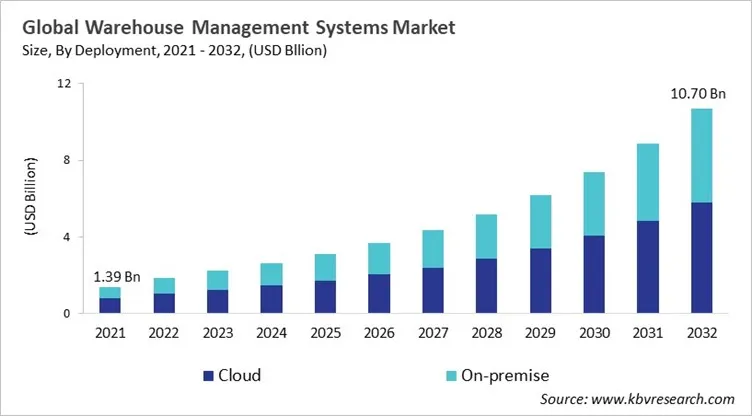
The warehouse management systems market has developed into advanced, cloud-connected platforms that play a crucial role in modern supply chains. Initially, WMS solutions emphasize basic inventory tracking, but the expansion of the e-commerce sector, increasing global trade, and government-supported logistics modernization supported the need for smarter, scalable systems. The advent of cloud computing and widespread digitalization allow real-time data exchange, multi-site deployments, and deeper integration with automation technologies like conveyors, robotics, and AR/RS. Industry 4.0 is reshaping the landscape of IoT, machine learning, and AI features that deliver automated decision-making, predictive insights, and seamless coordination between warehouse robotics and transformation networks.
The warehouse management systems market is estimated to grow steadily, driven by recent trends including sustainability, automation, and cloud-native architectures. Warehouse management systems platforms largely act as orchestration engines for robotic picking arms, high-density storage systems, and autonomous mobile robots, helping enterprises address increasing order volumes and labor shortages. Governments’ digital-trade initiatives propel demand for API-driven, scalable cloud systems that streamline data across supply chain partners and warehouses. Regulatory and sustainability compliance are becoming core drivers, with warehouse management systems tools offering optimized routing, energy monitoring, and ESG-focused analytics. The warehouse management systems market is intensively competitive as specialized vendors, enterprise software giants, developing cloud providers, and automation OEMs providers introduce AI-enabled, automation-ready WMS platforms developed for global operational demands, and diverse industries.
The COVID-19 pandemic slowed the Warehouse Management Systems market at first because lockdowns, worker shortages, and supply chain problems delayed both ongoing and planned deployments. There weren't enough scanners and other hardware, which caused long lead times and project backlogs that slowed down modernization efforts. Because of financial stress, small and medium-sized businesses put off investments and focused on keeping their operations running instead of upgrading their technology. Travel restrictions made it harder to integrate, train, and assess people on site, which hurt service delivery. Retail and manufacturing are two industries that saw a drop in demand. They put off spending on technology, which slowed down the adoption and transformation of new technologies in the early days of the pandemic. Thus, the COVID-19 pandemic had a negative impact on the market.

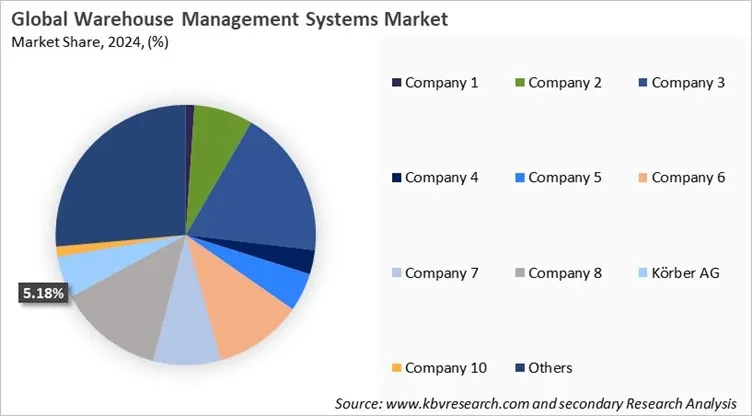
The leading players in the market are competing with diverse innovative offerings to remain competitive in the market. The above illustration shows the percentage of revenue shared by some of the leading companies in the market. The leading players of the market are adopting various strategies in order to cater demand coming from the different industries. The key developmental strategies in the market are Acquisitions, and Partnerships & Collaborations.
Based on deployment, the warehouse management systems market is characterized into cloud and on-premise. The on-premise segment attained 44% revenue share in the warehouse management systems market in 2024. The on-premise deployment segment in the warehouse management systems market maintains relevance among organizations that prioritize direct control over their data, system architecture, and security environment. Many businesses with highly customized workflows, strict regulatory requirements, or intensive integration needs with legacy hardware still prefer on-premise systems for their ability to provide deep configurability and dedicated infrastructure.
On the basis of function, the warehouse management systems market is classified into analytics & optimization, systems integration & maintenance, labor management system, consulting services, and billing & yard management. The systems integration & maintenance segment recorded 22% revenue share in the Warehouse Management Systems Market in 2024. The systems integration and maintenance function plays a pivotal role in ensuring that warehouse management platforms operate seamlessly within broader supply-chain ecosystems.
On the basis of component, the warehouse management systems market is segmented into services and software. The software segment gained 20% revenue share in the warehouse management systems market in 2024. The software component of the warehouse management systems market represents the core technological framework that enables organisations to manage warehouse activities including inventory tracking, order processing, picking, packing, labour allocation, and yard coordination. Modern WMS platforms are designed to offer real-time visibility, automated workflows, and data-driven decision support, enabling businesses to streamline operations and enhance productivity.

Free Valuable Insights: Warehouse Management System Market size to reach USD 10.70 Billion by 2032
Region-wise, the Warehouse Management Systems Market is analyzed across North America, Europe, Asia Pacific, and LAMEA. The North America segment recorded 34% revenue share in the Warehouse Management Systems Market in 2024. The warehouse management systems market is predicted to grow at a prominent rate in North America and Europe. The market is driven by 3PLs, large retailers, and grocers, encouraging omnichannel fulfilment, robotics and automation to reduce cycle times and labor costs. Operators modernize legacy DCs and add robotics, SaaS WMS deployments, and real-time inventory, which results in a warehouse management systems market in the region. Moreover, Europe represents steady expansion supported by the rapid adoption of automation, strict labour-optimization and sustainability priorities that result in increasing spending toward advanced warehouse management system, integration with warehouse automation and analytics platforms.
In the Asia Pacific and LAMEA regions, the warehouse management software market is anticipated to grow at a substantial rate. The expansion is supported by the large growth of e-commerce in India, Southeast Asia, and China, strong investment in logistics infrastructure, and a surge in 3PL capacity-which is propelling cloud WMS, mobile picking and regional customization of solutions. Additionally, the LAMEA warehouse management systems market is showcasing growth opportunities. Warehouse management systems adoption is rising as 3PLs and retailers modernize fulfilment, especially in large urban areas and Gulf logistics hubs, leading to market growth. Further, automation projects, the requirement of reducing manual errors, and increasing cross-border trade are some of the elements leading to growth.
| Report Attribute | Details |
|---|---|
| Market size value in 2025 | USD 3.10 Billion |
| Market size forecast in 2032 | USD 10.70 Billion |
| Base Year | 2024 |
| Historical Period | 2021 to 2023 |
| Forecast Period | 2025 to 2032 |
| Revenue Growth Rate | CAGR of 19.3% from 2025 to 2032 |
| Number of Pages | 583 |
| Number of Tables | 471 |
| Report coverage | Market Trends, Revenue Estimation and Forecast, Segmentation Analysis, Regional and Country Breakdown, Competitive Landscape, Market Share Analysis, Porter’s 5 Forces Analysis, Company Profiling, Companies Strategic Developments, SWOT Analysis, Winning Imperatives |
| Segments covered | Deployment, Function, Component, Application, Region |
| Country scope |
|
| Companies Included | Tecsys, Inc., Infor, Inc. (Koch Industries), Blue Yonder Group, Inc. (Panasonic Holdings Corporation), IBM Corporation, SAP SE, Oracle Corporation, Manhattan Associates, Inc., Softeon, Inc., Körber AG and PSI Global Logistics |
By Deployment
By Function
By Component
By Application
By Geography
This Market size is expected to reach USD 10.70 Billion by 2032.
The warehouse management system market is projected to grow at a CAGR of 19.3% between 2025 and 2032.
The expansion of global e-commerce and omnichannel fulfillment, alongside rising adoption of automation and robotics in warehousing, is fueling market growth.
Tecsys, Inc., Infor, Inc. (Koch Industries), Blue Yonder Group, Inc. (Panasonic Holdings Corporation), IBM Corporation, SAP SE, Oracle Corporation, Manhattan Associates, Inc., Softeon, Inc., Körber AG and PSI Global Logistics
The Services segment led the Global Warehouse Management Systems Market by Component in 2024; thereby, achieving a market value of $8.32 billion by 2032.
The North America region dominated the Global Warehouse Management Systems Market by Region in 2024, and would continue to be a dominant market till 2032; thereby, achieving a market value of $3.47 billion by 2032.
Our team of dedicated experts can provide you with attractive expansion opportunities for your business.












 Unique Offerings