“Global Transformerless UPS Market to reach a market value of USD 4.94 Billion by 2032 growing at a CAGR of 11.1%”
The Global Transformerless UPS Market size is expected to reach USD 4.94 billion by 2032, rising at a market growth of 11.1% CAGR during the forecast period.
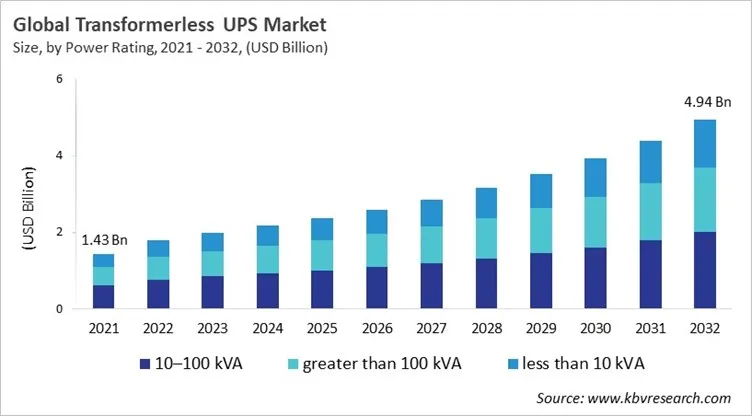
The development of UPS technology had progressed from transformer-based architectures to highly-efficient, compact transformerless systems, redefining the critical-power industry. Supported by the increasing power reliability demands across telecom, data centres, and industrial sectors, manufacturing like Eaton and ABB pioneered transformerless UPS designs that integrate advanced power electronics and wide-bandgap semiconductors to achieve lighter weight, higher efficiency, and smaller size. Transformerless UPS systems are now developed to serve multi-megawatt applications, replacing the need for transformer-based units. This shift represents broad market priorities, including optimizing energy efficiency, reducing overall ownership cost, and allowing high-density, modular infrastructure deployments.
The transformerless UPS market is predicted to be driven by the increasing energy-efficiency and sustainability pressures, rapid growth of data centres and edge computing, and a significant shift toward scalable and modular infrastructure. OEMs such as Eaton and Legrand are emphasizing on innovation-offering modular, compact systems with integrated battery management, hot-swappable components, and superior lifecycle support. Market strategies focus on segmentation across several industries, such as telecom, healthcare, and IT, alongside a strong service ecosystem emphasizing overall ownership cost and predictive maintenance. The transformerless UPS market seems to be competitive, with key players such as Legrand, ABB, and Eaton competing with regional manufacturers offering cost-efficient alternatives.
The transformerless UPS market was hit hard during the height of COVID-19 in 2020–2021 when factories in China, India, and Europe had to close, which led to shortages of important parts like IGBTs and lithium-ion modules. There was a 10–15% drop in global shipments because of delays in project installations across data centers, healthcare, and industries. These were caused by production stops, high shipping costs, and raw material shortages. Reduced capital expenditure and postponed automation projects further weakened demand, especially among SMEs. Travel restrictions made it hard to do maintenance and installation on site, and remote diagnostics didn't work well enough. Financial stress led to market consolidation as smaller firms existed or were acquired. Digital service models helped larger OEMs like Schneider Electric and Vertiv bounce back, but the crisis showed how weak the supply chain was, leading to a shift toward localized production and planning for resilience. Thus, the COVID-19 pandemic had a negative impact on the market.

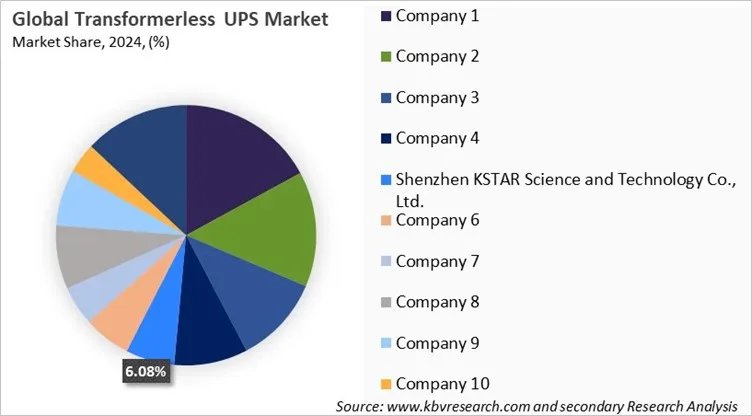
The leading players in the market are competing with diverse innovative offerings to remain competitive in the market. The above illustration shows the percentage of revenue shared by some of the leading companies in the market. The leading players of the market are adopting various strategies to cater demand coming from the different industries. The key developmental strategies in the market are Acquisitions, and Partnerships & Collaborations.
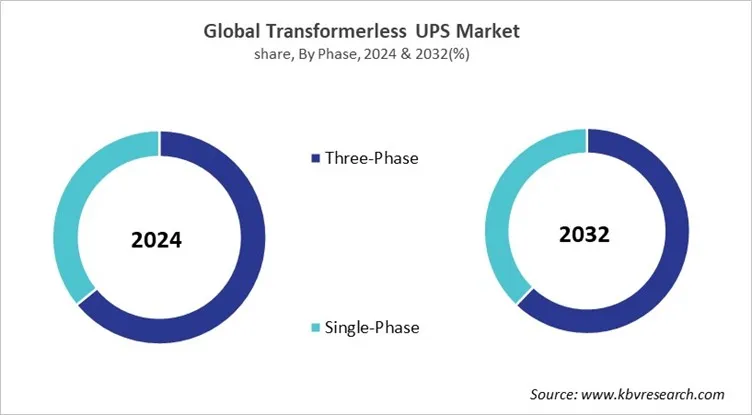
Based on phase, the Transformerless UPS Market is characterized into three-phase and single-phase. The single-phase segment attained 36% revenue share in the Transformerless UPS Market in 2024. The single-phase segment, on the other hand, focuses on providing uninterruptible power solutions for small- to medium-scale applications. These systems are typically used in residential, small business, and office environments where the power demand is moderate but consistent reliability is still essential. Single-phase UPS systems are valued for their compact design, ease of installation, and cost-effectiveness. They play a key role in ensuring power backup for sensitive equipment such as computers, communication devices, and small-scale automation systems.
On the basis of power rating, the Transformerless UPS Market is classified into 10–100 kVA, greater than 100 kVA, and less than 10 kVA. The greater than 100 kVA segment recorded 33% revenue share in the Transformerless UPS Market in 2024. The greater than 100 kVA segment encompasses high-capacity UPS systems engineered for large-scale industrial plants, hospitals, IT facilities, and other infrastructure-intensive sectors. These systems are built to handle heavy electrical loads and ensure uninterrupted power supply for operations that cannot afford downtime. Their robust design, superior power conversion efficiency, and advanced monitoring capabilities make them ideal for applications requiring continuous, high-quality power.
Free Valuable Insights: Transformerless UPS Market size to reach USD 4.94 Billion by 2032
Region-wise, the Transformerless UPS Market is analyzed across North America, Europe, Asia Pacific, and LAMEA. The Asia Pacific segment gained 43% revenue share in the Transformerless UPS Market in 2024. The transformerless UPS market is anticipated to experience ample growth in the North America and Europe regions. This expansion is backed by the rapid growth of hyperscale data centres, strict energy-efficiency mandates, and cloud infrastructure. Both North America and Europe are expected to have strong adoption of high-efficiency UPS systems as businesses emphasize reducing ownership cost and meeting sustainability goals under regulatory frameworks like the US Department of Energy standards and the EU Green Deal. Key market players such as Eaton, Schneider Electric, and ABB have well-established manufacturing and service presence, supporting mission-critical facilities in industries like healthcare, IT, and industrial automation. Moreover, the growth in these regions is characterized by strong demand driven by advanced product portfolios and lifecycle service offerings.
The Asia Pacific and LAMEA regions are witnessing significant growth in the transformerless UPS market. The expansion is supported by industrial expansion, rapid digitalization, and heavy investments in cloud, telecom, and edge infrastructure. Asia Pacific, dominated by Japan, India, China, and Southeast Asia-are experiencing strong growth because of the widespread data-centre construction, rising awareness of energy-efficient backup systems, and smart city initiatives. In addition to this, the LAMEA transformerless UPS market is accelerating due to the infrastructure reliability challenges and power quality issues, creating the demand for lightweight, modular, and cost-efficient UPS solutions. The manufacturers in the region are also expanding with competitive pricing, and global OEMs are strengthening collaborations and regional assembly to cater to diverse end-user demands. The Asia Pacific and LAMEA regions represent rapid expansion with surged demand backed by sustainability goals, infrastructure modernization, and the prevalence of digital-critical environments.
| Report Attribute | Details |
|---|---|
| Market size value in 2025 | USD 2.16 Billion |
| Market size forecast in 2032 | USD 4.94 Billion |
| Base Year | 2024 |
| Historical Period | 2021 to 2023 |
| Forecast Period | 2025 to 2032 |
| Revenue Growth Rate | CAGR of 11.1% from 2025 to 2032 |
| Number of Pages | 525 |
| Number of Tables | 461 |
| Report coverage | Market Trends, Revenue Estimation and Forecast, Segmentation Analysis, Regional and Country Breakdown, Market Share Analysis, Porter’s 5 Forces Analysis, Company Profiling, Companies Strategic Developments, SWOT Analysis, Winning Imperatives |
| Segments covered | Phase, Power Rating, Form Factor, End-use Industry, Region |
| Country scope |
|
| Companies Included | Schneider Electric SE, Eaton Corporation plc, Vertiv Group Corp., Huawei Technologies Co., Ltd. (Huawei Investment & Holding Co., Ltd.), Shenzhen KSTAR Science and Technology Co., Ltd., ABB Ltd., Legrand S.A. (Legrand Group), Delta Electronics, Inc., Mitsubishi Electric Corporation and General Electric Company |
By Phase
By Power Rating
By Form Factor
By End-use Industry
By Geography
The market size is projected to reach USD 4.94 billion by 2032.
The transformerless UPS market is projected to grow at a CAGR of 11.1% between 2025 and 2032.
Rapid expansion of digital infrastructure and data centres, coupled with the efficiency, space, and weight advantages of transformerless designs, is driving strong technology adoption.
Schneider Electric SE, Eaton Corporation plc, Vertiv Group Corp., Huawei Technologies Co., Ltd. (Huawei Investment & Holding Co., Ltd.), Shenzhen KSTAR Science and Technology Co., Ltd., ABB Ltd., Legrand S.A. (Legrand Group), Delta Electronics, Inc., Mitsubishi Electric Corporation and General Electric Company
The Tower segment is leading the Global Transformerless UPS Market by Form Factor in 2024; thereby, achieving a market value of $1.86 billion by 2032.
The Asia Pacific region dominated the Global Transformerless UPS Market by Region in 2024, and would continue to be a dominant market till 2032; thereby, achieving a market value of $2.18 billion by 2032.
Our team of dedicated experts can provide you with attractive expansion opportunities for your business.







 Unique Offerings