“Global Trailer Assist System Market to reach a market value of USD 220.58 Million by 2032 growing at a CAGR of 9.1%”
The Global Trailer Assist System Market size is expected to reach USD 220.58 million by 2032, rising at a market growth of 9.1% CAGR during the forecast period.
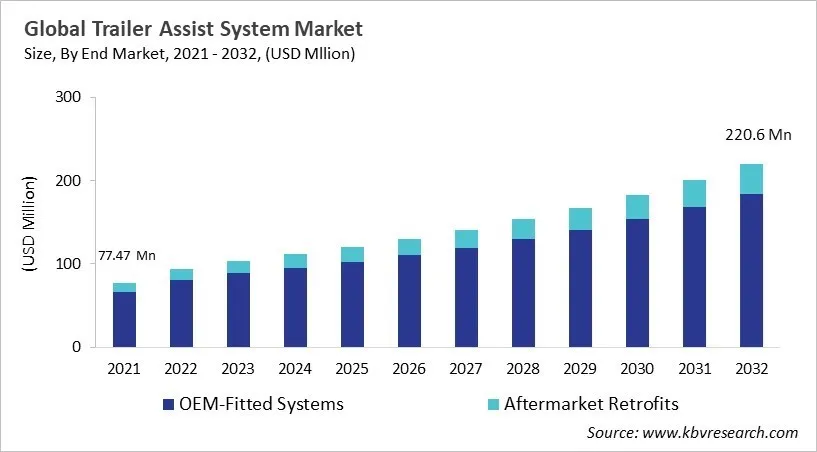
The global trailer assist systems market has evolved from a luxury accessory to a commonplace safety and convenience feature in pickups, SUVs and light commercial vehicles. These systems make parking and reversing with trailers easier by utilising sensors, cameras, radar, and steering modules. This lowers the risk of accidents and increases driver confidence. Stricter safety laws, an increase in the use of recreational and commercial trailers, and consumer demand for cutting-edge driver assistance are the main factors driving adoption. More advanced automation with real-time imaging and predictive algorithms, regulatory pressure for standardisation, and broader availability beyond premium models are some of the major trends.
Furthermore, leading OEMs like Ford, Land Rover, and Volkswagen, as well as technology providers with expertise in sensors and software, dominate the competition. Innovation, ecosystem integration, regulatory compliance, and consumer education are the main focusses of strategies. Partnerships speed up technology development, while adherence to changing safety regulations offers a significant advantage. Trailer assist will play a significant role in the industry's transition to automated mobility as smart trailer research and connected ecosystems suggest semi-autonomous towing in the future.
The COVID-19 pandemic had a negative impact on the trailer assist system market, disrupting supply chains, delaying production, and limiting product launches due to plant shutdowns and semiconductor shortages. Weakened consumer spending and reduced demand for SUVs, pickups, and commercial fleets further slowed adoption, while OEMs scaled back R&D and postponed technology upgrades. Industry events moving online also reduced visibility for new innovations. However, the market is now steadily recovering as automakers refocus on safety, convenience, and automation.

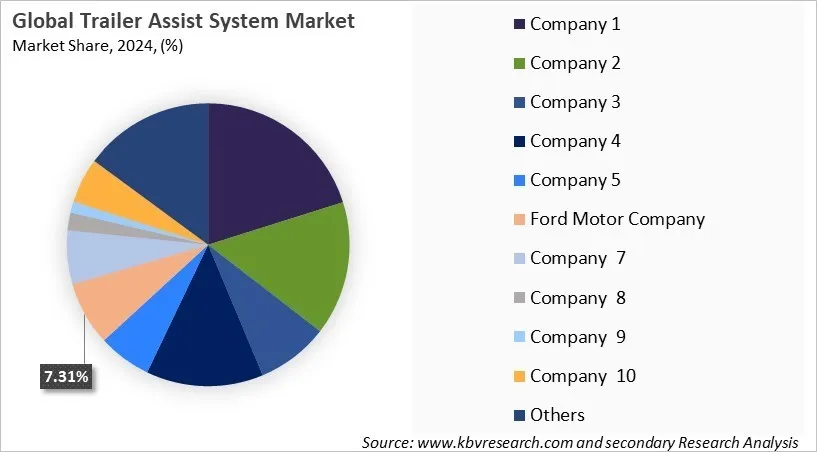
The leading players in the market are competing with diverse innovative offerings to remain competitive in the market. The above illustration shows the percentage of revenue shared by some of the leading companies in the market. The leading players of the market are adopting various strategies in order to cater demand coming from the different industries. The key developmental strategies in the market are Acquisitions, and Partnerships & Collaborations.
Based on End Market, the market is segmented into OEM-Fitted Systems, and Aftermarket Retrofits. The aftermarket retrofits segment recorded 15% revenue share in the market in 2024. This segment caters to vehicle owners who wish to add or upgrade trailer assist capabilities after purchase. It reflects a demand for flexibility and adaptability, giving consumers the opportunity to access advanced driving assistance without requiring a brand-new vehicle. These retrofit solutions appeal to users seeking customization and cost-effective upgrades, often providing essential features that improve towing safety and maneuverability.
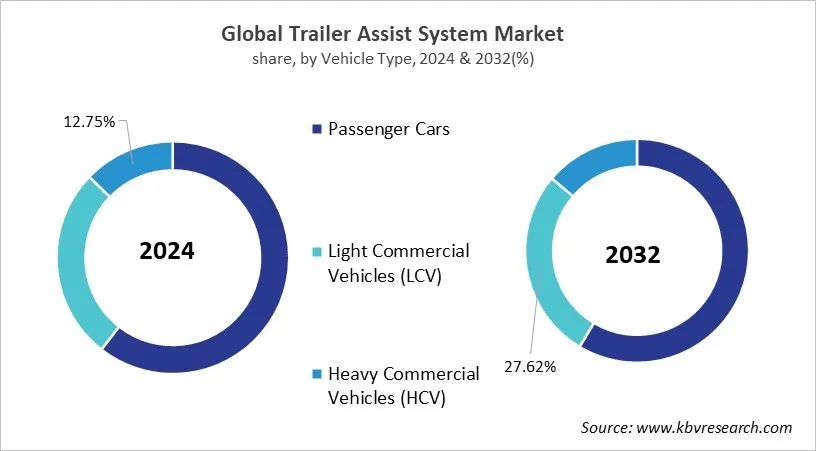
Based on Vehicle Type, the market is segmented into Passenger Cars, Light Commercial Vehicles (LCV), and Heavy Commercial Vehicles (HCV). The light commercial vehicles (LCV) segment recorded 27% revenue share in the market in 2024. This segment is supported by the rising utilization of LCVs for logistics, last-mile delivery, and small-scale transportation needs, where maneuverability and operational efficiency are critical. The incorporation of trailer assist technologies enhances ease of operation for drivers, particularly in urban and semi-urban areas where space constraints are common.
Free Valuable Insights: Global Trailer Assist System Market size to reach USD 220.58 Million by 2032
Region-wise, the trailer assist system market is analyzed across North America, Europe, Asia Pacific, and LAMEA. The North America segment recorded 37% revenue share in the market in 2024. Strong consumer demand, high trailer usage, and stringent safety regulations are all contributing to the rapid expansion of the trailer assist system market in NorthAmerica and Europe. Trailer assist is widely used in pickups, SUVs, and RVs in North America, primarily in the United States and Canada. OEMs such as Ford and GM have integrated it as a standard safety and convenience feature. Trailer assist is now a part of ADAS compliance in Europe due to strict frameworks like the EU General Safety Regulation, which is speeding up adoption. With cutting-edge systems that use cameras, sensors, and predictive algorithms, automakers like Volkswagen, Audi, and Land Rover are at the forefront. Together, these regions are transforming trailer assist from a premium add-on into a mainstream, regulated requirement.
Furthermore, growth in recreational towing, expanding logistics, and changing regulations are the main drivers of adoption in Asia-Pacific and LAMEA, though at different rates. Both mass-market and premium solutions are in high demand in Asia-Pacific markets like China, India, Japan, and Australia. OEMs are concentrating on scalable and affordable systems that strike a balance between compliance and convenience. While adoption is still in its infancy, it is picking up steam in Latin America, where commercial trailers are commonly utilised, and the Middle East, where SUVs and pickups predominate. Growth in these areas is being shaped by factors like affordability, fleet adaptability, and compliance with new safety regulations, which establish caravan assist as a useful and safety-improving feature.
| Report Attribute | Details |
|---|---|
| Market size value in 2025 | USD 120.16 Million |
| Market size forecast in 2032 | USD 220.58 Million |
| Base Year | 2024 |
| Historical Period | 2021 to 2023 |
| Forecast Period | 2025 to 2032 |
| Revenue Growth Rate | CAGR of 9.1% from 2025 to 2032 |
| Number of Pages | 528 |
| Number of Tables | 421 |
| Report coverage | Market Trends, Revenue Estimation and Forecast, Segmentation Analysis, Regional and Country Breakdown, Market Share Analysis, Porter’s 5 Forces Analysis, Company Profiling, Companies Strategic Developments, SWOT Analysis, Winning Imperatives |
| Segments covered | End Market, Technology Level, Vehicle Type, Component, Region |
| Country scope |
|
| Companies Included | Robert Bosch GmbH, Continental AG, Magna International, Inc., ZF Friedrichshafen AG, Valeo SA, Ford Motor Company, Volkswagen AG, Garmin Ltd., Westfalia Technologies, Inc., and General Motors Co. |
By End Market
By Technology Level
By Vehicle Type
By Component
By Geography
The market size is projected to reach USD 220.58 Billion billion by 2032.
The trailer assist system market is projected to grow at a CAGR of 9.1% between 2025 and 2032.
Rising focus on road safety and accident prevention coupled with the growth of e-commerce, logistics, and commercial transportation.
Robert Bosch GmbH, Continental AG, Magna International, Inc., ZF Friedrichshafen AG, Valeo SA, Ford Motor Company, Volkswagen AG, Garmin Ltd., Westfalia Technologies, Inc., and General Motors Co.
The Passenger Cars segment led the maximum revenue in the Global Trailer Assist System Market by Vehicle Type in 2024, thereby, achieving a market value of USD 129.2 million by 2032.
The North America region dominated the Global Trailer Assist System Market by Region in 2024, thereby, achieving a market value of USD 79.4 million by 2032.
Our team of dedicated experts can provide you with attractive expansion opportunities for your business.








 Unique Offerings