“Global Three Phase Sectionalizer Market to reach a market value of USD 1.59 Billion by 2032 growing at a CAGR of 5.8%”
The Global Three Phase Sectionalizer Market size is expected to reach $1.59 billion by 2032, rising at a market growth of 5.8% CAGR during the forecast period.
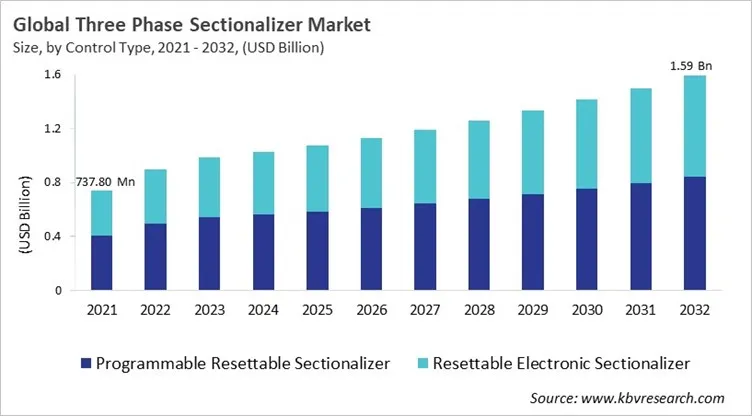
The three-phase sectionalizer market has transformed from regular mechanical devices to advanced, smart systems that incorporate flawlessly into modern smart grids. Originally requiring manual resets and fewer capabilities, now automation, real-time monitoring, and SCADA/ADMS are driving these devices. They play an important role in the continuous service, fault isolation, and accommodating scattered energy resources. Public initiatives in Europe, the U.S., and the Asia Pacific with large-scale electrification plans have increased adoption, with OEMs such as Eaton, ABB, and Schneider Electric giving modular, rugged, and programmable solutions. The rising need for quick outage response, grid power, and adaptability to renewable energy integration is managed by these innovations.
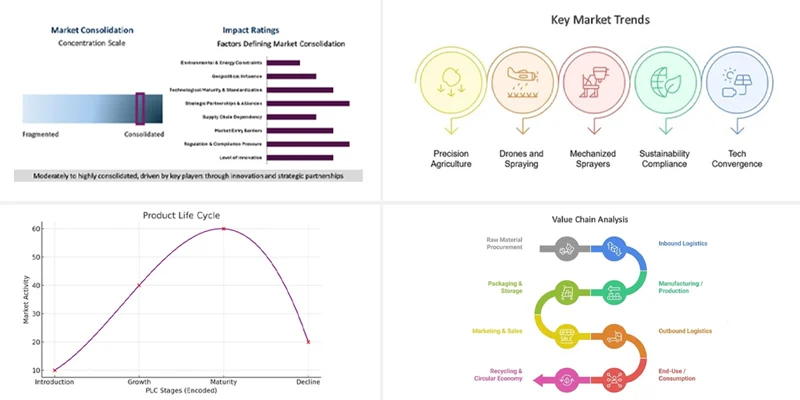
Major market trends are the rising use in smart grid automation plans, particularly in regions going through swift electrification, the rising need for cost-effective yet smart devices in developing regions, and the increasing focus on grid stability against climate events, aging infrastructure, and cyberattacks. OEMs are emphasising tailored design, ease of deployment, and collaboration with smart control systems. Major companies like Eaton, ABB, NOJA Power, Schneider Electric, and G&W Electric lead the market with competitive strategies that include localized manufacturing, utility partnerships, and full post-installation services. Utilities are starting to use IoT-enabled diagnostics and predictive maintenance. To stay ahead of the competition, companies need to be innovative, ready for digital technology, and able to provide lifecycle value in a variety of settings.
The COVID-19 pandemic hurt the global three-phase sectionalizer market, especially in 2020 and 2021, when production and installation were delayed because of problems with the supply chain, factory closures, and shortages of raw materials. Utilities and governments shifted money away from grid modernization and electrification projects in favor of healthcare and emergency needs. This was especially true in developing areas. The economic slowdown made private sector investments even lower, and restrictions on field operations and a lack of workers slowed down maintenance and commissioning activities. As a result, the market stopped growing because utilities were more concerned with keeping the grid reliable than with expanding or upgrading distribution networks.

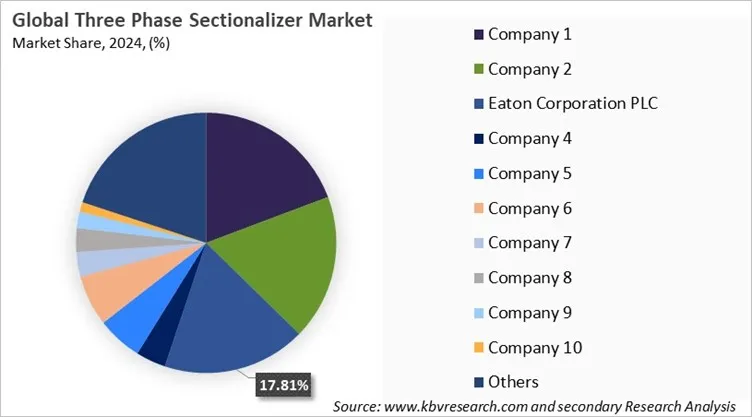
The leading players in the market are competing with diverse innovative offerings to remain competitive in the market. The above illustration shows the percentage of revenue shared by some of the leading companies in the market. The leading players of the market are adopting various strategies in order to cater demand coming from the different industries. The key developmental strategies in the market are Acquisitions, and Partnerships & Collaborations.
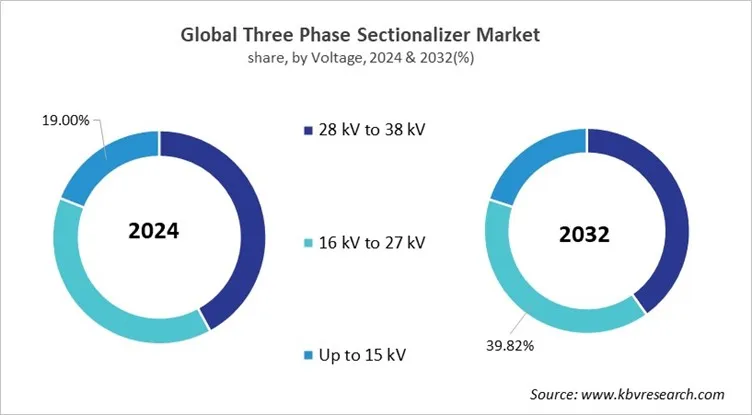
On the basis of voltage, the three phase sectionalizer market is classified into 28 kv to 38 kv, 16 kv to 27 kv, and up to 15 kv. The 28 kv to 38 kv segment acquired 42% revenue share in the three phase sectionalizer market in 2024. This range is widely used in industrial and high-capacity utility grids because it can support reliable fault isolation in environments with a lot of load. Its use in suburban distribution networks and rural electrification projects also increased demand, making it a key area for improving the resilience and safety of electrical infrastructure in both developed and developing countries.
Based on end-use, the three phase sectionalizer market is characterized as industrial, commercial, and residential. The industrial segment acquired 41% revenue share in the three phase sectionalizer market in 2024. Because there is a high demand for continuous power supply in heavy manufacturing plants, mining operations, and large-scale processing plants, this segment is very important to the market. To find and fix problems and make operations more reliable, sectionalizers are used a lot in industrial grids. Their use helps with automation, cuts down on downtime, and protects sensitive machinery from power outages, which makes industrial infrastructure more efficient and lowers maintenance costs.
Free Valuable Insights: Global Three Phase Sectionalizer Market size to reach USD 1.59 Billion by 2032
Region-wise, the three phase sectionalizer market is analyzed across North America, Europe, Asia Pacific, and LAMEA. The Asia Pacific segment recorded 37% revenue share in the three phase sectionalizer market in 2024. Strong efforts to modernize smart grids in North America, especially in the U.S. and Canada, are good for the three-phase sectionalizer market. Utilities are using SCADA-integrated, remotely operable devices to improve their response to outages and meet strict reliability goals. The U.S. Department of Energy funds these efforts. The EU's goals for integrating renewable energy and digitalizing the grid are driving growth in Europe. Advanced, climate-resistant sectionalizers are being used to handle dense urban networks and complicated feeder automation needs.
In Asia Pacific, rapid industrialization, urbanization, and rural electrification programs—especially in China and India—are driving up the need for smart, low-cost devices that work well in a variety of climates. Brazil, Saudi Arabia, and South Africa are all part of the LAMEA markets. These markets are focusing on modernizing and strengthening the grid, and they prefer sectionalizers made in the region that are suited to local regulatory and environmental conditions.
| Report Attribute | Details |
|---|---|
| Market size value in 2024 | USD 1.02 Billion |
| Market size forecast in 2032 | USD 1.59 Billion |
| Base Year | 2024 |
| Historical Period | 2021 to 2023 |
| Forecast Period | 2025 to 2032 |
| Revenue Growth Rate | CAGR of 5.8% from 2025 to 2032 |
| Number of Pages | 564 |
| Number of Tables | 511 |
| Report coverage | Market Trends, Revenue Estimation and Forecast, Segmentation Analysis, Regional and Country Breakdown, Market Share Analysis, Porter’s 5 Forces Analysis, Company Profiling, Companies Strategic Developments, SWOT Analysis, Winning Imperatives |
| Segments covered | Control Type, Voltage, Location, End-use, Region |
| Country scope |
|
| Companies Included | ABB Ltd., S&C Electric Company, Eaton Corporation plc, Hubbell Incorporated, Schneider Electric SE, G&W Electric, Siemens AG, General Electric Company, NOJA Power Switchgear Pty. Ltd. and Mitsubishi Electric Corporation |
By Control Type
By Voltage
By Location
By End-use
By Application
By Geography
This Market size is expected to reach $ 1.59 Billion by 2032.
Rising Demand for Grid Reliability and Fault Isolation in Expanding Power Networks are driving the Market in coming years, however, High Initial Installation and Equipment Cost restraints the growth of the Market.
ABB Ltd., S&C Electric Company, Eaton Corporation plc, Hubbell Incorporated, Schneider Electric SE, G&W Electric, Siemens AG, General Electric Company, NOJA Power Switchgear Pty. Ltd. and Mitsubishi Electric Corporation
The expected CAGR of this Market is 5.8% from 2023 to 2032.
The Programmable Resettable Sectionalizer segment is leading the Market by Control Type in 2024; thereby, achieving a market value of $841.1 million by 2032.
The Asia Pacific region dominated the Market by Region in 2024, and would continue to be a dominant market till 2032; thereby, achieving a market value of $608.6 million by 2032.
Our team of dedicated experts can provide you with attractive expansion opportunities for your business.







 Unique Offerings