“Global Teleneurology Market to reach a market value of USD 13.51 Billion by 2032 growing at a CAGR of 11.2%”
The Global Teleneurology Market size is expected to reach $13.51 billion by 2032, rising at a market growth of 11.2% CAGR during the forecast period.
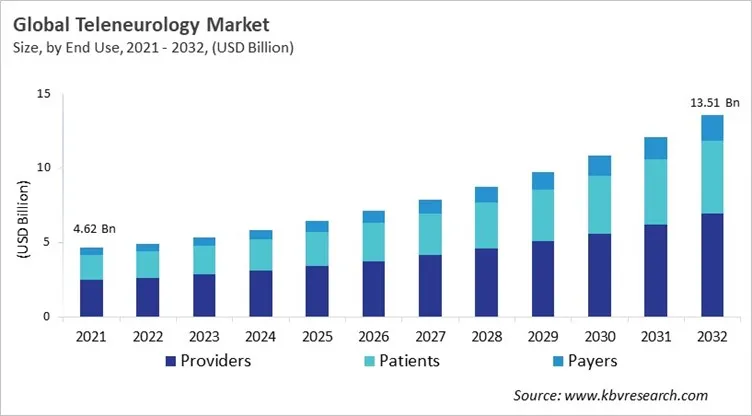
The teleneurology market has transformed from its beginning in late-20th-century initial virtual care trials to an important part of neurological care. Firstly, it was focused on swift stroke consultations, now it has extended to manage conditions such as Parkinson’s disease, epilepsy, multiple sclerosis, and migraine. Governmental health plans, regulatory support, and the COVID-19 pandemic-induced adoption have sped up its incorporation into routine care. Advancements in internet technology, wearable neuro-monitoring devices, AI-powered diagnostics, and cloud-based EMR access have enabled teleneurology to expand specialist care to rural and underserved communities globally, helping to bridge the neurologist shortage and meet the growing burden of neurological diseases.
Key trends are the use of AI for real-time diagnosis and predictive monitoring, the growth of neurology-specific mHealth apps for tracking symptoms, and cross-border teleconsultations made possible by national telemedicine portals. Global healthcare companies, nimble startups, and government programs all affect competition in the market. Philips Healthcare, GE HealthCare, and Medtronic are adding teleneurology to bigger digital health platforms—hospitals like the Mayo Clinic work with tech companies to expand their services. Strategic partnerships, specialized training programs, and new ideas that focus on a specific area, like pediatric neurology or neurorehabilitation, are all helping to set the sector apart. This makes it very competitive and full of chances for growth.
The COVID-19 pandemic accelerated the adoption of teleneurology by shifting neurological care from in-person consultations to virtual platforms, addressing challenges posed by restricted hospital visits and strained resources. It enabled continued management of conditions like stroke, epilepsy, and Parkinson’s disease through video consultations, remote monitoring, and AI-assisted diagnostics, particularly benefiting rural and underserved areas. Emergency departments leveraged virtual stroke assessments to improve treatment efficiency while reducing infection risks. Collaborative efforts among healthcare providers, technology firms, and regulators, supported by temporary policy relaxations and expanded reimbursements, fueled rapid integration. However, infrastructure limitations and digital literacy gaps hindered uniform adoption, especially in developing regions. Overall, the pandemic established a strong foundation for teleneurology’s long-term growth and integration into healthcare systems.

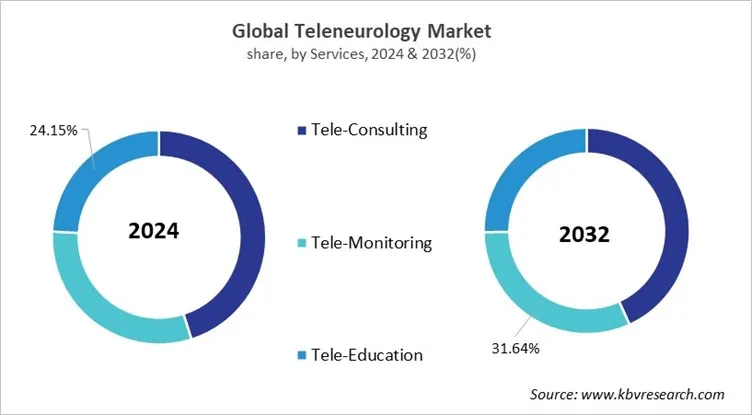
Based on service, the global teleneurology market is segmented into teleconsulting, tele-monitoring, and tele-education. The teleconsulting segment garnered the 45.1% revenue share in the market in 2024. It allows patients to consult neurologists remotely through video conferencing or digital platforms, reducing the need for physical travel and enabling faster diagnosis and treatment planning. This service is particularly effective in rural and underserved areas, where access to specialized neurological care is limited. Hospitals, clinics, and standalone neurologists are increasingly integrating tele-consultation platforms into their systems to streamline workflows, improve patient engagement, and extend their service reach.
By application, the global teleneurology market is divided into Stroke, Parkinson, Epilipesy, Headache, Multiple sclerosis, Dementia, and Other Application. The stroke segment witnessed the 27.2% revenue share in the market in 2024. Teleneurology enables timely intervention through remote consultations, especially in rural or underserved areas lacking access to neurologists. Hospitals are increasingly utilizing telestroke programs to facilitate quicker decision-making and improve outcomes for patients experiencing acute strokes.
Free Valuable Insights: Global Teleneurology Market size to reach USD 13.51 Billion by 2032
Based on the Region, the market is segmented into North America, Europe, Asia Pacific, and LAMEA. North America leads with a 34.80% share in 2024. North America is the leader in the global teleneurology market because of its advanced healthcare systems, strong broadband connections, and policies that help pay for teleneurology services in the U.S. and Canada. High rates of neurological diseases, early use of AI-based diagnostics, and big programs like the National Teleneurology Program from the U.S. Department of Veterans Affairs have all helped the market grow. Major hospital networks like the Mayo Clinic and Cleveland Clinic, as well as tech-healthcare partnerships, are still making it easier for specialists to see patients, especially in rural areas.
Europe, Asia Pacific, and LAMEA have significant growth potential. Germany, the U.K., and France are the most advanced countries in adopting cross-border teleconsultation, which is good for Europe's strong public healthcare and regulatory support. The Asia Pacific region is growing the fastest because more people are getting access to the internet, the government in China and India is supporting telemedicine, and more money is being put into neuro-monitoring tools. Adoption of LAMEA is starting to happen, with Brazil, the UAE, and South Africa moving forward with pilot projects and mobile health solutions. Even though there are still gaps in infrastructure, more connectivity and global partnerships are expected to speed up adoption.
| Report Attribute | Details |
|---|---|
| Market size value in 2024 | USD 5.84 Billion |
| Market size forecast in 2032 | USD 13.51 Billion |
| Base Year | 2024 |
| Historical Period | 2021 to 2023 |
| Forecast Period | 2025 to 2032 |
| Revenue Growth Rate | CAGR of 11.2% from 2025 to 2032 |
| Number of Pages | 380 |
| Number of Tables | 391 |
| Report coverage | Market Trends, Revenue Estimation and Forecast, Segmentation Analysis, Regional and Country Breakdown, Porter’s 5 Forces Analysis, Company Profiling, Companies Strategic Developments, SWOT Analysis, Winning Imperatives |
| Segments covered | Service, End Use, Application, Region |
| Country scope |
|
| Companies Included | Teladoc Health, Inc., American Well Corporation (Amwell), MDLive, Inc., Blue Sky Telehealth (CarePoint, P.C.), Siemens Healthineers AG (Siemens AG), Access TeleCare Holdings, Inc., Sevaro Health, Inc., GlobalMed Holdings, LLC (GlobalMed), Lakewood Health System, and TeleSpecialists |
By Service
By End Use
By Application
By Geography
This Market size is expected to reach $13.51 Billion by 2032.
Growing Burden of Neurological Disorders Worldwide are driving the Market in coming years, however, Regulatory and Reimbursement Challenges restraints the growth of the Market.
Teladoc Health, Inc., American Well Corporation (Amwell), MDLive, Inc., Blue Sky Telehealth (CarePoint, P.C.), Siemens Healthineers AG (Siemens AG), Access TeleCare Holdings, Inc., Sevaro Health, Inc., GlobalMed Holdings, LLC (GlobalMed), Lakewood Health System, and TeleSpecialists
The expected CAGR of this Market is 11.2% from 2023 to 2032.
The Providers market dominated the Market by End Use in 2024; thereby, achieving a market value of $6.9 billion by 2032.
The North America region dominated the Market by Region in 2024, and would continue to be a dominant market till 2032; thereby, achieving a market value of $4.50 billion by 2032.
Our team of dedicated experts can provide you with attractive expansion opportunities for your business.












 Unique Offerings