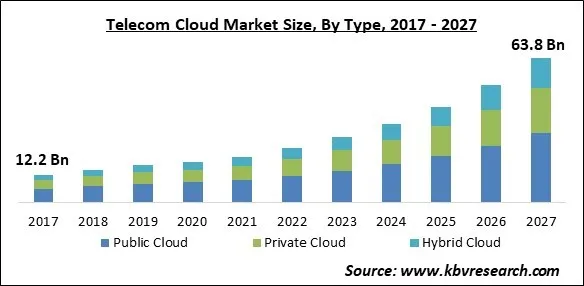
The Global Telecom Cloud Market size is expected to reach $63.8 billion by 2027, rising at a market growth of 21.1% CAGR during the forecast period.
The term telecom cloud refers to the telecommunications industry's transition from traditional landline services to modern cloud computing solutions. Companies can take advantage of networking resources more efficiently due to their shift to cloud computing. The telecom cloud market will benefit industries by allowing them to use cloud computing for information technology optimization.
Mobile networking hardware manufacturers, such as 5G equipment makers, and mobile telephony software development businesses can bundle their products with the cloud data center orchestration capabilities and sell them to CSPs in regional markets throughout the world as full solutions.
When combined with infrastructure-as-code methodologies, the level of operational standardization enabled by NFV and the inherent benefits of virtualization provide a tried and proven method for TSPs to deploy new technologies across all regions of service according to the demands of scale while saving money on data center networking costs. International vendors can bundle their product with the data center orchestration software as a full solution, which can then be trained by integrators or telecom personnel for use as mobile telephony.
The COVID-19 pandemic has impacted various segments of the business domain. Due to the imposition of various regulations across the globe like complete lockdown, ban on import & exports and temporary ban on manufacturing units, many companies have witnessed a decline in their sales and revenue. In addition, this pandemic has compelled companies to shift to cloud-based solutions to overcome various challenges.
In many regions of the world, adoption of next-generation communication technologies such as 5G network deployments has accelerated, and service automation has become a top priority. According to research published by Nokia, more than 64% of communication service providers are focusing on boosting the automation of operational services using cloud technology. Owing to these features and rapid pace of digitalization, the demand for telecom cloud would witness a surge in the coming years.
Telecom cloud solutions and services enable telecom operators and communication service providers to rapidly scale up when demand is high and scale down when demand is low, allowing for faster deployment and scalability of services. Scaling up and down with these modern telecom cloud platforms is substantially faster and less expensive than with legacy on-premises telephony systems. This would enable telecom operators and communication service providers to strike a more effective balance between their services and cost management, which would lead to a far more flexible business model.
The transition to the cloud for many telecom companies has been made easy by the digital transformation and the workflows for the new business. Cloud technologies are being adopted by businesses in order to get a competitive advantage and differentiate themselves in the market. In the future, investment on cloud infrastructure and business intelligence (BI) is likely to rise.
The digital era has seen a buzzing technology called the cloud, but the cloud develops some serious concerns. The risk of data loss is always there when users do not have the information saved in their private systems. This risk of data loss exists when the data is unintentionally deleted by the user, thinking that it would be saved somewhere else or when the system gets corrupted. Overwriting of data is also one of the serious concerns of the clients.
On the basis of type, the telecom cloud market is segmented into public cloud, private cloud, and hybrid cloud. The private cloud segment procured a substantial revenue share in the telecom cloud market in 2020. Rapid technical advancements have fueled the growth of the private cloud segment. The rise of internet-based services and applications, such as social media, video streaming, and online payments, has raised the demand for secure data storage. Similarly, the growing volume of data in industries like BFSI, IT & telecom, healthcare, government, retail, and others has prompted these industries to utilize private cloud services.
By application, the telecom cloud market is divided into Enterprise Application, Data Storage, Computing, Archiving and others. The enterprise application segment acquired the maximum revenue share in the telecom cloud market in 2020. Enterprise application software is a collection of programs that share business applications and organizational modelling tools to provide unrivalled functionality. Any computer-based information system would be incomplete without EA software. Through business level support functionality, EA software eventually improves efficiency and productivity.
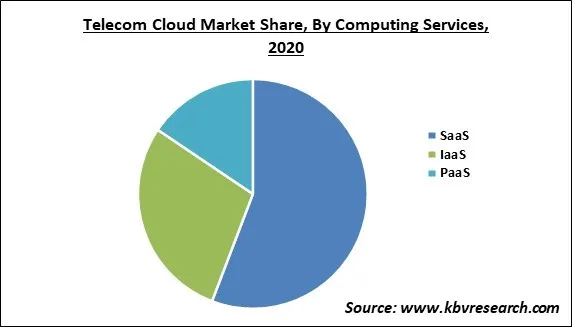
Based on the computing services, the telecom cloud market is fragmented into SaaS, PaaS and IaaS. The SaaS segment dominated the telecom cloud segment with the largest revenue share in 2020. Network maintenance, network device monitoring, monthly status reporting, upgrade/patching deployment, and user management are all examples of these services, which would attract more customers in the forecast years.
On the basis of services type, the telecom cloud market is bifurcated into Network & Management Services and Colocation Services. The network & management services segment witnessed the highest revenue share in the telecom cloud market in 2020. This growth is attributed to the various services provided under this segment including network maintenance, monitoring of attached network devices, monthly status reporting, upgrade/patching deployment, and user management.
By organization size, the telecom cloud market is segregated into small & medium sized enterprises and large enterprises. The small & medium sized enterprises segment acquired a significant revenue share in the telecom cloud market in 2020. It is due to the fact that these telecom cloud services are cost effective and are easy to deploy, which makes it convenient for SMEs to operate in the competitive world.
Based on vertical, the telecom cloud market is divided into BFSI, retail & consumer goods, healthcare, manufacturing, media & entertainment and others. The BFSI sector dominated the telecom cloud market with the largest revenue share in 2020. The banking, financial services, and insurance industry has begun outsourcing non-core tasks in order to decrease costs. Banks benefit from outsourcing since it allows them to save expenses and increase efficiency. As a result, channelized content insights and precise banking information are required, which can be unified via a telecom cloud solution.
| Report Attribute | Details |
|---|---|
| Market size value in 2020 | USD 17.9 Billion |
| Market size forecast in 2027 | USD 63.8 Billion |
| Base Year | 2020 |
| Historical Period | 2017 to 2019 |
| Forecast Period | 2021 to 2027 |
| Revenue Growth Rate | CAGR of 21.1% from 2021 to 2027 |
| Number of Pages | 370 |
| Number of Tables | 654 |
| Report coverage | Market Trends, Revenue Estimation and Forecast, Segmentation Analysis, Regional and Country Breakdown, Competitive Landscape, Companies Strategic Developments, Company Profiling |
| Segments covered | Type, Application, Computing Services, Services Type, Organization Size, Vertical, Region |
| Country scope | US, Canada, Mexico, Germany, UK, France, Russia, Spain, Italy, China, Japan, India, South Korea, Singapore, Malaysia, Brazil, Argentina, UAE, Saudi Arabia, South Africa, Nigeria |
| Growth Drivers |
|
| Restraints |
|
Region-wise, the telecom cloud market is analyzed across North America, Europe, Asia Pacific and LAMEA. North America emerged as the leading region in telecom cloud market with the maximum revenue share in 2020 and is anticipated to continue this trend over the forecast period. This growth is attributed to the fact that large companies with technically skilled staff have a significant presence across this region, which would provide constant revolutionary technology.
Free Valuable Insights: Global Telecom Cloud Market size to reach USD 63.8 Billion by 2027
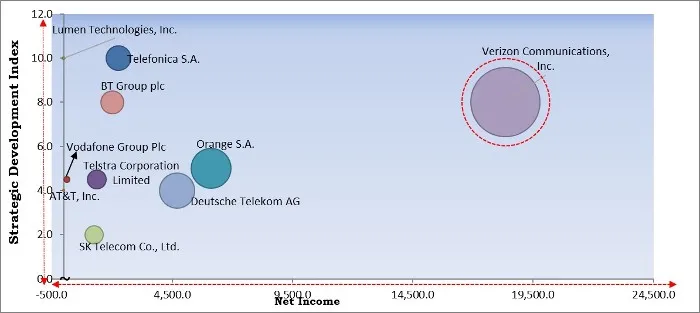
The major strategies followed by the market participants are Partnerships. Based on the Analysis presented in the Cardinal matrix; Verizon Communications, Inc. is the major forerunner in the Telecom Cloud Market. Companies such as Orange S.A., Deutsche Telekom AG, Telefonica S.A. are some of the key innovators in the Market.
The market research report covers the analysis of key stake holders of the market. Key companies profiled in the report include Telstra Corporation, Orange S.A. (Orange Business Services), Telefonica S.A., Vodafone Group Plc, Deutsche Telekom AG, AT&T, Inc. (AT&T Intellectual Property), Verizon Communications, Inc., BT Group plc, Lumen Technologies, Inc., and SK Telecom Co., Ltd.
By Type
By Application
By Computing Services
By Services Type
By Organization Size
By Vertical
By Geography

The telecom cloud market size is projected to reach USD 63.8 billion by 2027.
Quick deployment and scalability of services are driving the market in coming years, however, risk of information loss limited the growth of the market.
Telstra Corporation, Orange S.A. (Orange Business Services), Telefonica S.A., Vodafone Group Plc, Deutsche Telekom AG, AT&T, Inc. (AT&T Intellectual Property), Verizon Communications, Inc., BT Group plc, Lumen Technologies, Inc., and SK Telecom Co., Ltd.
The Public Cloud market acquired maximum revenue share in the Global Telecom Cloud Market by Type 2020, thereby, achieving a market value of $30.6 billion by 2027.
The Data Storage market would showcase highest growth rate of 20.2% during (2021 - 2027).
The North America market is the fastest growing region in the Global Telecom Cloud Market by Region 2020, and would continue to be a dominant market till 2027.
Our team of dedicated experts can provide you with attractive expansion opportunities for your business.



 Unique Offerings