“Global Tankless Water Heater Market to reach a market value of USD 8.06 Billion by 2032 growing at a CAGR of 9.7%”
The Global Tankless Water Heater Market size is expected to reach USD 8.06 billion by 2032, rising at a market growth of 9.7% CAGR during the forecast period.
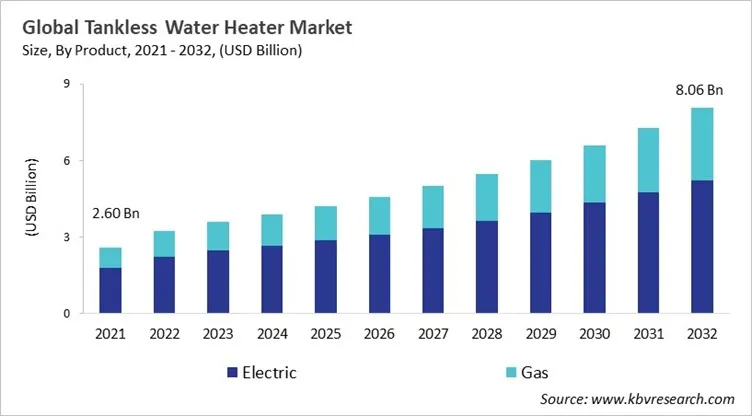
Recently, the tankless water heater market has developed into a mainstream component of the water-heating industry, supported by urbanization, increasing energy-efficiency standards, and consumer demand for smart and compact appliances. Initially dominated by conventional storage-tank systems, the industry transformed as on-demand heating technology developed-offering benefits like space savings, reduced standby losses, and continued hot-water availability. Regulatory initiatives, particularly from regulatory bodies such as the US Department of Energy, have played an important role by tightening energy standards and phasing out inefficient non-condensing models, encouraging manufacturers to innovate with higher-efficiency units and condensing heat exchangers. Further, global megatrends like smart-home integration and urban densification have surged adoption, with modern tankless units largely featuring remote diagnostics, digital connectivity, and compact designs suitable for smaller living spaces.
The tankless water heater market is expanding because of the strict efficiency mandates and consumer awareness. Also, the emerging nations are witnessing growth backed by infrastructure investment, urbanization, and the replacement of outdated systems. Global manufacturers such as Rinnai and A.O. Smith are expanding distribution and production in India and China, offering region specific electric and gas models and investing in R&D to improve flow rates, smart capabilities, and condensing performance. The tankless water heater market is competitive, led by large incumbents with regulatory expertise, through regional entrants are gaining popularity in emerging markets. The tankless water heater market is shifting toward a digitally connected, highly efficient, and geographically diversified market ecosystem.
The COVID-19 pandemic had a huge effect on the tankless water heater market. It caused factories to close, labor shortages, and supply chain problems that slowed down production and raised the cost of parts. There weren't enough heating elements and control electronics, which made prices go up and delivery times longer. Demand fell even more because of construction delays and postponed renovation projects. Homeowners put off big purchases because they weren't sure what to do. Manufacturers had to deal with lower profit margins because of higher input costs and a lack of available workers. The sector started to recover in 2021–2022 thanks to better supply-chain resilience and automation. However, the pandemic's effects were still felt in the form of delayed upgrades, slower adoption, and limited market growth. Thus, the COVID-19 pandemic had a negative impact on the market.
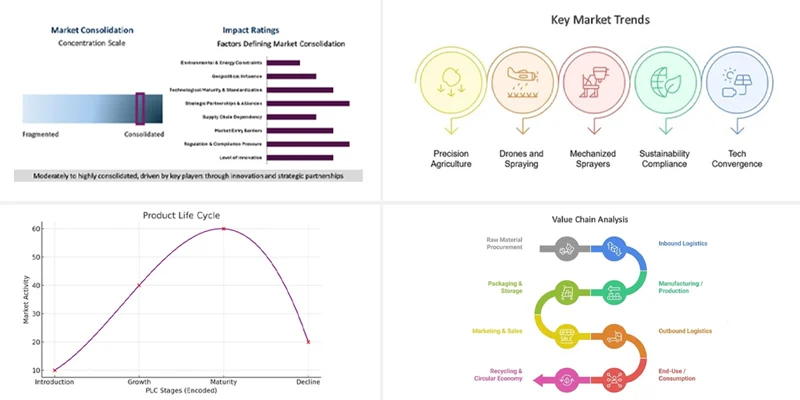

Based on product, the tankless water heater market is characterized into electric and gas. The gas segment attained 32% revenue share in the tankless water heater market in 2024. Gas-fired tankless water heaters remain a preferred option in regions with established natural-gas networks and high demand for continuous hot water. These systems use gas burners to heat water as it passes through, providing high flow rates suitable for larger households or commercial spaces. Publicly available manufacturer guidance notes that advances such as condensing technology and stainless-steel heat exchangers have improved efficiency and reduced emissions, making modern gas tankless systems cleaner and more durable.
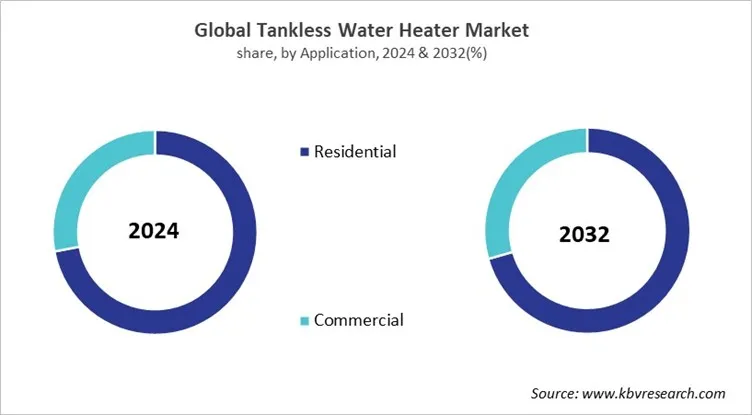
Based on application, the tankless water heater market is classified into residential and commercial. The commercial segment recorded 28% revenue share in the tankless water heater market in 2024. Commercial operators value tankless systems because they can deliver hot water on demand at varying flow rates, reduce energy waste associated with idle or oversized tanks, and support building efficiency targets. OEMs serving commercial customers emphasise that tankless units allow modular expansion (multiple units in parallel) and simplify maintenance since each unit remains dedicated and responds to actual demand rather than storing heat.
Free Valuable Insights: Global Tankless Water Heater Market size to reach USD 8.06 Billion by 2032
Region-wise, the tankless water heater market is analyzed across North America, Europe, Asia Pacific, and LAMEA. The Europe segment witnessed 33% revenue share in the tankless water heater market in 2024. The tankless water heater market is predicted to experience prominent growth in North America and Europe. This market is expanding due to consumer preference for sustainable technologies, the ongoing replacement of traditional tank systems, and strict energy-efficient regulations. The US Department of Energy’s standards mandating higher energy efficiency and phasing out non-condensing gas units are surging the transformation toward advanced condensing and smart-connected models. Regions, well-established housing markets, smart home integration, and increasing energy costs trends are further accelerating adoption. Manufacturers like Rheem, Rinnai, and A.O. Smith lead these markets, leveraging technological innovation, strong distribution networks, and compliance leadership. Furthermore, Europe’s focus on renewable energy integration and decarbonization-particularly in nations such as Italy, Germany, and the UK-also drives demand of hybrid and electric tankless systems designed to pair with heat-pump and solar technologies.
In the Asia Pacific and LAMEA region, the tankless water heater market is anticipated to significantly grow at a steady pace. The growth is driven by rising awareness of energy conservation, rapid urbanization, and increasing residential construction. In the Asia Pacific, nations like Japan, South Korea, India, and China are experiencing strong demand for both electric and gas tankless systems, with regional manufacturing investments by global OEMs to fulfil regional requirements. Rising disposable incomes, government energy-efficiency programs, and compact housing trends are fuelling the market expansion. Furthermore, in the LAMEA region, the adoption is increasing, supported by infrastructure development and hospitality sector demand. Key market players are targeting these regions with climate-adapted models and regional after-sales support, thereby offering lucrative market opportunities.
| Report Attribute | Details |
|---|---|
| Market size value in 2025 | USD 4.22 Billion |
| Market size forecast in 2032 | USD 8.06 Billion |
| Base Year | 2024 |
| Historical Period | 2021 to 2023 |
| Forecast Period | 2025 to 2032 |
| Revenue Growth Rate | CAGR of 9.7% from 2025 to 2032 |
| Number of Pages | 320 |
| Number of Tables | 241 |
| Report coverage | Market Trends, Revenue Estimation and Forecast, Segmentation Analysis, Regional and Country Breakdown, Porter’s 5 Forces Analysis, Company Profiling, Companies Strategic Developments, SWOT Analysis, Winning Imperatives |
| Segments covered | Product, Application, Region |
| Country scope |
|
| Companies Included | Rheem Manufacturing Company, Bradford White Corporation, Robert Bosch GmbH, Rinnai Corporation, EcoSmart Green Energy Products, Inc., Stiebel Eltron GmbH & Co. KG, Noritz Corporation, Kyungdong Navien Co., Ltd., Takagi Seiko Co., Ltd. and A. O. Smith Corporation |
By Product
By Application
By Geography
This Market size is expected to reach USD 8.06 billion by 2032.
The tankless water heater market is projected to grow at a CAGR of 9.7% between 2025 and 2032.
Rise in energy-efficiency and operating cost savings is reinforced by urbanisation, smaller living spaces, and growth in replacement and new construction.
Rheem Manufacturing Company, Bradford White Corporation, Robert Bosch GmbH, Rinnai Corporation, EcoSmart Green Energy Products, Inc., Stiebel Eltron GmbH & Co. KG, Noritz Corporation, Kyungdong Navien Co., Ltd., Takagi Seiko Co., Ltd. and A. O. Smith Corporation
The Residential segment is leading the Global Tankless Water Heater Market by Application in 2024 and would continue to be a dominant market till 2032; thereby, achieving a market value of $5.69 billion by 2032.
The Europe region dominated the Global Tankless Water Heater Market by Region in 2024, and would continue to be a dominant market till 2032; thereby, achieving a market value of $2,573.2 million by 2032.
Our team of dedicated experts can provide you with attractive expansion opportunities for your business.









 Unique Offerings