“Global Stemware Market to reach a market value of USD 6.34 Billion by 2032 growing at a CAGR of 5.3%”
The Global Stemware Market size is expected to reach $6.34 billion by 2032, rising at a market growth of 5.3% CAGR during the forecast period.
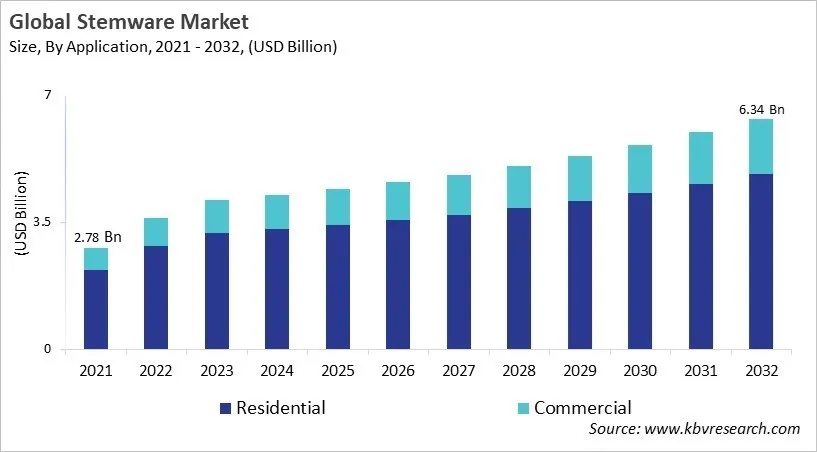
The stemware market has evolved into a broad consumer and hospitality staple, supported by mechanised production, developing drinking and dining culture, and globalised supply chains. Automation-pioneered by enterprises such as Arc International-expanded access and reduced costs, allowing stemware to penetrate mass and mid-premium segments across commercial and residential end-users. Increasing global consumption of wine, premium spirits, and champagne, combined with rising at-home entertaining and westernised dining habits in developing markets, has accelerated the demand. This expansion is supported by innovations in materials, the rapid adoption of omni-channel retail, and the diversification of designs.
The stemware market is driven by sustainability, lifestyle shifts, intensifying competition, and premiumisation. Consumers largely value design precision, brand prestige, and sensory performance-exemplified by RIEDEL’s varietal-specific glassware-while the hospitality sector continues to invest in high-quality drinkware to improve experience-led dining. Sustainability has become a core competitive lever, with manufacturers focusing on eco-friendly production, durability, and recyclable materials. Competitive dynamics span large-scale producers with global footprints, and emerging brands, vying on differentiators like aesthetics, materials, quality, brand story, channel strategy, and distribution reach. As consumer preferences develop toward higher-quality, design-rich, and sustainable stemware, ongoing innovation in materials, branding, and production will continue to shape the market.
The stemware market saw a big drop during the COVID-19 pandemic because the global hospitality sector, which is a major source of income, was closed for a long time. Demand dropped sharply when restaurants, hotels, bars, and event venues closed, and bulk orders from distributors were canceled, which put a strain on manufacturers' cash flows. International supply chains were disrupted, there weren't enough workers, and it took longer to get raw materials, which made production and distribution even harder. Consumer demand also dropped because social events and parties were canceled. This was made worse by cautious spending and limited online shopping for fragile, high-end glassware. Sales that were based on events, like weddings and business events, were put off or canceled. This caused product launches to be delayed and production planning to be more cautious. So, the pandemic had a big effect on the overall growth of the stemware market. Thus, the COVID-19 pandemic had a negative impact on the market.

Based on Product, the market is segmented into Wine Glasses, Cocktail Glasses, Champagne Glasses, Martini Glasses, and Other Product. The Cocktail Glasses segment attained 17% revenue share in the market in 2024. This segment has seen considerable adoption driven by the expanding popularity of mixology and cocktail culture across bars, restaurants, and home settings. These glasses are designed to complement a wide variety of cocktails, emphasizing both aesthetics and functionality. The segment prioritizes innovation in terms of glass durability, intricate designs, and ergonomic features, ensuring a premium drinking experience.
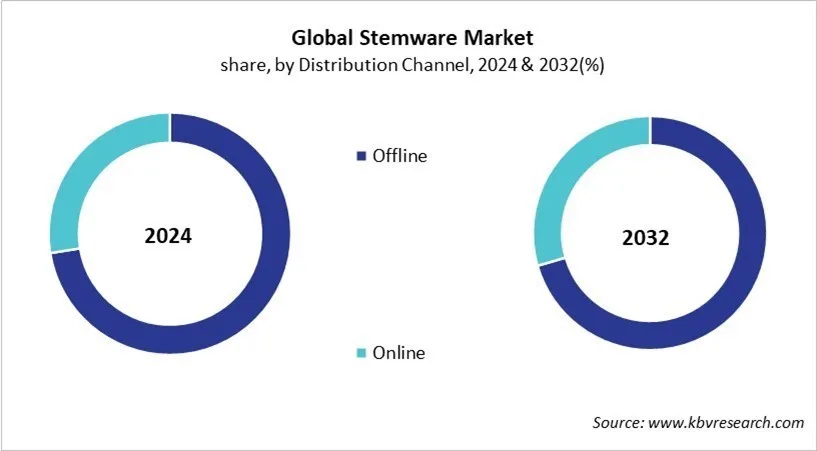
Based on Distribution Channel, the market is segmented into Offline, and Online. The Online segment acquired 28% revenue share in the market in 2024. This segment is experiencing growth due to the convenience, wide selection, and competitive pricing offered through e-commerce platforms. Consumers increasingly rely on online channels for purchasing stemware, benefiting from detailed product descriptions, reviews, and doorstep delivery. Investments are focused on user-friendly interfaces, digital marketing, fast logistics, and secure payment systems, enabling retailers to provide a seamless shopping experience while expanding market reach and catering to tech-savvy and time-conscious consumers.
Free Valuable Insights: Stemware Market size to reach USD 6.34 Billion by 2032
Region-wise, the Stemware Market is analyzed across North America, Europe, Asia Pacific, and LAMEA. The Asia Pacific segment recorded 36% revenue share in the market in 2024. The stemware market is predicted to capture prominent growth in the North America and Europe region. The market is driven by premium dining culture, a well-established hospitality sector, and a strong wine culture. In North America and Europe, premiumisation has become a dominant trend, with consumers moving towards varietal-specific glasses, high-quality crystal, and design-driven collections. The hospitality sector, luxury hotels, restaurants, bars, continues to invest in elegant and durable stemware to support experience-led dining, while residential consumers are largely upgrading home-bar setups. In addition to this, the Europe stemware market is expanding by leading in artisanal glassmaking, heritage brands, and sustainability-driven manufacturing. Further, the demand is also accelerating through e-commerce, specialty retail, and lifestyle-oriented brands.
In the Asia Pacific and LAMEA region, the stemware market is anticipated to grow at a steady rate during the forecast period. This expansion is supported by increasing disposable incomes, the adoption of Western-style dining, and rising urbanization. The Asia Pacific region is experiencing rapid expansion with cocktail culture, wine appreciation, and modern hospitality infrastructure growing across Southeast Asia, India, Japan, and China. The region also benefits from regional manufacturing footprints of global players looking into supply-chain efficiency. Furthermore, the LAMEA stemware market is expanding substantially because of increasing demand with growing luxury tourism, premium hospitality projects, and affluent urban consumer. Further, in both regions, rising gift-giving culture, online retail, and exposure to global brands are surging the adoption of stemware.
| Report Attribute | Details |
|---|---|
| Market size value in 2025 | USD 4.40 Billion |
| Market size forecast in 2032 | USD 6.34 Billion |
| Base Year | 2024 |
| Historical Period | 2021 to 2023 |
| Forecast Period | 2025 to 2032 |
| Revenue Growth Rate | CAGR of 5.3% from 2025 to 2032 |
| Number of Pages | 459 |
| Number of Tables | 451 |
| Report coverage | Market Trends, Revenue Estimation and Forecast, Segmentation Analysis, Regional and Country Breakdown, Porter’s 5 Forces Analysis, Company Profiling, Companies Strategic Developments, SWOT Analysis, Winning Imperatives |
| Segments covered | Product, Application, Distribution Channel, Region |
| Country scope |
|
| Companies Included | Libbey Glass LLC, Tiroler Glashütte GmbH (Riedel), Fiskars Group (Waterford), Baccarat SA (Fortune Legend Limited), Zwiesel Kristallglas AG (Fortessa Tableware Solutions, LLC), Bormioli Luigi S.p.A., Bayerische Glaswerke GmbH (Nachtmann), Stölzle Lausitz GmbH, ARC Management & Services SAS (Cristal d'Arques Paris), and GLASVIN |
By Product
By Application
By Distribution Channel
By Geography
The market size is projected to reach USD 6.34 Billion by 2032.
The stemware market is projected to grow at a CAGR of 5.3% between 2025 and 2032.
Rising global wine, spirits, and hospitality consumption driven by premiumisation, aesthetic appeal, and design innovation.
Libbey Glass LLC, Tiroler Glashütte GmbH (Riedel), Fiskars Group (Waterford), Baccarat SA (Fortune Legend Limited), Zwiesel Kristallglas AG (Fortessa Tableware Solutions, LLC), Bormioli Luigi S.p.A., Bayerische Glaswerke GmbH (Nachtmann), Stölzle Lausitz GmbH, ARC Management & Services SAS (Cristal d'Arques Paris), and GLASVIN
The Residential segment led the maximum revenue in the Global Stemware Market by Application in 2024, thereby, achieving a market value of $4.8 billion by 2032.
The Asia Pacific region dominated the Global Stemware Market by Region in 2024, and would continue to be a dominant market till 2032; thereby, achieving a market value of $2.4 billion by 2032.
Our team of dedicated experts can provide you with attractive expansion opportunities for your business.











 Unique Offerings