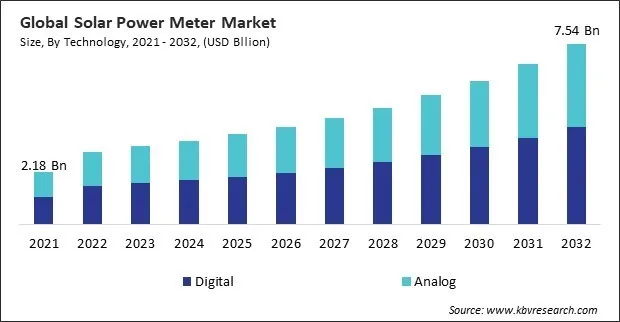
“Global Solar Power Meter Market to reach a market value of USD 7.54 Billion by 2032 growing at a CAGR of 10.4%”
The Global Solar Power Meter Market size is expected to reach $7.54 billion by 2032, rising at a market growth of 10.4% CAGR during the forecast period.
Digital technology has changed the way solar energy is measured, monitored, and managed, making it a game-changer in the solar power meter market. In the past, solar power meters were analog devices that only gave basic readings of irradiance. But adding digital parts like microcontrollers, sensors, cloud computing, and wireless communication has made these tools much more accurate, useful, and adaptable.
The major strategies followed by the market participants are Product Launches as the key developmental strategy to keep pace with the changing demands of end users. For instance, In September, 2024, EKO Instruments Co., Ltd. unveiled the MS‑80SH Plus+, a compact, Class A solar monitoring station designed for bifacial PV systems. Featuring a rotating shadow band, GPS, and combined GHI/DHI/DNI measurements in a single IP67-rated unit, it enables precise irradiance tracking without the need for sun-tracker hardware. Moreover, In June, 2024, Solar Light Company, LLC unveiled the patented Poly602 HDRS and Mono602 instruments, alongside the SPF290 UV Transmittance Analyzer and LS1000 Solar Simulator. These advanced tools improve accuracy in solar simulators and sunscreen testing, reinforcing its leadership in the precision solar measurement sector.
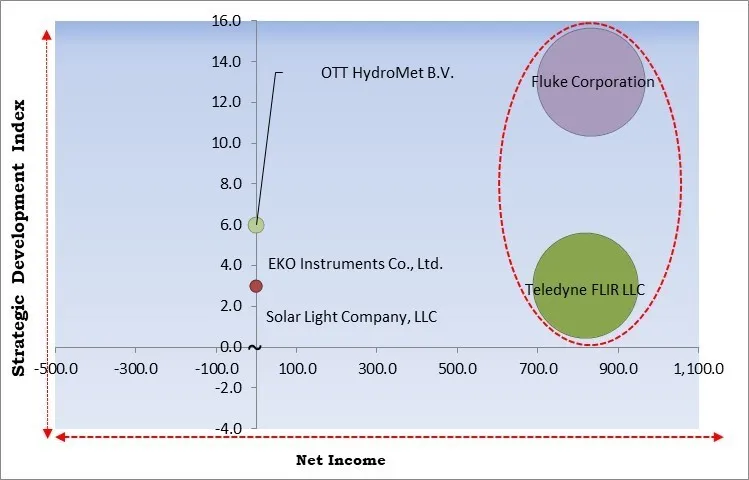
Based on the Analysis presented in the KBV Cardinal matrix; Fluke Corporation and Teledyne FLIR LLC are the forerunners in the Solar Power Meter Market. In April, 2025, Teledyne FLIR LLC unveiled advanced testing solutions that simplify and speed up inspections during solar panel installation and maintenance. These high-performance tools enhance diagnostic accuracy and efficiency, supporting safer and more effective operations of solar power systems, thereby playing a crucial role in the solar power meter and monitoring market. Companies such as OTT HydroMet B.V., EKO Instruments Co., Ltd., and Solar Light Company, LLC are some of the key innovators in Solar Power Meter Market.
The global solar power meter market took a big hit during the COVID-19 pandemic because manufacturing was disrupted. Production facilities were either closed or ran at a lower capacity because of strict lockdowns and quarantines around the world. This caused shipments of important parts, like photovoltaic sensors, microcontrollers, and optical meters, which are necessary for solar power meter systems, to be late. Because of this, the supply chain problems made it hard to get solar power meters to homes, businesses, and factories on time and set them up. The pandemic made it hard for people to invest in the energy sector. So, the COVID-19 pandemic hurt the market.

In the last twenty years, the global energy paradigm has changed a lot in favor of renewable resources, with solar energy becoming a major pillar. The sharp rise in solar photovoltaic (PV) installations in homes, businesses, and utilities is one of the most important things that is making this change happen. Governments and environmental groups all over the world are pushing for the use of clean energy because people are worried about climate change, energy security, and the need to use less fossil fuels. The rise in solar installations and the shift to clean energy around the world are two of the main things that drive the solar power meter market.
Furthermore, the tools that support solar PV systems need to change as the systems themselves get more advanced. One of the main technological factors driving the growth of the solar power meter market is the constant improvement in the accuracy of sensors, their ability to work with other devices, and their portability. Most of the time, traditional meters were analog or simple digital devices with basic displays. Modern solar meters, on the other hand, now have more advanced features like wireless data transmission, IoT integration, cloud-based logging, and compatibility with smartphones. So, ongoing innovation and digital integration in solar metering technologies are important for market growth and competition.
The availability and price of solar power meters are not the only things that affect their use. The knowledge and skills of the people who will use them are also important. A lot of people who use solar energy in their homes or small businesses don't know about solar measurement tools and how important they are for getting the most energy out of the system and making sure it works. This lack of knowledge makes it very hard for people to use it widely. So, the full potential of solar metering adoption won't be reached until awareness and training programs are widely used.
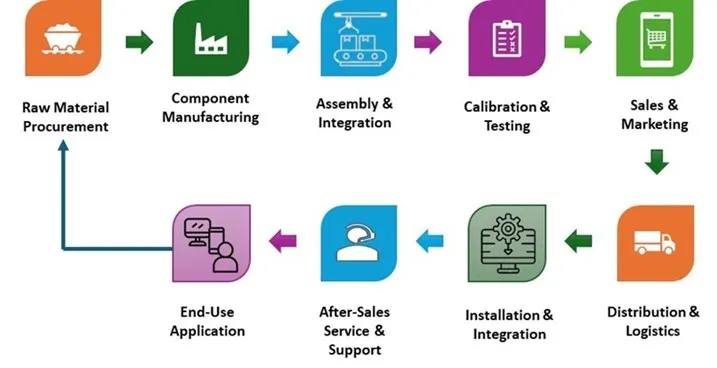
The value chain of the Solar Power Meter Market starts with Raw Material Procurement, which includes sourcing electronic components and sensor materials. These are then processed during Component Manufacturing, followed by Assembly & Integration to create functioning solar power meters. The products undergo Calibration & Testing to ensure precision and quality, then move through Sales & Marketing to drive demand. Distribution & Logistics ensures timely delivery to clients, after which the meters are Installed & Integrated into solar power systems. After-Sales Service & Support ensures customer satisfaction, and End-Use Applications provide practical insights, influencing future improvements and raw material needs.
Free Valuable Insights: Global Solar Power Meter Market size to reach USD 7.54 Billion by 2032
Based on technology, the solar power meter market is characterized into digital and analog. The analog segment procured 47% revenue share in the solar power meter market in 2024. The analog solar power meter segment includes regular meters that use mechanical parts to show how much solar power is being used. Most of the time, these meters have needle-based dials or rotating discs to show measurements, and you have to read them by hand. Analog meters aren't as advanced as digital meters, but people like them because they're simple, strong, and don't need much maintenance.
| Category | Details |
|---|---|
| Use Case Title | Confidential |
| Date | 2025 |
| Entities Involved | Confidential |
| Objective | Enable cost-effective and rugged solar irradiance tracking in rural/off-grid areas without relying on digital infrastructure. |
| Context and Background | In areas lacking connectivity or stable power, analog meters provide dependable, maintenance-free solutions for periodic system checks. |
| Description | Analog meters were used by field technicians across rural African sites to manually track irradiance and verify solar system performance. |
| Key Capabilities Deployed |
|
| Regions Covered |
|
| Benefits |
|
| Source | Confidential |
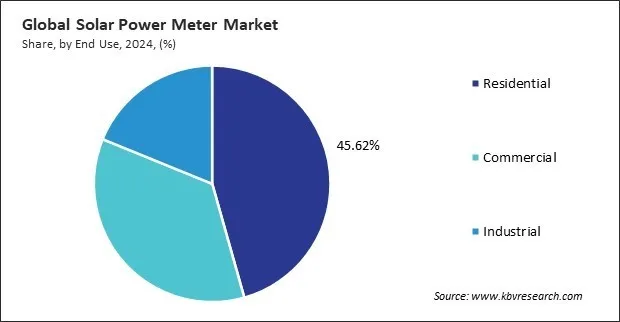
On the basis of end use, the solar power meter market is categorized into residential, commercial, and industrial. The commercial segment attained 36% revenue share in the solar power meter market in 2024. Solar power meters used in offices, stores, schools, and other business settings are part of the commercial segment. These meters are very important for keeping track of peak loads, managing energy efficiency, and reaching sustainability goals. In business settings, accurate metering helps with budgeting, lowering operational costs, and following the rules.
On the basis of product, the solar power meter market is classified into net meter, bi-directional meter, dual meter, and others. The bi-directional meter segment recorded 28% revenue share in the solar power meter market in 2024. The bi-directional meter segment can measure the flow of electricity in both directions: from the grid to the home and back again. Bi-directional meters keep separate readings for incoming and outgoing power, unlike net meters that only show the net difference. This feature is especially useful for advanced metering infrastructure and time-of-use billing, where separate data on consumption and generation is needed.
By measurement, the solar power meter market is divided into energy measurement, power measurement, current measurement, voltage measurement, and others. The power measurement segment garnered 29% revenue share in the solar power meter market in 2024. The power measurement part includes meters that measure the amount of power being used or produced at the moment, usually in watts or kilowatts. These devices are very important for figuring out how energy flows right now. They are also used a lot for system diagnostics, load balancing, and making solar arrays work better.
Based on integration type, the solar power meter market is segmented into on-grid solar power meters, off-grid solar power meters, and handheld solar power meters. The off-grid solar power meters segment acquired 22% revenue share in the solar power meter market in 2024. The off-grid solar power meters part is for solar systems that don't need to be connected to the main utility grid. These meters are used in rural or remote areas where access to the grid is limited or not possible. They help users keep track of how much energy is being produced and stored, usually with batteries. They are very important for making sure that standalone solar systems work well and can stand on their own, especially in places where the grid is unstable or doesn't exist at all.
Region-wise, the solar power meter market is analyzed across North America, Europe, Asia Pacific, and LAMEA. The Asia Pacific segment recorded 36% revenue share in the solar power meter market in 2024. The Asia Pacific region leads the solar power meter market, driven by rapid urbanization, expanding energy needs, and aggressive investment in renewable energy infrastructure. Countries such as China, India, Japan, and Australia are at the forefront of solar adoption, supported by government initiatives, favorable policies, and declining solar technology costs. Solar power meters in this region are widely used in both utility-scale and distributed solar projects, with increasing integration into smart grid frameworks.
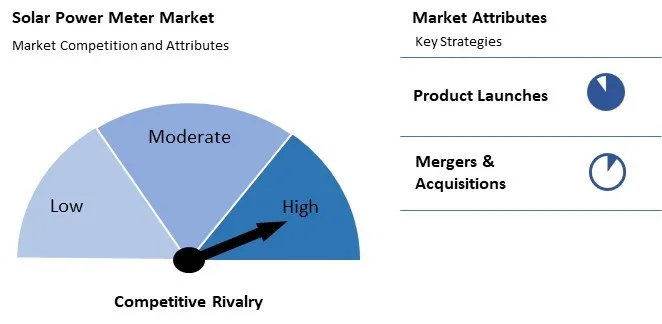
The Solar Power Meter Market is still very competitive, thanks to regional manufacturers and niche businesses. These companies make affordable, easy-to-use, and portable meters for homes and small businesses. New ways to monitor energy efficiency and a growing demand for solar energy solutions keep competition going. Smaller companies can win over certain market segments by specializing and distributing their products locally.
| Report Attribute | Details |
|---|---|
| Market size value in 2024 | USD 3.50 Billion |
| Market size forecast in 2032 | USD 7.54 Billion |
| Base Year | 2024 |
| Historical Period | 2021 to 2023 |
| Forecast Period | 2025 to 2032 |
| Revenue Growth Rate | CAGR of 10.4% from 2025 to 2032 |
| Number of Pages | 420 |
| Number of Tables | 567 |
| Report coverage | Market Trends, Revenue Estimation and Forecast, Segmentation Analysis, Regional and Country Breakdown, Competitive Landscape, Porter’s 5 Forces Analysis, Company Profiling, Companies Strategic Developments, SWOT Analysis, Winning Imperatives |
| Segments covered | Technology, End Use, Product, Measurement, Integration Type, Region |
| Country scope |
|
| Companies Included | Solar Light Company, LLC, PCE Instruments India Private Ltd. (PCE Holding AG), TES Electrical Electronic Corp., EKO Instruments Co., Ltd., General Tools & Instruments LLC (Global Transport Investments Inc.), Jaycar Pty. Ltd., Fluke Corporation (Fortive Corporation), Canstar Blue Pty Ltd, Teledyne FLIR LLC (Teledyne Technologies Incorporated), and OTT HydroMet B.V. (Kipp & Zonen) |
By Technology
By End Use
By Product
By Measurement
By Integration Type
By Geography
This Market size is expected to reach $7.54 billion by 2032.
Rising Global Adoption Of Solar Energy are driving the Market in coming years, however, High Cost And Limited Affordability In Emerging Markets restraints the growth of the Market.
Solar Light Company, LLC, PCE Instruments India Private Ltd. (PCE Holding AG), TES Electrical Electronic Corp., EKO Instruments Co., Ltd., General Tools & Instruments LLC (Global Transport Investments Inc.), Jaycar Pty. Ltd., Fluke Corporation (Fortive Corporation), Canstar Blue Pty Ltd, Teledyne FLIR LLC (Teledyne Technologies Incorporated), and OTT HydroMet B.V. (Kipp & Zonen)
The expected CAGR of this Market is 10.4% from 2023 to 2032.
The Residential segment captured the maximum revenue in the Market by End Use in 2024, thereby, achieving a market value of $3.3 billion by 2032.
The Asia Pacific region dominated the Market by Region in 2024, and would continue to be a dominant market till 2032; thereby, achieving a market value of $2.8 billion by 2032.
Our team of dedicated experts can provide you with attractive expansion opportunities for your business.







 Unique Offerings