“Global Solar Carport Market to reach a market value of USD 1.10 Billion by 2032 growing at a CAGR of 10.5%”
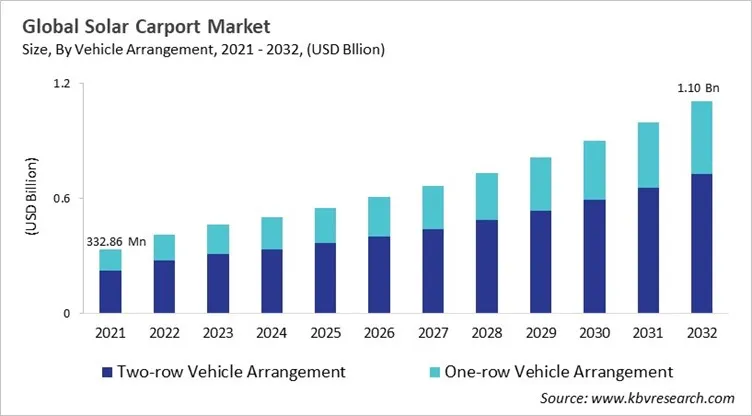
The Global Solar Carport Market size is expected to reach USD 1.10 billion by 2032, rising at a market growth of 10.5% CAGR during the forecast period.
The global solar carport market has evolved as an important factor of the renewable energy landscape, emerging from a specialized photovoltaic utilization into a key solution for vehicle protection and clean energy generation. The solar carports efficiently use parking areas by changing the into multi-purpose energy structure, fitting into wider carbon reduction strategies and sustainability goals. Rising government support, favourable initiatives, and increased environmental awareness are propelling the implementation throughout public, commercial and educational industry. As per the United Nations, current national climate plans – for 195 Parties to the Paris Agreement taken together – would lead to a 2.6% decrease in global greenhouse gas emissions by 2030, compared to 2019 levels. As organizations prioritize net-zero targets, solar carports are increasingly deployed by corporations, transit authorities, and universities to improve energy efficiency and reduce grid dependence.
One of the major market trends is the implementation of Electric vehicle (EV) charging infrastructure into solar carports. The solar carports systems are integrated with electric vehicle supply equipment (EVSE), which provide on-site solar charging, facilitating the rising demand for clean transportation solutions. As per the World Economic Forum, Electric vehicle (EV) sales exceeded 17 million globally in 2024, which represented more than 20% of global car sales. The rising EV sales worldwide is directly proportionate to the growth of the solar carport market. The result is a self-sustaining ecosystem that supports both electric mobility and decentralized energy generation. At the same time, innovations in modular solar canopy designs—featuring faster installation, flexible aesthetics, and high energy performance—are reducing costs and deployment times, making solar carports a viable option for urban infrastructure and green building projects.
The COVID-19 pandemic caused major problems in the global solar carport market. Lockdowns, factory closures in key manufacturing hubs, and lower demand from businesses and institutions all led to supply chain breakdowns, project delays, and higher costs. Healthcare and digital infrastructure became more important for capital spending, which caused many events to be postponed or canceled, especially in retail, transportation, and education. But as the economies started to recover, government stimulus packages in places like the EU, South Korea, and Canada brought clean energy investments back to life. The use of remote monitoring, digital permitting, and prefabricated structures made it possible to install solar carports even with restrictions on labor and contact. This made solar carports both a sustainable energy solution and a way to create green jobs. Overall, the market started out with negative growth.

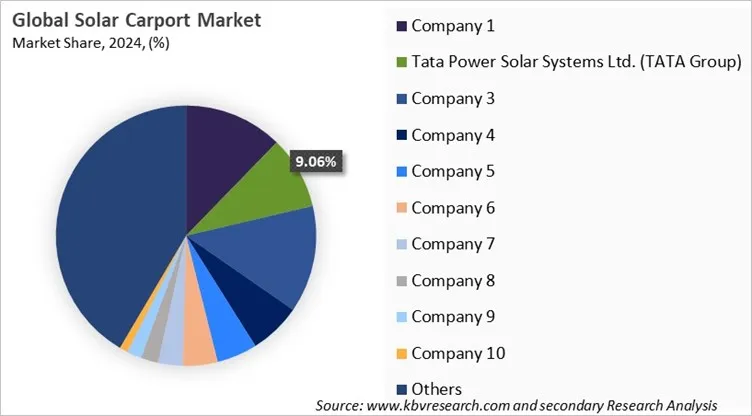
The leading players in the market are competing with diverse innovative offerings to remain competitive in the market. The above illustration shows the percentage of revenue shared by some of the leading companies in the market. The leading players of the market are adopting various strategies to cater demand coming from the different industries. The key developmental strategies in the market are Product Launches, and Partnerships & Collaborations.
Based on Vehicle Arrangement, the solar carport market is segmented into Two-row Vehicle Arrangement and One-row Vehicle Arrangement. The One-row Vehicle Arrangement segment acquired 33.4% revenue share in the market in 2024. This setup has a single row of cars covered by a special canopy. It needs less structural material and takes up less space. It doesn't make as much energy as two-row systems, but it's still a good and cost-effective choice for places that don't need a lot of coverage. Because it has a simpler design, it can be installed more quickly and fits in better with the way things are already set up on the site.
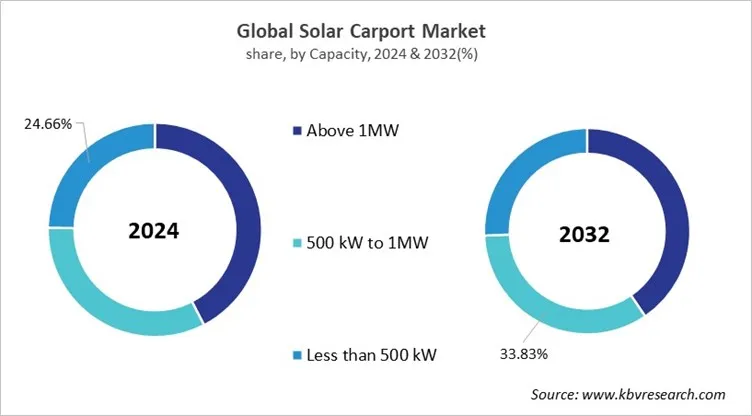
On the basis of Capacity, the solar carport market is segmented into Above 1MW, 500 kW to 1MW, and Less than 500 kW. In 2024, the Less than 500 kW segment made up 24.6% of the market's revenue. These systems work best in places with limited parking or moderate energy needs. Even though they are smaller, they help lower electricity bills, emissions, and property values. Small businesses and community groups that want to switch to renewable energy like them because they are cheaper to buy up front and easier to get permission to use.
Free Valuable Insights: Global Solar Carport Market size to reach USD 1.10 Billion by 2032
Region-wise, the solar carport market is analyzed across North America, Europe, Asia Pacific, and LAMEA. The North America segment recorded the 35.2% revenue share in the market in 2024. The solar carport market is growing quickly because of clean energy programs, government rules, and the need for more environmentally friendly infrastructure. Solar carports are becoming more than just places to park cars. They now have features like solar-powered displays, monitoring tools, and joint government-industry projects. Solar carports are now a big part of smart campuses, low-emission cities, and EV-ready transport hubs. They provide energy solutions that are cost-effective, scalable, and follow the rules. Adding EV charging stations is making them even more important in the shift to clean energy.
North America leads the market with strong policy support and wide commercial adoption, while Europe follows closely with climate-driven regulations. Asia Pacific is the fastest-growing region due to urban development, EV growth, and government incentives. In LAMEA, adoption is rising steadily as solar PV becomes more affordable and public investments in energy transition programs increase. Across all regions, solar carports are emerging as a vital part of the global shift toward renewable energy and electric mobility.
| Report Attribute | Details |
|---|---|
| Market size value in 2024 | USD 504.5 Million |
| Market size forecast in 2032 | USD 1.10 Billion |
| Base Year | 2024 |
| Historical Period | 2021 to 2023 |
| Forecast Period | 2025 to 2032 |
| Revenue Growth Rate | CAGR of 10.5% from 2025 to 2032 |
| Number of Pages | 402 |
| Number of Tables | 442 |
| Report coverage | Market Trends, Revenue Estimation and Forecast, Segmentation Analysis, Regional and Country Breakdown, Market Share Analysis, Porter’s 5 Forces Analysis, Company Profiling, Companies Strategic Developments, SWOT Analysis, Winning Imperatives |
| Segments covered | Vehicle Arrangement, Capacity, Type, Application, Region |
| Country scope |
|
| Companies Included | Schletter Solar GmbH (Enstall Group B.V.), Tata Power Solar Systems Ltd. (TATA Group), ANTAI TECHNOLOGY CO., LTD., Xiamen Mibet New Energy Co., Ltd, SolarEdge Technologies, Inc., Xiamen Wanhos Solar Technology Co.,Ltd, Quest Renewables, Inc. (Bravo LLC), Phoenix Solar Panel Systems (Suntrica), RenEnergy UK (Aggreko) and Greenchoice Integrated |
By Vehicle Arrangement
By Capacity
By Type
By Application
By Geography
This Market size is expected to reach $1.10 Billion by 2032.
Policy Support and Incentive Frameworks are driving the Market in coming years, however, High Initial Capital and Structural Costs restraints the growth of the Market.
Schletter Solar GmbH (Enstall Group B.V.), Tata Power Solar Systems Ltd. (TATA Group), ANTAI TECHNOLOGY CO., LTD., Xiamen Mibet New Energy Co., Ltd, SolarEdge Technologies, Inc., Xiamen Wanhos Solar Technology Co.,Ltd, Quest Renewables, Inc. (Bravo LLC), Phoenix Solar Panel Systems (Suntrica), RenEnergy UK (Aggreko) and Greenchoice Integrated
The expected CAGR of this Market is 10.5% from 2023 to 2032.
The Two-row Vehicle Arrangement segment is leading the Market by Vehicle Arrangement in 2024; thereby, achieving a market value of USD 728.2 Million by 2032.
The North America region dominated the Market by Region in 2024 and would continue to be a dominant market till 2032; thereby, achieving a market value of USD 374.4 Million by 2032.
Our team of dedicated experts can provide you with attractive expansion opportunities for your business.











 Unique Offerings