“Global Soft Facility Management Market to reach a market value of USD 1107.03 Billion by 2032 growing at a CAGR of 5%”
The Global Soft Facility Management Market size is expected to reach USD 1,107.03 billion by 2032, rising at a market growth of 5.0% CAGR during the forecast period.
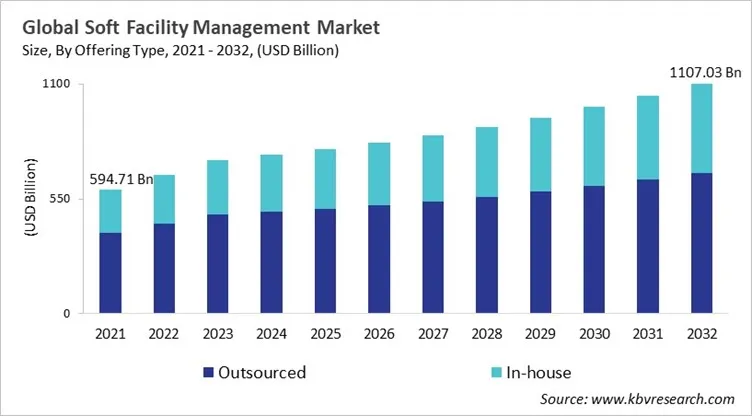
The global soft facility management (FM) market is all about non-technical services that affect the daily lives, comfort, and efficiency of people who live in buildings. These services include cleaning, catering, security, landscaping, concierge, waste management, and other similar services. The industry used to be broken up and delivered locally, but it has changed through outsourcing, globalization, and consolidation. This has allowed big companies like ISS and Sodexo to offer integrated, multi-geography service models. As standards for hygiene, safety, sustainability, and workplace well-being have risen, soft FM has gone from being a back-office function to a strategic tool for improving productivity, health, and compliance with environmental, social, and governance (ESG) standards. Digitalization, smart-building technologies, hybrid work models, and data-driven service optimization are all having a big impact on how the market is changing. These changes are turning soft FM into a modern, high-value platform for workplace experience.
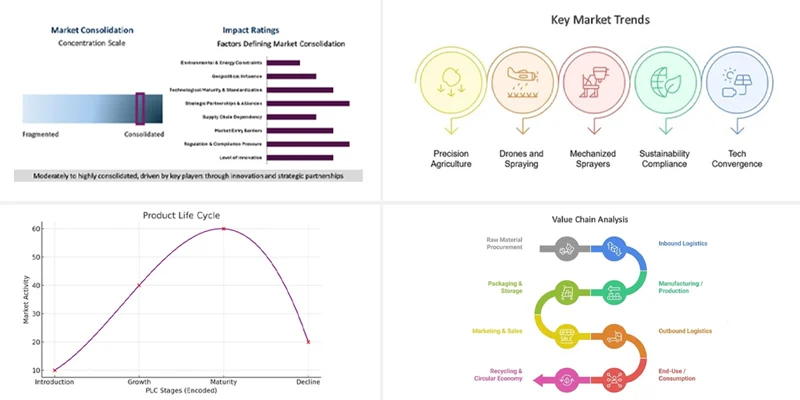
At the same time, big trends like more use of technology, aligning with ESG goals, service contracts based on outcomes, and combining services across services are changing the way companies compete. Top providers are concentrating on selective portfolio growth, investing in digital platforms, managing global accounts, standardizing delivery, and differentiating themselves based on sustainability. There are both global integrated service providers that use scale and technology and regional specialists that offer flexible, customized solutions. The market is getting more competitive as businesses look for bundled, multi-service contracts and results that focus on experience. Providers who can offer integrated, insight-driven, occupant-focused, and sustainability-oriented FM solutions will have an edge.
The COVID-19 pandemic hit the LAMEA Soft FM market hard in the short term because many facilities had to close, which led to canceled contracts, suspended services, and big drops in revenue, especially in cleaning, catering, and front-of-house operations. Labour shortages got worse as migrant and temporary workers couldn't move around as freely, and new sanitation rules and PPE requirements made it more expensive to run a business, which hurt smaller providers the most. Multinational clients cut budgets and put off outsourcing, which caused delays in expansion plans and contract renewals. Demand dropped sharply in sectors like hospitality, retail, and commercial real estate. Sodexo, CBRE, and ISS, among other big companies, shifted their focus to important services in healthcare and manufacturing. The crisis showed how much the industry relies on manual labor and on-site work. This made clients renegotiate contracts and providers switch to more flexible staffing, digital monitoring, and cost-effective models. In the end, COVID-19 showed that the region needs Soft FM strategies that are more flexible, tech-enabled, and focused on planning for the worst. Thus, the COVID-19 pandemic had a negative impact on the market.

Based on offering type, the soft facility management market is characterized into outsourced and in-house. The in-house segment attained 36% revenue share in the soft facility management market in 2024. The In-House offering type in the soft facility management market retained a significant presence, as some organisations continue to prefer managing non-technical facility services within their own operations. This model offers direct operational control, closer alignment with organisational culture and internal oversight of staffing and service delivery, which is appealing for institutions with specialised needs or highly sensitive environments.
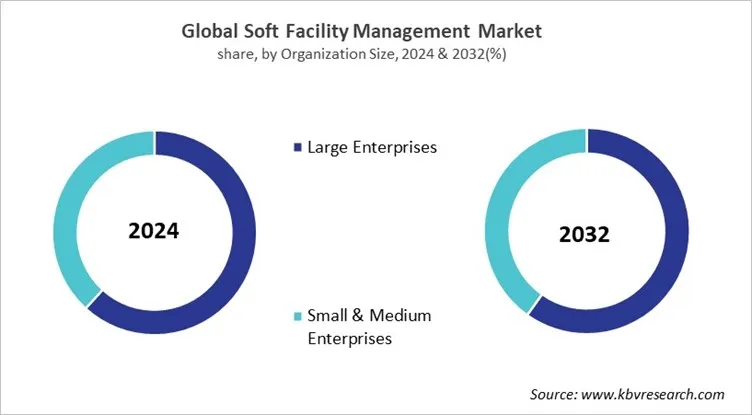
Based on organization size, the soft facility management market is classified into large enterprises and small & medium enterprises. The small & medium enterprises segment recorded 38% revenue share in the soft facility management market in 2024. The small & medium-enterprises (SMEs) segment recorded a notable share of the soft facility management market, as such organisations increasingly recognise the value of professionalised facility services despite a more constrained budget and fewer facilities compared with large players.
Free Valuable Insights: Soft Facility Management Market size to reach USD 1107.03 Billion by 2032
Region-wise, the Soft Facility Management Market is analyzed across North America, Europe, Asia Pacific, and LAMEA. The North America segment recorded 34% revenue share in the Soft Facility Management Market in 2024. North America and Europe are the most developed markets for soft facility management. This is because outsourcing is common, hygiene and safety rules are strict, and workplace-experience models are widely used. More businesses in these areas depend on integrated service providers to offer bundled soft FM solutions that include cleaning, catering, security, reception, and sustainability services for portfolios with multiple sites. The rise of hybrid work, strong ESG commitments, and the move toward data-enabled workplace optimization have all made the need for digital FM platforms, smart-building tools, and outcome-based service models grow even faster. ISS and Sodexo are two big global companies that have a strong presence here. They benefit from long-term contracts, standardized delivery frameworks, and clients' preference for FM solutions that can grow with their needs and use technology.
The Asia Pacific region is becoming the fastest-growing soft FM market. This is because cities are growing quickly, commercial infrastructure is expanding, hygiene and sustainability standards are rising, and more non-core workplace services are being outsourced. Countries like India, China, Japan, and Australia are seeing a lot of companies use integrated FM models because they want to be more efficient, make their employees happy, and create modern workplaces. Latin America, the Middle East, and Africa (LAMEA) are developing but growing market where demand is driven by infrastructure growth, the presence of multinational corporations, and the need for professional service delivery. Digital FM tools, ESG-focused services, and bundled multi-service contracts are becoming more popular in both regions. This lets global and regional providers reach more customers and meet their changing needs.
| Report Attribute | Details |
|---|---|
| Market size value in 2025 | USD 787.30 Billion |
| Market size forecast in 2032 | USD 1107.03 Billion |
| Base Year | 2024 |
| Historical Period | 2021 to 2023 |
| Forecast Period | 2025 to 2032 |
| Revenue Growth Rate | CAGR of 5.0% from 2025 to 2032 |
| Number of Pages | 583 |
| Number of Tables | 491 |
| Report coverage | Market Trends, Revenue Estimation and Forecast, Segmentation Analysis, Regional and Country Breakdown, Porter’s 5 Forces Analysis, Company Profiling, Companies Strategic Developments, SWOT Analysis, Winning Imperatives |
| Segments covered | Offering Type, Organization Size, Services Type, End Use, Region |
| Country scope |
|
| Companies Included | Sodexo S.A., ISS A/S, Aramark Corporation, AHI Facility Services, Inc., CBRE Group, Inc., Jones Lang LaSalle Incorporated, Johnson Controls International PLC, Cushman & Wakefield plc, Imdaad LLC and Guardian Service Industries, Inc. |
By Offering Type
By Organization Size
By Services Type
By End Use
By Geography
The market size is projected to reach USD 1107.03 billion by 2032.
The soft facility management market is projected to grow at a CAGR of 5% between 2025 and 2032.
Accelerating urbanization and real estate growth, coupled with an elevated focus on workplace experience, well-being, and brand value, is reshaping modern facility demand.
Sodexo S.A., ISS A/S, Aramark Corporation, AHI Facility Services, Inc., CBRE Group, Inc., Jones Lang LaSalle Incorporated, Johnson Controls International PLC, Cushman & Wakefield plc, Imdaad LLC and Guardian Service Industries, Inc.
The Office Support & Security Services market dominated the Global Soft Facility Management Market by Services Type in 2024; thereby, achieving a market value of $384.30 Billion by 2032.
The North America market dominated the Global Soft Facility Management Market by Region in 2024, and would continue to be a dominant market till 2032; thereby, achieving a market value of $362,665.5 million by 2032, growing at a CAGR of 4.4 % during the forecast period.
Our team of dedicated experts can provide you with attractive expansion opportunities for your business.







 Unique Offerings