“Global Social Commerce Market to reach a market value of USD 11.95 Trillion by 2032 growing at a CAGR of 33.5%”
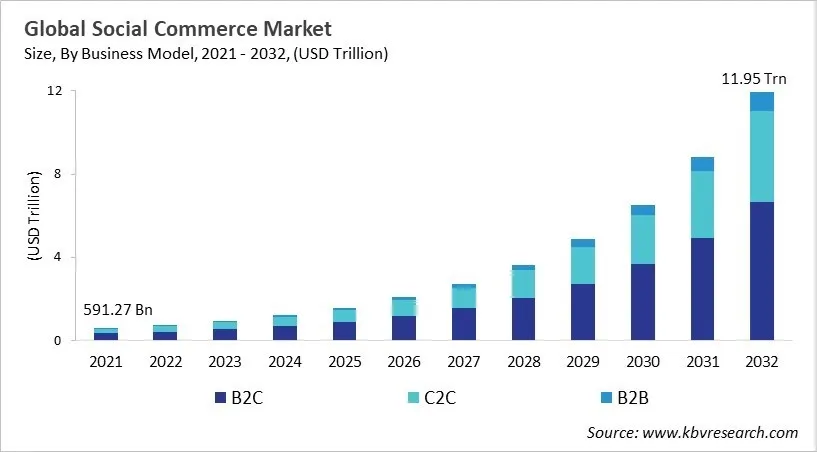
The Global Social Commerce Market size is expected to reach $11.95 Trillion by 2032, rising at a market growth of 33.5% CAGR during the forecast period.
In the early 2000s, people experimented with user reviews and recommendations, but now social commerce is a major retail channel that combines social interaction with online shopping. Smartphones, fast internet, and social media sites like Facebook, Instagram, TikTok, and Pinterest all helped people get used to shopping online. Livestream shopping, which started in China, combines entertainment, influencers, and instant buying. COVID-19 sped up this change by forcing platforms to add more integrated shopping features and giving small businesses new chances. Some important trends are the fast growth of livestream selling, the rise of all-in-one commerce ecosystems, and influencer marketing that is based on honesty.
The competition is high, with Meta's ecosystem working together and TikTok's viral content being the best. Asian leaders like Douyin, Xiaohongshu, and WeChat are the best in their markets because they know what works for them. YouTube, Pinterest, and Twitch are all adding formats that let you shop, and smaller businesses are focusing on specific product categories. Success depends on smooth integration of commerce, strong partnerships with influencers, trust and compliance with regulations, and a variety of content formats supported by data-driven personalization. Rapid innovation is likely to change how people buy even more.

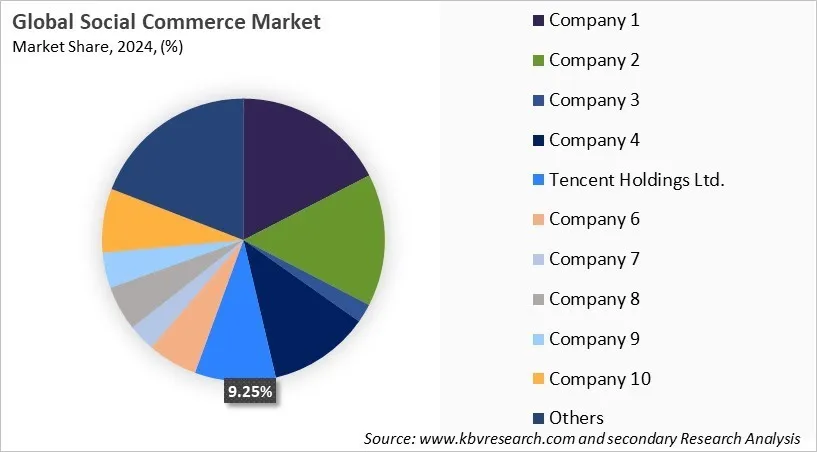
The leading players in the market are competing with diverse innovative offerings to remain competitive in the market. The above illustration shows the percentage of revenue shared by some of the leading companies in the market. The leading players of the market are adopting various strategies in order to cater demand coming from the different industries. The key developmental strategies in the market are Acquisitions, and Partnerships & Collaborations.
Consumers increasingly turned to digital platforms for shopping due to lockdowns and other mobility restrictions, which greatly accelerated the growth of social commerce during the COVID-19 pandemic. With the addition of features like live shopping, shoppable posts, and influencer-driven campaigns, social media sites like Facebook, Instagram, Pinterest, and TikTok developed into important marketplaces. By using these platforms to communicate directly with consumers, small and medium-sized enterprises increased the variety and accessibility of their product offerings. Influencer and peer recommendations were crucial in the shift in consumer behavior toward trust-based purchasing. Improved payment methods and interactive features, such as live demonstrations and Q&A sessions, increased confidence and engagement even more, which had a significant positive effect on the social commerce market. Thus, the COVID-19 pandemic had a Positive impact on the market.
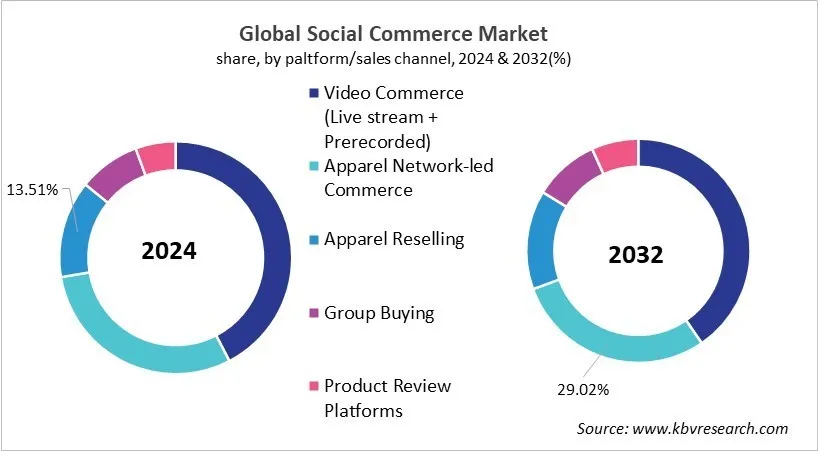
Based on platform/sales channel, the social commerce market is characterized into video commerce (live stream + prerecorded), apparel network-led commerce, apparel reselling, group buying, and product review platforms. The apparel network-led commerce segment attained 30% revenue share in the market in 2024. plays an important role in driving sales by connecting fashion-focused communities through dedicated platforms. These networks often feature curated collections, style inspiration, and personalized recommendations, fostering strong engagement among fashion-conscious shoppers. Sellers in this space benefit from established audiences who actively seek the latest trends, creating opportunities for niche targeting and brand loyalty.
On the basis of business model, the social commerce market is classified into B2C, C2C, and B2B. The C2C segment recorded 36% revenue share in the market in 2024. This segment thrives on peer-to-peer transactions facilitated by online communities, marketplaces, and social networking groups. Individuals use platforms to sell pre-owned goods, handmade items, or niche products, often relying on trust-building mechanisms such as user reviews, profile verifications, and direct communication. This model benefits from low entry barriers for sellers, community-driven engagement, and the rising consumer interest in sustainable shopping practices like re-commerce and thrift buying.
Free Valuable Insights: Global Social Commerce Market size to reach USD 11.95 Trillion by 2032
Region-wise, the social commerce market is analyzed across North America, Europe, Asia Pacific, and LAMEA. The Asia Pacific segment gained 69% revenue share in the market in 2024. North America and Europe are both well-established social commerce markets. Widespread social media use, a strong e-commerce infrastructure, and the popularity of platforms like Facebook, Instagram, TikTok, and Pinterest drive north America's market. The U.S. is ahead in adoption, with numerous influencer campaigns, integrated shopping features, and livestream events. Privacy-focused rules and small business participation help Canada's growth. Europe focuses on trust, openness, and following the GDPR. This is especially true for fashion, luxury, and lifestyle goods, as well as hybrid online and offline retail strategies.
Asia Pacific and LAMEA are growing quickly, with Asia Pacific leading the way because platforms like Douyin, Xiaohongshu, and WeChat in China, Japan, South Korea, and India have highly integrated, influencer-led, and livestream-heavy ecosystems. LAMEA is a new but quickly growing market, thanks to the increasing use of smartphones, better payment systems, and the rise in online shopping. Brazil, the UAE, and South Africa are becoming popular places for mobile-first consumers as global and local platforms use localized strategies to reach them.
| Report Attribute | Details |
|---|---|
| Market size value in 2024 | USD 1.20 Trillion |
| Market size forecast in 2032 | USD 11.95 Trillion |
| Base Year | 2024 |
| Historical Period | 2021 to 2023 |
| Forecast Period | 2025 to 2032 |
| Revenue Growth Rate | CAGR of 33.5% from 2025 to 2032 |
| Number of Pages | 501 |
| Number of Tables | 411 |
| Report coverage | Market Trends, Revenue Estimation and Forecast, Segmentation Analysis, Regional and Country Breakdown, Market Share Analysis, Porter’s 5 Forces Analysis, Company Profiling, Companies Strategic Developments, SWOT Analysis, Winning Imperatives |
| Segments covered | Platform/Sales Channel, Business Model, Product Type, Region |
| Country scope |
|
| Companies Included | Meta Platforms, Inc., ByteDance Ltd., Pinterest, Inc., Alibaba Group Holding Limited, Tencent Holdings Ltd., Pinduoduo Inc., Snap, Inc. (SnapChat), Google LLC (Youtube, LLC), Shopify Inc., and Amazon.com, Inc. |
By Platform/Sales Channel
By Business Model
By Product Type
By Geography
This Market size is expected to reach $11.95 Trillion by 2032.
Widespread Smartphone And Internet Penetration are driving the Market in coming years, however, Data Privacy And Security Concerns restraints the growth of the Market.
Meta Platforms, Inc., ByteDance Ltd., Pinterest, Inc., Alibaba Group Holding Limited, Tencent Holdings Ltd., Pinduoduo Inc., Snap, Inc. (SnapChat), Google LLC (Youtube, LLC), Shopify Inc., and Amazon.com, Inc.
The expected CAGR of this Market is 33.5% from 2023 to 2032.
The B2C segment led the maximum revenue in the Market by Business Model in 2024, thereby, achieving a market value of $6.6 Trillion by 2032.
The Asia Pacific region dominated the Market by Region in 2024, and would continue to be a dominant market till 2032; thereby, achieving a market value of $8.3 Trillion by 2032.
Our team of dedicated experts can provide you with attractive expansion opportunities for your business.







 Unique Offerings