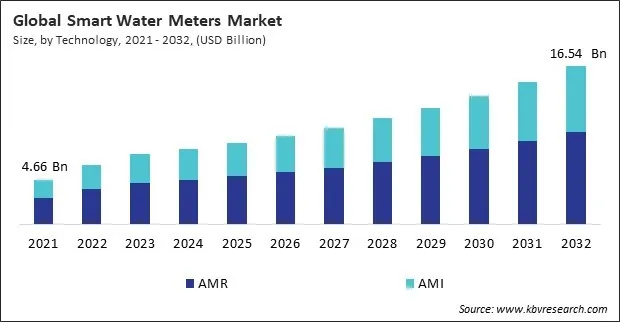
“Global Smart Water Meters Market to reach a market value of USD 16.54 Billion by 2032 growing at a CAGR of 10.0%”
The Global Smart Water Meters Market size is expected to reach $16.54 billion by 2032, rising at a market growth of 10.0% CAGR during the forecast period.
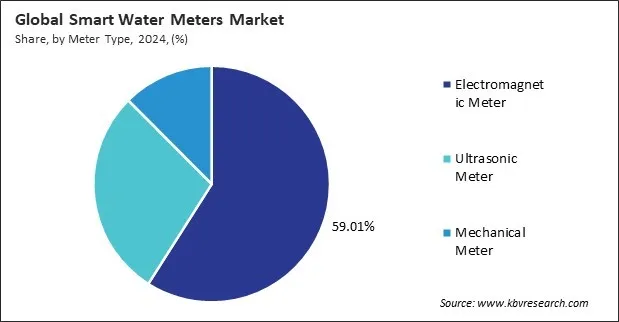
Electromagnetic meters have gained popularity due to their high precision and long-term reliability, making them particularly suitable for both municipal and industrial water monitoring applications. These meters operate without any moving parts, which significantly reduces the chances of mechanical failure and lowers maintenance requirements. Their design allows them to measure the flow of water with consistent accuracy, regardless of water quality, presence of particles, or changes in pressure. Additionally, electromagnetic meters are resistant to corrosion and fouling, allowing them to maintain performance in harsh or variable conditions. Thus, the electromagnetic meter segment acquired 59% revenue share in the smart water meters market in 2024.
The major strategies followed by the market participants are Product Launches as the key developmental strategy to keep pace with the changing demands of end users. For instance, In December, 2023, Xylem, Inc. unveiled a new smart meter featuring advanced grid-edge capabilities, including real-time data on electric vehicle (EV) charging. Designed to enhance energy efficiency, the meter supports utilities in managing load demand and grid reliability, promoting smarter infrastructure for a sustainable and resilient energy future. Additionally, In May, 2023, Honeywell International Inc. unveiled a next-generation cellular module that upgrades traditional utility meters into smart meters. This innovation enhances connectivity and data capabilities, enabling utilities to modernize infrastructure without full-meter replacement. The module supports efficient energy management, remote monitoring, and improved service delivery across utility networks.
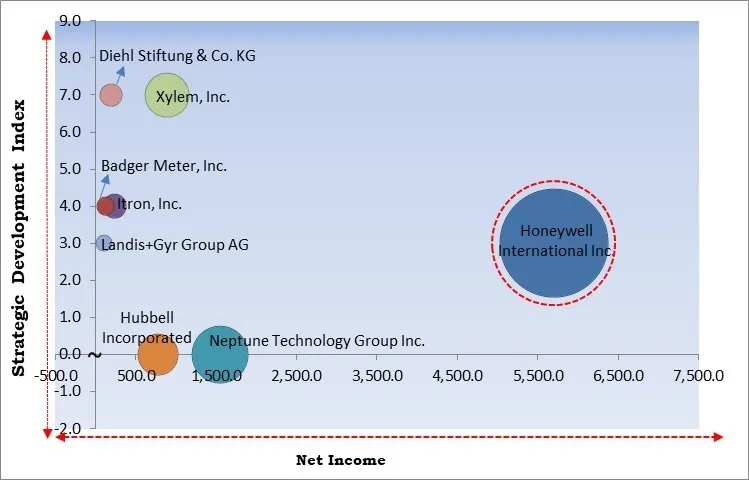
Based on the Analysis presented in the KBV Cardinal matrix; Honeywell International Inc. is the forerunner in the Smart Water Meters Market. Companies such as Neptune Technology Group Inc., Xylem, Inc., and Hubbell Incorporated are some of the key innovators in Smart Water Meters Market. In January 2023, Diehl Stiftung & Co. KG unveiled the IZAR@SMART-WATER, a cutting-edge smart water solution that enhances efficiency and transparency in water management. It enables utilities to monitor consumption in real time, detect leaks early, and optimize resources, supporting sustainability and digital transformation in the water industry through advanced data analytics and connectivity.
The outbreak of COVID-19 significantly disrupted global supply chains, and the smart water meters market was not immune to these effects. During the initial phases of the pandemic, manufacturing facilities experienced temporary shutdowns or reduced operational capacity, particularly in countries heavily impacted by lockdowns. This resulted in delays in the production and delivery of key components such as sensors and communication modules, hampering the timely deployment of smart water meters worldwide. COVID-19 restrictions also led to the postponement or cancellation of many infrastructure projects, including smart water meter installations. Municipalities and utility companies faced workforce shortages and restricted site access due to health and safety protocols, further delaying scheduled upgrades and new deployments. Thus, the COVID-19 pandemic had negative impact on the market.

Water scarcity, driven by population growth, urbanization, and climate change, is a critical global challenge, making smart water meters essential for sustainable water management. These devices provide real-time data on consumption, enabling utilities and consumers to monitor usage with precision. Unlike traditional meters, smart water meters detect leaks early, identify excessive consumption, and promote responsible water use. For example, households can receive alerts about unusual water flow, such as a running toilet, allowing quick fixes to prevent wastage. In water-stressed regions like Sub-Saharan Africa or parts of India, smart meters ensure fair access by tracking usage in community systems, preventing over-extraction. In conclusion, the urgent need to conserve water amidst growing scarcity drives the adoption of smart water meters, as they empower efficient and sustainable resource management.
Additionally, the evolution of IoT and connectivity technologies is transforming water management, making it a key driver for the smart water meters market. Smart meters leverage IoT to connect with utility networks and consumer devices, using sensors and wireless networks like NB-IoT or LoRaWAN to transmit real-time usage data. This allows utilities to monitor water flow across networks, detecting anomalies like leaks instantly. For example, a pressure drop in a pipeline can trigger an alert, enabling rapid repairs to prevent water loss. Consumers access usage data via mobile apps, gaining insights into consumption patterns and potential savings. Thus, advancements in IoT and connectivity technologies are propelling the smart water meters market by enabling real-time, data-driven solutions.
However, the high initial costs associated with installing and maintaining smart water meters pose a significant restraint on market growth, particularly for utilities and municipalities with limited budgets. Smart water meters, equipped with advanced sensors, IoT connectivity, and digital communication systems, are considerably more expensive than traditional mechanical meters. The cost of a single smart meter can be several times higher, and when scaled to thousands or millions of units across a city, the financial burden becomes substantial. Therefore, the high initial installation and maintenance costs significantly restrain the smart water meters market by limiting adoption among budget-constrained utilities and consumers.
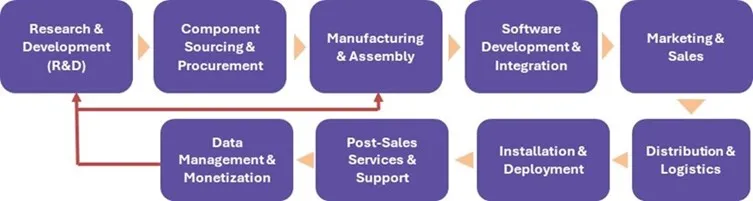
The Smart Water Meter Market value chain starts with Research & Development (R&D) focused on metering technologies, connectivity standards, and energy-efficient designs. Component Sourcing & Procurement follows, involving secure communication modules, sensors, and hardware parts. In Manufacturing & Assembly, smart meters are built and tested for durability. Software Development & Integration enables data analytics, remote monitoring, and billing functionalities. Through Marketing & Sales, vendors promote smart infrastructure benefits. Distribution & Logistics ensure timely delivery, followed by Installation & Deployment at utility or residential sites. Post-Sales Services & Support maintain operational efficiency, while Data Management & Monetization transforms meter data into actionable insights and new revenue streams.
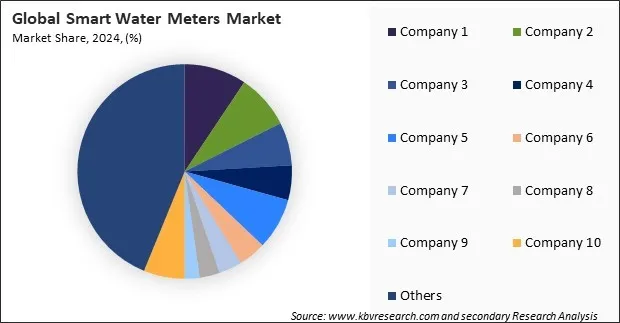
The leading players in the market are competing with diverse innovative offerings to remain competitive in the market. The above illustration shows the percentage of revenue shared by some of the leading companies in the market. The leading players of the market are adopting various strategies in order to cater demand coming from the different industries. The key developmental strategies in the market are Acquisitions, and Partnerships & Collaborations.
Free Valuable Insights: Global Smart Water Meters Market size to reach USD 16.54 Billion by 2032
Based on technology, the smart water meters market is characterized into AMR and AMI. The AMI segment procured a considerable revenue share in the smart water meters market in 2024. AMI systems provide two-way communication between utilities and consumers, enabling real-time monitoring, advanced analytics, and enhanced water management capabilities. Utilities benefit from improved data accuracy, leak detection, and better customer service due to the detailed insights provided by AMI technology. The growing emphasis on smart city initiatives and sustainable water management practices has fuelled the demand for AMI-based solutions, supporting their significant presence in the market.
| Category | Details |
|---|---|
| Use Case Title | Confidential |
| Date | 2025 |
| Entities Involved | Confidential |
| Objective | To enable real-time water usage monitoring, leak detection, and demand management in a smart city ecosystem by deploying AMI-based smart water meters with two-way communication capabilities. |
| Context and Background | As smart cities evolve in 2025, utilities are adopting Advanced Metering Infrastructure (AMI) to enable two-way communication between water meters and utility systems. AMI technology supports real-time data collection, remote control, and advanced analytics for water management. Itron, a leader in smart metering, partnered with Microsoft to integrate its AMI solution with Azure’s cloud platform, enabling scalable and data-driven water management for a smart city in Europe. |
| Description | Itron deployed its OpenWay Riva AMI platform across a smart city’s water utility network. The solution included:
|
| Key Capabilities Deployed |
|
| Benefits |
|
| Source | Confidential |
On the basis of meter type, the smart water meters market is classified into electromagnetic meter, ultrasonic meter, and mechanical meter. The mechanical meter segment held 12% revenue share in the smart water meters market in 2024. Mechanical meters have long been the traditional solution for water metering due to their simple construction and cost-effectiveness. These meters work by using moving components such as gears and turbines to measure the volume of water that flows through them.
By application, the smart water meters market is divided into residential, commercial, and industrial. The commercial segment garnered 25% revenue share in the smart water meters market in 2024. Commercial users, such as office buildings, hotels, retail centers, and schools, are increasingly turning to smart water meters to manage their water resources more efficiently and reduce operational costs. These meters provide detailed consumption analytics and facilitate billing accuracy, which are essential for businesses that need to monitor usage across multiple tenants or facilities.
Region-wise, the smart water meters market is analyzed across North America, Europe, Asia Pacific, and LAMEA. The North America segment recorded 45% revenue share in the smart water meters market in 2024. The region’s leadership is driven by widespread adoption of advanced metering technologies, strong governmental support for smart infrastructure, and ongoing investments by utilities to modernize water management systems.
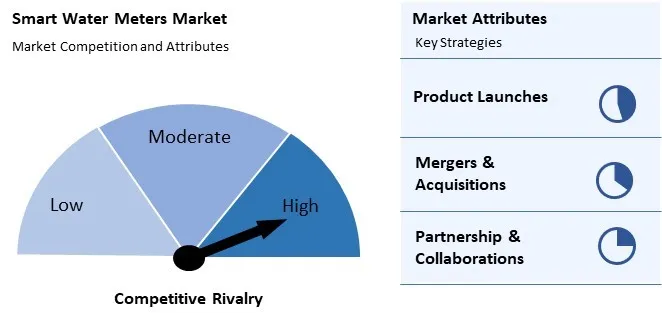
The Smart Water Meters Market is moderately to highly competitive, driven by increasing global demand for efficient water management and leak detection. Numerous players offer differentiated solutions based on communication technologies, data analytics integration, and billing automation. Vendors compete on accuracy, battery life, interoperability, and smart grid compatibility. Governments and utilities seeking smart infrastructure create strong demand, encouraging innovation. Price competitiveness and regulatory compliance further intensify rivalry. Strategic partnerships, service reliability, and post-installation support are key factors influencing vendor selection and long-term customer retention.
| Report Attribute | Details |
|---|---|
| Market size value in 2024 | USD 7.87 Billion |
| Market size forecast in 2032 | USD 16.54 Billion |
| Base Year | 2024 |
| Historical Period | 2021 to 2023 |
| Forecast Period | 2025 to 2032 |
| Revenue Growth Rate | CAGR of 10.0% from 2025 to 2032 |
| Number of Pages | 312 |
| Number of Tables | 352 |
| Report coverage | Market Trends, Revenue Estimation and Forecast, Segmentation Analysis, Regional and Country Breakdown, Competitive Landscape, Market Share Analysis, Porter’s 5 Forces Analysis, Company Profiling, Companies Strategic Developments, SWOT Analysis, Winning Imperatives |
| Segments covered | Technology, Meter Type, Application, Region |
| Country scope |
|
| Companies Included | Itron, Inc., Neptune Technology Group Inc. (Roper Technologies, Inc.), Honeywell International Inc., Badger Meter, Inc., Landis+Gyr Group AG, Hubbell Incorporated, Arad Group, Diehl Stiftung & Co. KG, B METERS S.R.L., and Xylem, Inc. (Sensus) |
By Technology
By Meter Type
By Application
By Geography
The Market size is projected to reach USD16.54 billion by 2032.
Growing Need for Water Conservation Amidst Scarcity are driving the Market in coming years, however, High Initial Installation and Maintenance Costs restraints the growth of the Market.
Itron, Inc., Neptune Technology Group Inc. (Roper Technologies, Inc.), Honeywell International Inc., Badger Meter, Inc., Landis+Gyr Group AG, Hubbell Incorporated, Arad Group, Diehl Stiftung & Co. KG, B METERS S.R.L., and Xylem, Inc. (Sensus)
The expected CAGR of this Market is 10.0% from 2023 to 2032.
The AMR segment is leading the Market by Technology in 2024, thereby, achieving a market value of $9.58 billion by 2032.
The North America region dominated the Market by Region in 2024, and would continue to be a dominant market till 2032; thereby, achieving a market value of $7.01 billion by 2032.
Our team of dedicated experts can provide you with attractive expansion opportunities for your business.






 Unique Offerings