“Global Situation Awareness Systems Market to reach a market value of USD 44.44 Billion by 2032 growing at a CAGR of 6.8%”
The Global Situation Awareness Systems Market size is expected to reach USD 44.44 billion by 2032, rising at a market growth of 6.8% CAGR during the forecast period.
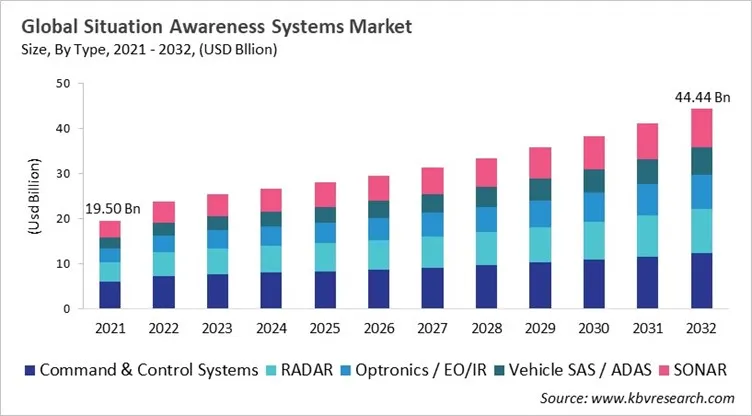
Situation awareness systems are integrated platforms developed to fuse, collect, analyze, and visualize real-time data from diverse sources to support informed decision making across homeland security, defense, maritime, aviation, emergency response, and critical infrastructure industry. Previously, situation awareness systems were hardware-centric and relied largely on manual interpretation of communication and radar data. Advancements in digital computing have allowed software-driven sensor fusion, decision-support tools, and geographical visualization, expanding adoption into maritime domain awareness and air traffic management. Further, rising concerns of border security, terrorism, and disaster preparedness encourage governments to invest in more integrated, multi-agency platforms, expanding deployment of situation awareness into transportation safety, civil protection, and public emergency management.
The situation awareness system market has shifted toward software-defined, network-defined, and interoperable architectures that integrate data from unmanned systems, satellites, open-source intelligence, and IoT sensors. Key trends driving the situation awareness system market include multi-domain data fusion across sea, land, space, and air; expanding usage in civilian infrastructure and disaster management, and the integration of AI and advanced analytics for automated alerting and predictive insights. Governments largely prioritize open standards, public-sector aligned R&D, scalable platforms, and lifecycle support. The market remains competitive, favouring well-established OEMs with proven compliance, government credibility, and reliability.
The major strategies followed by the market participants are (Strategy name) as the key developmental strategy to keep pace with the changing demands of end users. For instance, In February, 2025, Honeywell International, Inc. expanded its partnership with NXP Semiconductors, a Dutch semiconductor company, to advance AI-powered avionics and next-generation cockpit systems. Announced at CES 2025, the partnership integrates NXP’s high-performance processors into the Honeywell Anthem cockpit, enhancing situational awareness, flight safety, and operational efficiency. Additionally, In September, 2024, RTX Corporation's Collins Aerospace expanded its collaboration with C3 AI, an enterprise AI software provider, to enhance AI-driven defense and intelligence solutions. This partnership focuses on deploying AI applications such as C3 AI Readiness and C3 Generative AI for Defense and Intelligence, improving situational awareness, operational efficiency, and national security decision-making. The initiative aligns with federal priorities, equipping agencies with scalable AI tools to enhance mission readiness and strategic advantage.
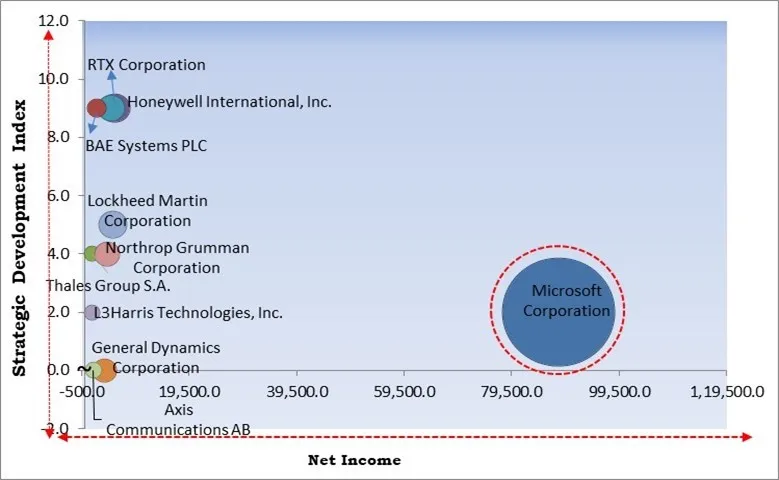
Based on the Analysis presented in the KBV Cardinal matrix; Microsoft Corporation are the forerunners in the Situation Awareness Systems Market. Companies such as Honeywell International, Inc., RTX Corporation, Lockheed Martin Corporation are some of the key innovators in Situation Awareness Systems Market. In February, 2025, Microsoft Corporation partnered with Anduril Industries, a defense technology company, to advance the U.S. Army’s Integrated Visual Augmentation System (IVAS) program. Under this partnership, Anduril will oversee hardware and software development, while Microsoft Azure will serve as the preferred hyperscale cloud for AI-driven military applications. This partnership aims to enhance battlefield situational awareness, decision-making, and operational effectiveness by integrating augmented reality (AR) and AI technologies, reinforcing Microsoft’s role in defense innovation.
The COVID-19 pandemic hurt the Situation Awareness Systems market because it messed up the supply chain and slowed down production. Lockdowns slowed down the production and delivery of important hardware parts, which raised costs and pushed back project deadlines. When money was moved from defense, transportation, and infrastructure projects to healthcare, spending on those things went down. Many system deployments were put off because of rules that made it hard to install and train people on-site. Private companies put off investments because they weren't sure about their finances. Limitations on the workforce hurt R&D productivity. These factors made it take longer for people to adopt new technologies and slowed short-term market growth during the pandemic. Thus, the COVID-19 pandemic had a negative impact on the market.

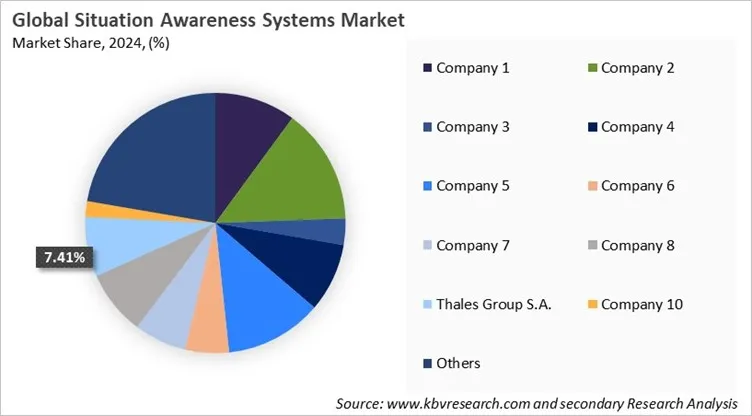
The leading players in the market are competing with diverse innovative offerings to remain competitive in the market. The above illustration shows the percentage of revenue shared by some of the leading companies in the market. The leading players of the market are adopting various strategies to cater demand coming from the different industries. The key developmental strategies in the market are Acquisitions, and Partnerships & Collaborations.
Free Valuable Insights: Situation Awareness Systems Market size to reach USD 44.44 Billion by 2032
Based on Type, the Situation Awareness Systems Market is segmented into Command & Control Systems, RADAR, Optronics / EO/IR, Vehicle SAS / ADAS, and SONAR. The RADAR segment attained 22% revenue share in the market in 2024. The RADAR segment contributes significantly to the Situation Awareness Systems Market by offering reliable detection, tracking, and monitoring capabilities under diverse environmental conditions. Radar systems are widely used for surveillance, threat detection, navigation support, and perimeter security, providing consistent performance regardless of visibility or weather constraints.
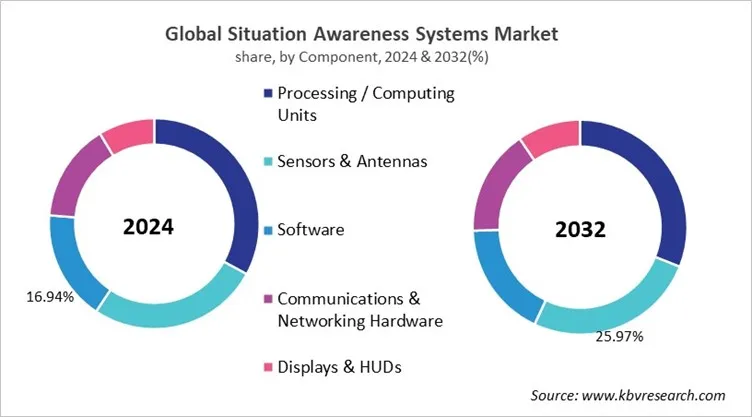
Based on Component, the Situation Awareness Systems Market is segmented into Processing / Computing Units, Sensors & Antennas, Software, Communications & Networking Hardware, and Displays & HUDs. The Sensors & Antennas segment attained 26% revenue share in the market in 2024. The Sensors & Antennas segment plays a fundamental role in the Situation Awareness Systems Market by serving as the primary data acquisition layer across operational environments. This segment encompasses a wide range of sensing technologies designed to capture physical, electromagnetic, acoustic, and visual information, enabling comprehensive environmental perception.
Based on Platform, the Situation Awareness Systems Market is segmented into Land, Air, Sea, and Space. The Air segment attained 33% revenue share in the market in 2024. The Air platform segment plays a vital role in the Situation Awareness Systems Market by enabling comprehensive monitoring and decision support for aerial operations. Airborne situation awareness systems are designed to support aircraft, unmanned aerial vehicles, and air defense operations by integrating radar, navigation data, communication links, and sensor inputs into a unified operational picture.
Region-wise, the Situation Awareness Systems Market is analyzed across North America, Europe, Asia Pacific, and LAMEA. The North America segment recorded 37% revenue share in the market in 2024. In the North America and Europe region, the situation awareness system market is anticipated to grow at a substantial rate. This is because of prominent government and defense spending, technological leadership, and large adoption in critical infrastructure, homeland security, and smart city initiatives. Regional nations leads the demand because of robust investments in advanced analytics, integrated surveillance systems, and AI-enabled platforms. Moreover, Europe situation awareness system market is predicted to capture a large share, driven by strong adoption across transportation safety, defense modernization, public safety, and cross-border security initiatives. The European market is further supported by investments in interoperable situational awareness platforms and strict regulatory frameworks focusing on cybersecurity and data protection.
The situation awareness system market is estimated to experience prominent expansion in the Asia Pacific and LAMEA region. The market is propelled by increasing defense and security expenditures, rapid urbanization, and large-scale infrastructure modernization projects in nations such as India, China, Japan, and South Korea. The regional market is further witnessing growth due to elements including IoT sensor proliferation, smart city deployments, and rising demand for real-time monitoring across industrial sectors and public safety. Furthermore, the LAMEA situation awareness system market is growing, supported by infrastructure investments, rising security concerns, and government initiatives to improve disaster management and border protection. Also, investments in digital transformation and public safety technologies are offering lucrative opportunities for providers looking for expansion.
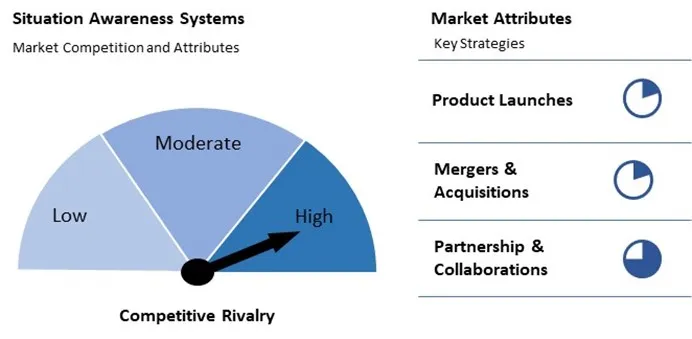
Market competition in the Situation Awareness Systems market is moderately high, driven by increasing demand from defense, homeland security, transportation, and critical infrastructure sectors. Competitors differentiate through system integration capabilities, real-time data processing, analytics accuracy, and interoperability with existing platforms. Technological innovation, including AI-driven analytics and sensor fusion, intensifies rivalry. High entry barriers related to complex system requirements and regulatory compliance limit new entrants, while long-term government contracts and customization needs encourage strategic partnerships and sustained competition.
| Report Attribute | Details |
|---|---|
| Market size value in 2025 | USD 28.04 Billion |
| Market size forecast in 2032 | USD 44.44 Billion |
| Base Year | 2024 |
| Historical Period | 2021 to 2023 |
| Forecast Period | 2025 to 2032 |
| Revenue Growth Rate | CAGR of 6.8% from 2025 to 2032 |
| Number of Pages | 764 |
| Number of Tables | 638 |
| Report coverage | Market Trends, Revenue Estimation and Forecast, Segmentation Analysis, Regional and Country Breakdown, Competitive Landscape, Market Share Analysis, Market Share Analysis, Porter’s 5 Forces Analysis, Company Profiling, Companies Strategic Developments, SWOT Analysis, Winning Imperatives |
| Segments covered | Type, Component, Platform, End-User Industry, Application, Region |
| Country scope |
|
| Companies Included | Honeywell International, Inc., RTX Corporation, Microsoft Corporation, BAE Systems PLC, Lockheed Martin Corporation, General Dynamics Corporation, L3Harris Technologies, Inc., Northrop Grumman Corporation, Thales Group S.A. and Axis Communications AB (Canon, Inc.) |
By Type
By Component
By Platform
By End-User Industry
By Application
By Geography
The market size is projected to reach USD 44.44 Billion by 2032.
The situation awareness systems market is projected to grow at a CAGR of 6.8% between 2025 and 2032.
Integration of multi-sensor and multi-source data, combined with adoption of artificial intelligence and advanced analytics, is driving market growth.
Honeywell International, Inc., RTX Corporation, Microsoft Corporation, BAE Systems PLC, Lockheed Martin Corporation, General Dynamics Corporation, L3Harris Technologies, Inc., Northrop Grumman Corporation, Thales Group S.A. and Axis Communications AB (Canon, Inc.)
The Defense & Military segment led the Global Situation Awareness Systems Market by End-User Industry in 2024; thereby, achieving a market value of $18.83 billion by 2032.
The North America region dominated the Global Situation Awareness Systems Market by Region in 2024, and would continue to be a dominant market till 2032; thereby, achieving a market value of $15.41 billion by 2032.
Our team of dedicated experts can provide you with attractive expansion opportunities for your business.







 Unique Offerings