“Global Sensing Cable Market to reach a market value of USD 1.68 Billion by 2032 growing at a CAGR of 6.6%”
The Global Sensing Cable Market size is expected to reach $1.68 billion by 2032, rising at a market growth of 6.6% CAGR during the forecast period.
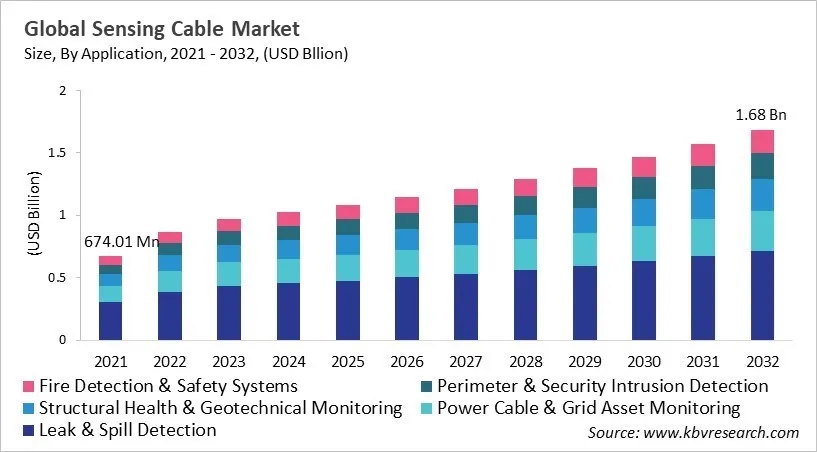
Sensing cables are fiber-optic, designed to identify physical changes like strain, temperature, vibration, or pressure in real-time. The sensing cable market has witnessed significant advancements with industries prioritizing safety compliance, automation, and real-time monitoring. Sensing cables have evolved from simple heat and fire detection systems supported by government safety mandates for crucial infrastructure. Sensing cables have gained the capability to detect strain, vibration, temperature, and acoustic signals across long distances, with the development of fiber-optic technology. The adoption has surged in transportation, oil & gas, mining, and smart city projects, where continuous environmental and structural monitoring is essential. Nowadays, sensing cables are being integrated with digital platforms, allowing predictive maintenance and enhanced asset reliability across tunnels, industrial facilities, energy sites, and public infrastructure.
The market competition is accelerated by elements including application diversity, product durability, and technological innovation. Key market players focus on boosting accuracy, improving cable resilience, and simplifying installation with support of R&D investments. They also develop solution that effortless integrate with remote monitoring systems, and cloud-based analytics. Partnerships with energy operators, infrastructure developers, and public agencies further help manufacturers tailor solutions to environmental and regulatory requirements. The key players in the market are dominating with mission-critical projects and newcomers are targeting areas such as smart infrastructure and environmental sensing. The market competition is continuously intensifying, with sensing cables becoming indispensable for safety-driven, modern, and automated operations.
The COVID-19 pandemic impacted the sensing cable market by severely disrupting global supply chains. Manufacturing facilities had to shut down temporarily, there weren't enough workers, and there were government rules that slowed down production and deliveries. At the same time, demand fell because important end-use industries like oil and gas, transportation, and infrastructure put off or canceled projects because of budget problems and limited access to sites. International trade barriers, shipping delays, and longer wait times for regulatory approvals all made projects take longer and made the market less active. There were also limits on research and development, with field tests, R&D programs, and collaborations with other companies being put on hold or canceled. All of these things together hurt sales, slowed down technological progress, and made the market's recovery take longer during the pandemic. Thus, the COVID-19 pandemic had a negative impact on the market.

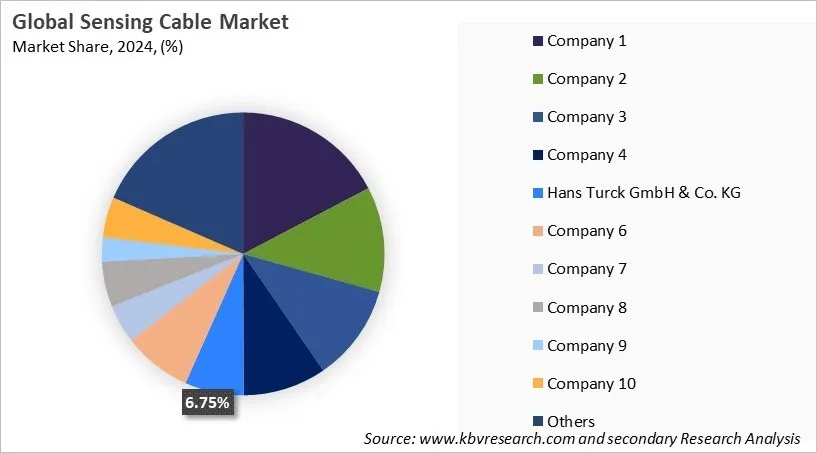
The leading players in the market are competing with diverse innovative offerings to remain competitive in the market. The above illustration shows the percentage of revenue shared by some of the leading companies in the market. The leading players of the market are adopting various strategies in order to cater demand coming from the different industries. The key developmental strategies in the market are Acquisitions, and Partnerships & Collaborations.
Based on Application, the market is segmented into Leak & Spill Detection, Power Cable & Grid Asset Monitoring, Structural Health & Geotechnical Monitoring, Perimeter & Security Intrusion Detection and Fire Detection & Safety Systems. The power cable & grid asset monitoring segment attained 19% revenue share in the sensing cable market in 2024. The power cable & grid asset monitoring segment shows strong demand due to the increasing emphasis on maintaining reliable energy infrastructure. Utilities and grid operators rely on sensing cables to track asset performance, prevent failures, and ensure uninterrupted power delivery. This application supports improved grid resilience and operational efficiency, making it an essential component of modern energy management systems.
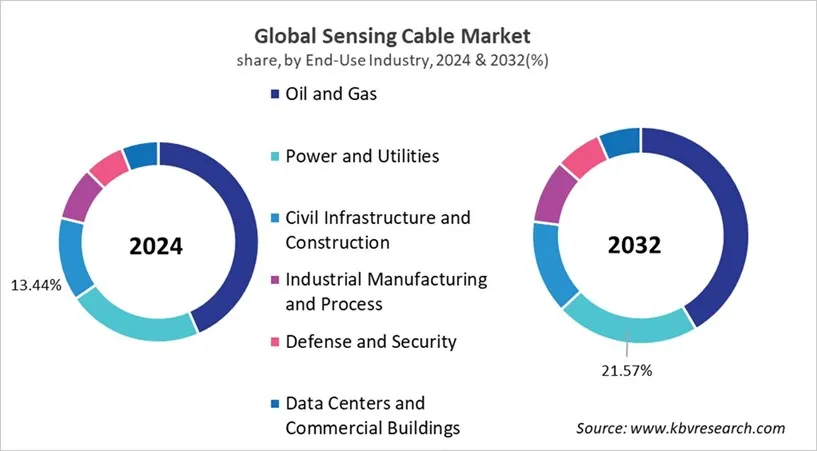
Based on End-Use Industry, the market is segmented into Oil and Gas, Power and Utilities, Civil Infrastructure and Construction, Industrial Manufacturing and Process, Defense and Security and Data Centers and Commercial Buildings. The power and utilities segment recorded 22% revenue share in the sensing cable market in 2024. The power and utilities segment demonstrates consistent utilization of sensing cable solutions to support reliable energy transmission and distribution. These cables help monitor power lines, identify faults, and ensure the health of critical grid components. By enabling predictive maintenance and improving network stability, sensing technologies contribute to the modernization and resilience of energy infrastructure across this sector.
Based on Sensing Technology, the market is segmented into Distributed Temperature Sensing (DTS), Distributed Acoustic Sensing (DAS), Distributed Strain/Pressure Sensing and Hybrid Multi-Parameter Sensing. The distributed acoustic sensing (DAS) segment recorded 30% revenue share in the sensing cable market in 2024. This is due to increasing demand for advanced monitoring and security solutions. DAS technology was widely used for pipeline surveillance, transportation infrastructure monitoring, and perimeter security, as it detected acoustic vibrations and disturbances in real time. Continuous advancements in data analytics, artificial intelligence, and signal interpretation improved system performance, which further accelerated global adoption across both public and private sector applications.
Based on Cable Type, the market is segmented into Fiber-Optic Sensing Cables, Electrical/Coaxial Sensing Cables, Polymer Optical Fiber (POF) Sensing Cables and Hybrid (Power + Fiber) Sensing Cables. The electrical/coaxial sensing cables segment recorded 13% revenue share in the sensing cable market in 2024. The electrical/coaxial sensing cables segment maintains a steady presence in the market as a dependable option for various industrial and commercial monitoring needs. These cables are commonly utilized in environments where electrical signal-based sensing is effective, offering practical performance in applications that do not require the extended range or precision associated with fiber-optic systems.
Free Valuable Insights: Sensing Cable Market size to reach USD 1.68 Billion by 2032
Region-wise, the sensing cable market is analyzed across North America, Europe, Asia Pacific, and LAMEA. The North America segment recorded 34% revenue share in the sensing cable market in 2024. The sensing cable market is predicted to grow at a significant rate in North America and Europe. This is because of industry automation, a strong focus on infrastructure safety, and regulatory compliance. North America benefits from large adoption in rail networks, oil & gas pipelines, data centers, and power utilities, driven by strict safety guidelines and government focus on real-time monitoring of crucial assets. Furthermore, the European sensing cable market is witnessing expansion supported by the expansion of renewable energy, stringent fire safety standards for metros, industrial facilities, and tunnels, and the modernization of transport corridors. Both North America and the European region have advanced fiber-optic manufacturing capabilities, OEM presence, and early adoption of distributed sensing technologies, thereby making them hubs for high-performance solutions and innovations. Also, continued upgradation in 5G infrastructure and demand for predictive maintenance tools further supported market expansion.
In the Asia Pacific and LAMEA regions, the sensing cable market is expected to experience noticeable expansion driven by heavy government investment in smart cities, energy deployment, and large infrastructure projects. Asia Pacific’s demand is fuelled by expanding urban tunnels, rail networks, industrial automation initiatives, and hydropower sites across Southeast Asia, Japan, India, and China. The region also witnesses rising deployment of sensing cables in perimeter security, geothermal plants, and environmental monitoring because of increasing climate resilience needs. In LAMEA, the sensing cable market is growing with investments in mining, oil & gas, and utility modernization, resulting in positive opportunities for fiber-optic sensing solutions. Middle Eastern nations are adopting advanced monitoring systems for industrial facilities and pipelines, while Africa and Latin America are gradually incorporating sensing technologies as part of broader infrastructure upgrades. Rising prevalence of global players in developing regions and increasing government incentives for industrial digitalization are projected to surge adoption at a steady pace. Additionally, rising focus on disaster-resilient infrastructure accelerates the demand for real-time sensing applications.
| Report Attribute | Details |
|---|---|
| Market size value in 2025 | USD 1.08 Billion |
| Market size forecast in 2032 | USD 1.68 Billion |
| Base Year | 2024 |
| Historical Period | 2021 to 2023 |
| Forecast Period | 2025 to 2032 |
| Revenue Growth Rate | CAGR of 6.6% from 2025 to 2032 |
| Number of Pages | 665 |
| Number of Tables | 511 |
| Report coverage | Market Trends, Revenue Estimation and Forecast, Segmentation Analysis, Regional and Country Breakdown, Market Share Analysis, Porter’s 5 Forces Analysis, Company Profiling, Companies Strategic Developments, SWOT Analysis, Winning Imperatives |
| Segments covered | Application, End-Use Industry, Sensing Technology, Cable Type, Region |
| Country scope |
|
| Companies Included | TE Connectivity Ltd., Schneider Electric SE, Belden, Inc., AP Sensing GmbH, Hans Turck GmbH & Co. KG, Bandweaver Technology Ltd., Baumer Holding AG, Pepperl+Fuchs SE, Schlumberger Limited, and Beckhoff Automation GmbH & Co. KG |
By Application
By End-Use Industry
By Sensing Technology
By Cable Type
By Geography
This Market size is expected to reach USD 1.68 billion by 2032.
The sensing cable market is projected to grow at a CAGR of 6.6% between 2025 and 2032.
Rising global emphasis on infrastructure safety, reliability, and disaster-resilient monitoring, alongside expansion of oil & gas, power transmission, utilities, and industrial networks worldwide.
TE Connectivity Ltd., Schneider Electric SE, Belden, Inc., AP Sensing GmbH, Hans Turck GmbH & Co. KG, Bandweaver Technology Ltd., Baumer Holding AG, Pepperl+Fuchs SE, Schlumberger Limited, and Beckhoff Automation GmbH & Co. KG
The Leak & Spill Detection segment captured the maximum revenue in the Global Sensing Cable Market by Application in 2024, thereby, achieving a market value of $718.3 million by 2032.
The North America region dominated the Global Sensing Cable Market by Region in 2024, and would continue to be a dominant market till 2032; thereby, achieving a market value of $547.8 million by 2032.
Our team of dedicated experts can provide you with attractive expansion opportunities for your business.






 Unique Offerings