“Global Self Services Technology Market to reach a market value of USD 112.59 Billion by 2032 growing at a CAGR of 13.4%”
The Global Self Services Technology Market size is estimated at $46.57 billion in 2025 and is expected to reach $112.59 billion by 2032, rising at a market growth of 13.4% CAGR during the forecast period (2025-2032). The projected growth of the global self-service technology market is driven by rising adoption of kiosks, ATMs, and automated checkouts across retail, banking, healthcare, and transportation sectors. Increasing demand for contactless services, operational efficiency, reduced labor costs, and advancements in AI and IoT technologies further justify the strong CAGR during 2025–2032.
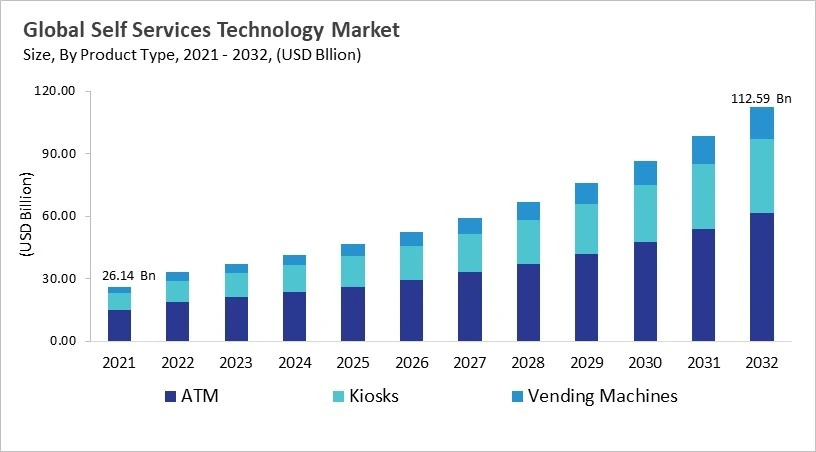
Self-service technology allows users to complete transactions and access services independently through integrated hardware like touchscreens and kiosks and supporting software platforms. The development began with automated banking systems such as ATMs, which shifted customer access to financial services, and later expanded into hospitality, retail, travel, and government services as touchscreen interfaces and computing power advanced. Self-service solutions are largely used for hotel and airline check-ins, self-checkout, transit ticketing, healthcare patient registration, and public service delivery. Enterprises and governments have embraced these systems to enhance accessibility, efficiency, and convenience, underlining a shift toward automated service models and customer empowerment supported by enterprise integration and cloud connectivity.
The self-services technology market is propelled by trends like user-centric design, multi-industry adoption, digital platform integration, and rising demand for contactless interactions. Key OEMs focus on integrated, scalable platforms, operational efficiency, customizable solutions, and strong compliance and security frameworks. Market competition is driven by reliability, technological differentiation, and integration capabilities, with OEMs such as Toshiba TEC and NCR competing along with regional specialists. Strong service networks, continued innovation, and the ability to deliver connected, secure, and flexible self-service ecosystems are some of the elements critical for developing the market.

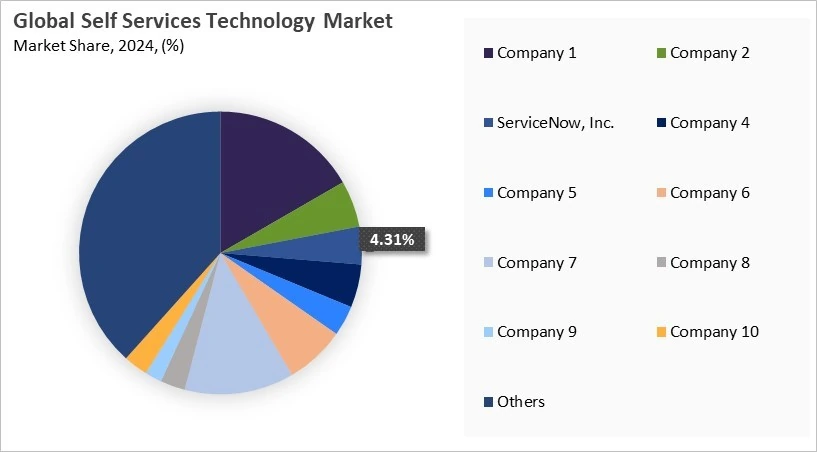
The leading players in the market are competing with diverse innovative offerings to remain competitive in the market. The above illustration shows the percentage of revenue shared by some of the leading companies in the market. The leading players of the market are adopting various strategies in order to cater demand coming from the different industries. The key developmental strategies in the market are Acquisitions, and Partnerships & Collaborations.
The COVID-19 pandemic initially hindered the self-service technology market due to economic uncertainty, industry shutdowns, and delayed capital investments across sectors such as retail, hospitality, and transportation. Supply chain disruptions, factory closures, labor shortages, and rising logistics costs slowed production and delivery of self-service systems. Installation and maintenance activities were restricted by travel bans and social distancing rules. Concerns over hygiene and shared-touch interfaces further reduced deployment in public spaces. Small and medium-sized enterprises were especially affected by financial stress, limiting their technology spending. Many businesses postponed automation projects to focus on short-term survival. As a result, the market faced short-term contraction and uneven regional growth during the peak of the pandemic. Thus, the COVID-19 pandemic had a Negative impact on the market.
Based on product type, the self-services technology market is characterized into ATM, kiosks, and vending machines. The kiosks segment attained 31% revenue share in the Self Services Technology Market in 2024. The kiosks segment is a prominent part of the Self Services Technology Market, driven by its versatility and broad application across industries such as retail, hospitality, healthcare, transportation, and government services. Organizations increasingly utilize kiosks to improve service efficiency, reduce waiting times, and enhance customer engagement through intuitive, interactive platforms.
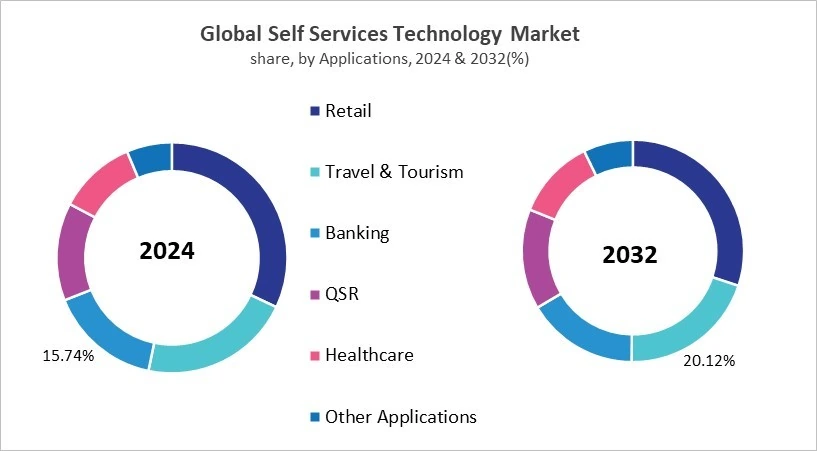
On the basis of applications, the self-services technology market is classified into retail, travel & tourism, banking, QSR, healthcare, and other applications. The travel & tourism segment recorded 21% revenue share in the self-service technology market in 2024. This is driven by increasing passenger volumes and the need for efficient service delivery across airports, hotels, railways, and entertainment venues. Self-check-in kiosks, automated ticketing systems, and digital information terminals have become essential tools for managing high traffic while improving traveler experience.
Free Valuable Insights: Self Services Technology Market Size to reach $112.59 by 2032
Region-wise, the Self Services Technology Market is analyzed across North America, Europe, Asia Pacific, and LAMEA. The North America segment recorded 31% revenue share in the Self Services Technology Market in 2024. The self-service technology market is estimated to grow at a significant rate in the North America and Europe region. This is because of high adoption across the banking, retail, transportation, healthcare, and hospitality industries. Canada and the US are leading the market with millions of kiosks, ATMs, and vending machines installed, and widespread consumer preference for contactless, automated interactions resulting in growth. Significant investments in innovation, strong digital infrastructure, and advanced consumer readiness for automation across the region are resulting in expansion. Furthermore, the European self-service market is anticipated to expand at a prominent rate. The market is propelled by transport ticketing, retail self-checkout, and digital banking services. The region is driven by sustainability regulations and strict data privacy, which encourage design priorities and deployment strategies.
In the Asia Pacific and LAMEA region, the self-service technology market is predicted to capture a prominent rate. The market is driven by expanding digital infrastructure, rapid urbanization, increasing middle-class populations, and government initiatives across smart cities. Key regions like Japan, China, and India are witnessing large-scale deployments of ATMs, kiosks, and automated services terminals across several industries like transportation, retail, public services, and the hospitality sector. This region’s expansion is supported by rising mobile integration, digital payments, and cost-effective manufacturing ecosystems. Moreover, the LAMEA self-service technology market is expected to grow at a substantial rate. The region market is propelled by tourism expansion, infrastructure upgrades, and the digitization of public services.
| Report Attribute | Details |
|---|---|
| Market size value in 2025 | USD 46.57 Billion |
| Market size forecast in 2032 | USD 112.59 Billion |
| Base Year | 2024 |
| Historical period | 2021 to 2023 |
| Forecast Period | 2025 to 2032 |
| Revenue Growth Rate | CAGR of 13.4% from 2025 to 2032 |
| Number of Pages | 459 |
| Tables | 295 |
| Report Coverage | Market Trends, Revenue Estimation and Forecast, Segmentation Analysis, Regional and Country Breakdown, Market Share Analysis, Porter’s 5 Forces Analysis, Company Profiling, Companies Strategic Developments, SWOT Analysis, Winning Imperatives |
| Segments Covered | Product Type, Applications, Region |
| Country Scope |
|
| Companies Included | NCR Corporation, IBM Corporation, ServiceNow, Inc., Advantech Co., Ltd., Zendesk, Inc., Fujitsu Limited, Diebold Nixdorf, Inc., Crane Company, Frank Mayer and Associates Inc. and Shanghai Sunmi Technology Co., Ltd. |
By Product Type
By Applications
By Geography
Our team of dedicated experts can provide you with attractive expansion opportunities for your business.







 Unique Offerings