“Global Second Life EV Battery Market to reach a market value of USD 23.54 Billion by 2032 growing at a CAGR of 42.6%”
The Global Second Life EV Battery Market size is expected to reach USD 23.54 billion by 2032, rising at a market growth of 42.6% CAGR during the forecast period.
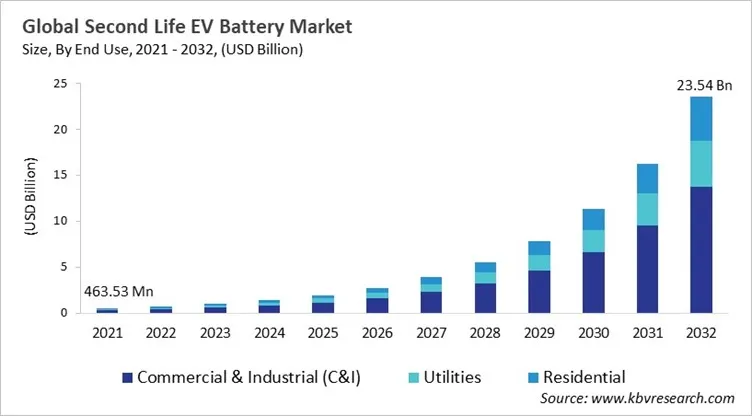
The second-life EV battery market has developed from experimental pilots to a commercial ecosystem backed by the twin imperatives of decarbonisation and circular economy. With the expanding adoption of electric vehicles, rising volumes of retired lithium-ion batteries are being repurposed into stationary ESS for renewable-energy firming, backup power, and grid services. Additionally, policy initiatives like the US DOE’s “Electric Drive Vehicle Battery Recycling and Second Life Applications” program, along with similar European efforts, are surging reuse frameworks. Also, advances in safety certification, modular battery design, and diagnostics are enhancing the economics and feasibility of second-life deployment, transforming the second-life EV battery market.
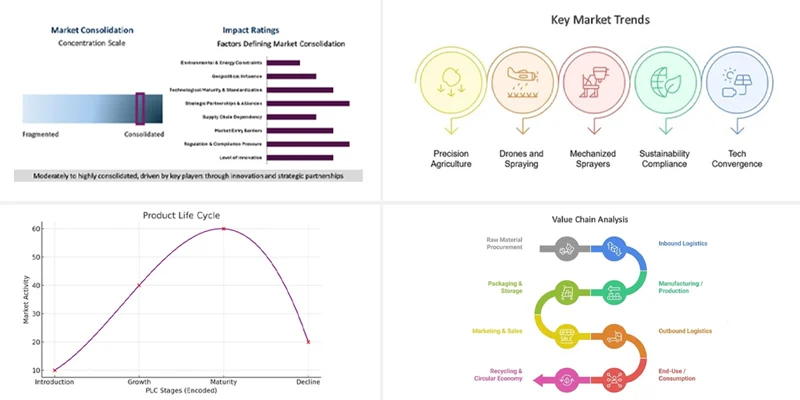
The second-life EV battery market is shaped by trends including strengthening regulatory and circular-economy frameworks and optimising battery design for reuse, and scaling stationery and grid-storage applications. Automakers such as BMW and Nissan are leading through vertical integration-grading, collecting, and repurposing retired EV batteries-and through cross-industry collaboration with storage and energy specialists. The growth of data-driven platforms for tracking battery state-of-health and certification further unveils efficient and safe reuse. The competitive landscape of the market remains fragmented; companies that can combine traceability, lifecycle ownership, and energy-market integration are gaining an advantage. With the increasing volumes of end-of-life EV batteries across the globe, the second-life EV battery market is expanding, supported by digitalization, collaborations, and circular supply-chain innovation.
The COVID-19 pandemic severely disrupted the global second-life EV battery market, halting manufacturing and supply chains due to lockdowns, labor shortages, and material scarcities. OEMs paused production, delaying the collection and repurposing of end-of-life batteries, while logistical and trade bottlenecks hindered the transport and availability of refurbished modules. Pilot projects by automakers like Nissan, BMW, and Renault were postponed, and R&D efforts slowed, stalling progress in standardization and innovation. Economic uncertainty further reduced investments from both public and private sectors, as companies prioritized financial stability over sustainability initiatives. Declining EV sales limited the supply of used batteries for reuse. However, the pandemic also highlighted supply chain vulnerabilities, prompting post-pandemic focus on circular economy and localized resilience. Overall, 2020–2021 marked a temporary setback but reshaped long-term strategies toward sustainability in the second-life battery sector. Thus, the COVID-19 pandemic had a Negative/Positive impact on the market.

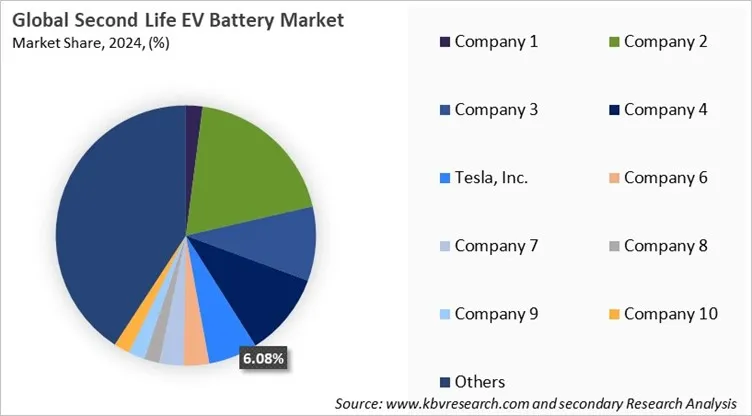
The leading players in the market are competing with diverse innovative offerings to remain competitive in the market. The above illustration shows the percentage of revenue shared by some of the leading companies in the market. The leading players of the market are adopting various strategies to cater demand coming from the different industries. The key developmental strategies in the market are Acquisitions, and Partnerships & Collaborations.
Based on end use, the second life EV battery market is characterized into commercial & industrial (C&I), utilities, and residential. The utilities segment attained 21% revenue share in the second life EV battery market in 2024. In the utilities sector, second-life EV batteries are being deployed to support grid-scale applications and ancillary services. Utilities are piloting the integration of repurposed battery modules into their energy-storage portfolios, enabling functions such as frequency regulation, balancing variable renewable energy supply and providing deferred investment in grid infrastructure. OEM networks partner with utilities to collect retired batteries, validate remaining capacity, and configure them into modular systems that can be aggregated at utility-scale sites.
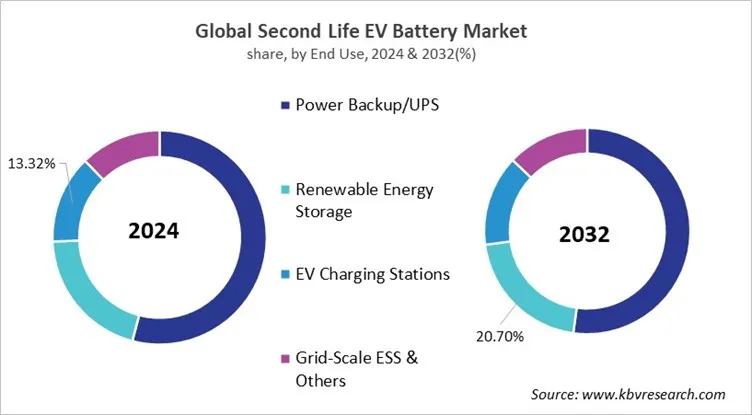
On the basis of application, the second life EV battery market is classified into power backup/UPS, renewable energy storage, EV charging stations, and grid-scale ESS & others. The renewable energy storage segment recorded 20% revenue share in the Second Life EV Battery Market in 2024. Another strong application area is storage of renewable-generation output at smaller scale, where second-life batteries are used to firm intermittent solar or wind supply. For instance, after the primary traction life of vehicle battery packs, they are repurposed for renewable-energy-storage systems (RESS) that help solar-PV installations in commercial rooftops or micro-grids to shift generation, manage ramp-up/ramp-down and elevate self-consumption.
Free Valuable Insights: Second Life EV Battery Market size to reach USD 23.54 Billion by 2032
Region-wise, the second life EV battery market is analyzed across North America, Europe, Asia Pacific, and LAMEA. The Asia Pacific segment gained 43% revenue share in the second life EV battery market in 2024. The second life EV battery market is predicted to experience prominent growth in the North America and Europe regions. The market expansion is supported by strong policy support, rising renewable-energy integration, and established EV fleets. The US Department of Energy’s initiatives under the Bipartisan Infrasturcture especially its “Battery Recycling and Second Life Applications” programs are serving as a foundation for large-scale reuse and repurposing of EV batteries. Furthermore, automakers like General Motors and Nissan, coupled with energy partners such as Enel and Connected Energy, are developing commercial second-life projects that integrate retired EV batteries into peak-shaving, backup power applications, and grid-balancing. Additionally, in Europe, strict circular-economy regulations, including emerging “battery passport” requirements and the EU Battery Regulation, are surging OEM responsibility for end-of-life battery management. These regulatory frameworks, along with the continent’s strong renewable generation mix, are driving the expansion of Europe's second life EV battery market.
In the Asia Pacific and LAMEA regions, the second-life EV battery market is anticipated to grow at a substantial rate. This is because large EV markets-particularly Japan, South Korea, and China have begun to produce significant volumes of retired batteries suitable for reuse. China is leading with national standards for battery reuse and traceability, and leading players like BYD and CATL are investing in integrated repurposing-recycling facilities. Japan’s early adoption of EVs and South Korea’s energy companies partnering with OEMs to commercialise repurposed battery solutions are some of the elements supporting market growth. Moreover, LAMEA’s market is driven by the increasing need for cost-effective energy storage to support renewable and off-grid systems. As regulatory frameworks and infrastructure develop, these regions are predicted to become necessary contributors to the demand for the second life EV battery market in the region.
| Report Attribute | Details |
|---|---|
| Market size value in 2025 | USD 1.95 Billion |
| Market size forecast in 2032 | USD 23.54 Billion |
| Base Year | 2024 |
| Historical Period | 2021 to 2023 |
| Forecast Period | 2025 to 2032 |
| Revenue Growth Rate | CAGR of 42.6% from 2025 to 2032 |
| Number of Pages | 387 |
| Number of Tables | 271 |
| Report coverage | Market Trends, Revenue Estimation and Forecast, Segmentation Analysis, Regional and Country Breakdown, Market Share Analysis, Porter’s 5 Forces Analysis, Company Profiling, Companies Strategic Developments, SWOT Analysis, Winning Imperatives |
| Segments covered | End Use, Application, Region |
| Country scope |
|
| Companies Included | Nissan Chemical Corporation, BYD Company Ltd., LG Chem Ltd. (LG Corporation), Samsung Electronics Co., Ltd. (Samsung Group), Tesla, Inc., BMW AG, Volvo Group, Mitsubishi Electric Corporation, Mercedes-Benz Group AG, Hyundai Motor Company |
By End Use
By Application
By Geography
This Market size is expected to reach USD 23.54 billion by 2032.
The second life EV battery market is projected to grow at a CAGR of 42.6% between 2025 and 2032.
Rising volumes of used EV batteries are supporting a cost-competitive supply of second-life batteries compared to new ones.
Nissan Chemical Corporation, BYD Company Ltd., LG Chem Ltd. (LG Corporation), Samsung Electronics Co., Ltd. (Samsung Group), Tesla, Inc., BMW AG, Volvo Group, Mitsubishi Electric Corporation, Mercedes-Benz Group AG, Hyundai Motor Company
The Commercial & Industrial (C&I) segment is leading the Global Second Life EV Battery Market by End Use in 2024, achieving a market value of $13.70 billion by 2032, growing at a CAGR of 42.1 % during the forecast period.
The Asia Pacific region dominated the Global Second Life EV Battery Market by Region in 2024, and would continue to be a dominant market till 2032; thereby, achieving a market value of $10,510.2 million by 2032.
Our team of dedicated experts can provide you with attractive expansion opportunities for your business.








 Unique Offerings