“Global Saccharin Market to reach a market value of USD 1.03 Billion by 2032 growing at a CAGR of 5.5%”
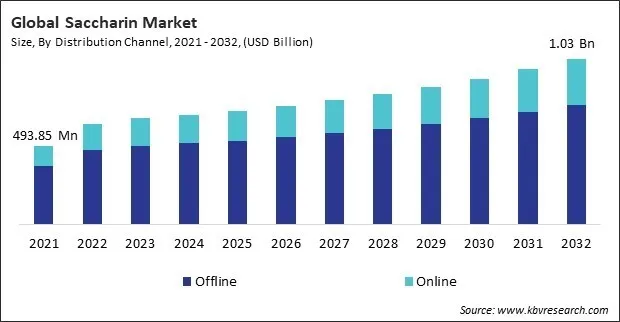
The Global Saccharin Market size is expected to reach $1.03 billion by 2032, rising at a market growth of 5.5% CAGR during the forecast period.
The offline distribution channel in the saccharin market refers to the traditional physical modes of product movement such as retail stores, supermarkets, hypermarkets, health & wellness stores, and direct-to-business sales. Despite the rapid expansion of online channels, the offline channel continues to dominate in many regions due to consumer trust, easier access, and the immediacy of product availability.
The COVID-19 pandemic severely disrupted global supply chains, resulting in prolonged logistics bottlenecks and limited access to raw materials, particularly in saccharin-producing countries like China and India. As factory shutdowns became widespread during national lockdowns, production capacities shrank rapidly. Manufacturers struggled with transport delays, rising input costs, and labor shortages, making it increasingly difficult to maintain timely deliveries of saccharin for both domestic and international markets. These supply chain disruptions not only constrained inventory levels but also hindered the fulfillment of long-term procurement contracts, creating widespread uncertainty across the value chain. Thus, the COVID-19 pandemic had a negative impact on the market.

The global shift toward healthier lifestyles has significantly intensified the demand for low-calorie sweeteners like saccharin. As consumers become increasingly aware of the health risks associated with excessive sugar consumption—such as obesity, type 2 diabetes, cardiovascular diseases, and metabolic syndromes—there has been a pronounced shift in dietary patterns. This trend has led individuals to seek alternatives that allow them to enjoy sweetened products without the associated caloric burden. In conclusion, the surge in health-conscious behaviors, combined with dietary reforms and sugar tax legislations, is a powerful driver supporting the growth of the saccharin market.
Additionally, Saccharin’s utility spans far beyond basic table-top sweeteners, with widespread use across multiple categories within the food and beverage sector. As the industry evolves, the demand for versatile, heat-stable, and economically viable sweeteners continues to grow, placing saccharin in a favorable position. Food producers value saccharin for its cost-effectiveness and potency—small quantities deliver strong sweetness, reducing overall input costs without sacrificing flavor. In summary, saccharin’s broad applicability across food and beverage segments, driven by its unique functional properties and economic advantages, is a fundamental growth engine for the market.
One of the most significant restraints hampering the growth of the saccharin market is the ongoing health concerns associated with its consumption. Saccharin, despite being one of the oldest artificial sweeteners available, has long been a subject of controversy due to its potential link to adverse health effects. Several decades ago, studies conducted on laboratory animals suggested that saccharin could be carcinogenic, particularly pointing to bladder cancer in rats. In conclusion, although saccharin has maintained its place in the artificial sweetener segment for over a century due to its high sweetness potency and low cost, its growth trajectory is constrained by persistent health concerns and stringent regulatory scrutiny.
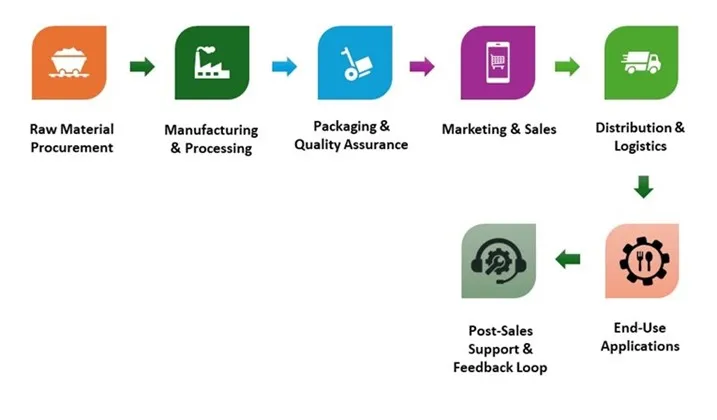
The value chain of the Saccharin Market begins with Raw Material Procurement, where essential inputs like toluene or anthranilic acid are sourced. This is followed by Manufacturing & Processing, where saccharin is synthesized and refined. The product then undergoes Packaging & Quality Assurance to ensure safety and compliance with regulatory standards. Marketing & Sales activities promote saccharin to target industries such as food, pharmaceuticals, and personal care. The product is distributed through Distribution & Logistics channels, reaching various End-Use Applications. Finally, Post-Sales Support & Feedback Loop ensures customer satisfaction and drives product improvements.
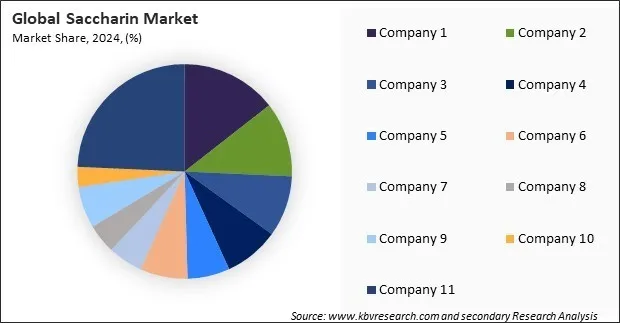
The leading players in the market are competing with diverse innovative offerings to remain competitive in the market. The above illustration shows the percentage of revenue shared by some of the leading companies in the market. The leading players of the market are adopting various strategies in order to cater demand coming from the different industries. The key developmental strategies in the market are Acquisitions, and Partnerships & Collaborations.
Based on distribution channel, the saccharin market is characterized into offline and online. The online segment procured 26% revenue share in the saccharin market in 2024. The online distribution channel has emerged as a vital complement to traditional retail methods, largely driven by the rapid expansion of e-commerce and changing consumer lifestyles. Online platforms offer a broad selection of saccharin products, often at competitive prices, along with the convenience of home delivery and user reviews that help buyers make informed choices.
| Category | Details |
|---|---|
| Use Case Title | Confidential |
| Date | 2025 |
| Entities Involved | Confidential |
| Objective | Provide niche dietary users direct access to pharmaceutical-grade saccharin blends via digital commerce platforms, ensuring authenticity and traceability. |
| Context and Background | Online channels have emerged as crucial for niche users like diabetics, fitness-conscious consumers, and food entrepreneurs. E-commerce ensures product variety, dosage transparency, and user feedback loops. |
| Description | Hermes Ingredients partnered with FitBlends to sell proprietary blends of saccharin with prebiotic fibers on Amazon. AI-based recommendations, auto-replenishment subscriptions, and user reviews enabled trust and recurring sales. Batch certification, expiry data, and source traceability were integrated into the product listing. |
| Key Capabilities Deployed |
|
| Regions Covered |
|
| Benefits |
|
| Source | Confidential |
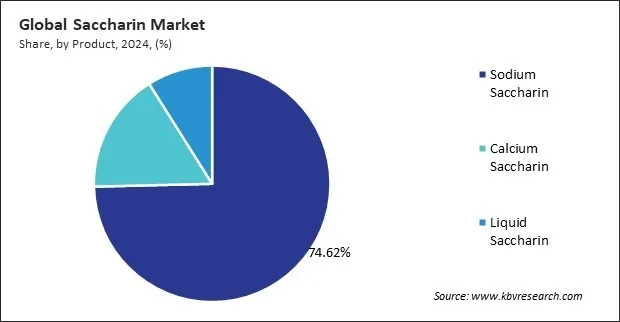
On the basis of product, the saccharin market is classified into sodium saccharin, calcium saccharin, and liquid saccharin. The calcium saccharin segment recorded 16% revenue share in the saccharin market in 2024. The calcium saccharin segment occupies an important position in the market, particularly in health-conscious or regulated product formulations. This variant is especially suitable for applications requiring low-sodium content, such as dietary foods or products for individuals with hypertension or other sodium-restricted conditions.
By application, the saccharin market is divided into food & beverage, pharmaceuticals, tabletop sweetener, and others. The pharmaceuticals segment garnered 27% revenue share in the saccharin market in 2024. The pharmaceutical industry also utilizes saccharin extensively due to its excellent solubility and non-caloric nature. It is commonly incorporated into medicinal syrups, chewable tablets, and lozenges to improve taste and mask the bitterness of active ingredients. Saccharin’s inert chemical profile ensures it does not interfere with the efficacy of medications, making it a safe and effective sweetening agent in both over-the-counter and prescription drugs.
Free Valuable Insights: Global Saccharin Market size to reach USD 1.03 Billion by 2032
Region-wise, the saccharin market is analyzed across North America, Europe, Asia Pacific, and LAMEA. The North America segment recorded 34% revenue share in the saccharin market in 2024. North America represents a significant region in the saccharin market, driven by increasing consumer demand for sugar substitutes amid rising health concerns such as obesity, diabetes, and cardiovascular issues. The presence of well-established food and beverage industries, coupled with a strong emphasis on health and wellness, has fueled the adoption of low-calorie sweeteners across various applications.
| Report Attribute | Details |
|---|---|
| Market size value in 2024 | USD 685.89 Million |
| Market size forecast in 2032 | USD 1.03 Billion |
| Base Year | 2024 |
| Historical Period | 2021 to 2023 |
| Forecast Period | 2025 to 2032 |
| Revenue Growth Rate | CAGR of 5.5% from 2025 to 2032 |
| Number of Pages | 290 |
| Number of Tables | 360 |
| Report coverage | Market Trends, Revenue Estimation and Forecast, Segmentation Analysis, Regional and Country Breakdown, Market Share Analysis, Porter’s 5 Forces Analysis, Company Profiling, Companies Strategic Developments, SWOT Analysis, Winning Imperatives |
| Segments covered | Distribution Channel, Product, Application, Region |
| Country scope |
|
| Companies Included | Kaifeng Xinghua Fine Chemical LTD, Shanghai Merry yang Enterprise Co.,Ltd., Blue Jet Healthcare Ltd., Vishnu Chemicals Limited, N.S.Chemicals, Jeil Moolsan Company(JMC) Corporation, PMC Specialties Group (PMC Co., Ltd.), PRODUCTOS ADITIVOS, S.A., Foodchem International Corporation, and Merck KGaA |
By Distribution Channel
By Product
By Application
By Geography
This Market size is expected to reach $1.03 billion by 2032.
Rising Demand For Low-Calorie And Sugar-Free Products are driving the Market in coming years, however, Health Concerns And Regulatory Restrictions restraints the growth of the Market.
Kaifeng Xinghua Fine Chemical LTD, Shanghai Merry yang Enterprise Co.,Ltd., Blue Jet Healthcare Ltd., Vishnu Chemicals Limited, N.S.Chemicals, Jeil Moolsan Company(JMC) Corporation, PMC Specialties Group (PMC Co., Ltd.), PRODUCTOS ADITIVOS, S.A., Foodchem International Corporation, and Merck KGaA
The expected CAGR of this Market is 5.5% from 2023 to 2032.
The Sodium Saccharin segment led the maximum revenue in the Market by Product in 2024, thereby, achieving a market value of $751.1 million by 2032.
The Asia Pacific region dominated the Global Saccharin Market by Region in 2032, thereby, achieving a market value of $345.4 million by 2032.
Our team of dedicated experts can provide you with attractive expansion opportunities for your business.






![North America Saccharin Market Size, Growth Report [2032]](https://www.kbvresearch.com/upload/cover/north-america-saccharin-market.webp "North America Saccharin Market Size, Growth Report [2032]")

 Unique Offerings