“Global Retail Audience Measurement Solutions Market to reach a market value of USD 18.90 Billion by 2032 growing at a CAGR of 19.1%”
The Global Retail Audience Measurement Solutions Market size is expected to reach USD 18.90 billion by 2032, rising at a market growth of 19.1% CAGR during the forecast period.
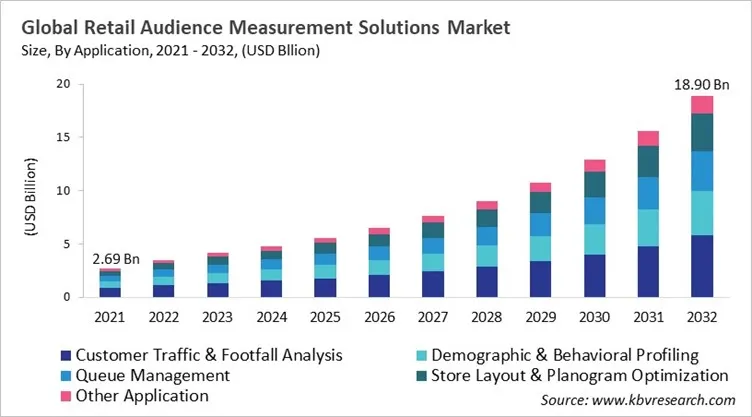
Retail audience measurement has developed into a sophisticated ecosystem of in-store analytics powered by sensors, video, cloud and AI platforms. Early innovations like analytics-driven platforms like RetailNext, and networked IP cameras from Axis Communications transformed traditional surveillance systems into engines of business intelligence, allowing retailers to measure dwell tomes, shopper flow, conversion and engagement with unprecedented precision. Key players such as Sensormatic Solutions expanded from loss-prevention and EAS systems into behavioral analytics suites, and comprehensive traffic, blending computer vision, video, and sensor data to give retailers a real-time view of customer behaviour. As technology advanced, edge processing, privacy-aware design, and machine learning became central, allowing real-time behavioural insights while catering to regulatory demands.
The retail audience measurement solutions market is shaped by privacy-first measurement technologies, AI-powered analytics, and integration with retail media networks and omnichannel data. Modern systems now infer demographic cues and support operational decisions like merchandising and staffing, while also providing attribution for in-store digital advertising. Competition is largely multidimensional, spanning quality, hardware, analytics depth, media monetisation, and privacy safeguards. Players such as Axis Sensormatic and RetailNext differentiate through integrated retail operational suites, SaaS platforms, and analytics-enabled hardware ecosystems. The retail audience measurement solutions market has transformed into a strategic, monetizable capability that allows retailers to improve customer experience and connect physical-store behaviour with digital channels.
The COVID-19 pandemic hurt the Retail Audience Measurement Solutions Market because lockdowns and limited movement made it hard for people to go to stores, which drove people to shop online. Retailers stopped spending money on in-store analytics and instead put their money toward important tasks like stabilizing the supply chain, cleaning, and managing their employees. Many stores had to close or had limited capacity, which meant that there was less need for traffic counters, behavioral tracking sensors, and store-based analytics platforms. Travel restrictions and technicians' limited access to stores caused delays or cancellations of installation and maintenance projects. The quick rise of curbside pickup and contactless shopping made in-store audience analytics even less useful right away. These problems made it harder for people to use new technology, delayed deployments, and stifled innovation until retail operations slowly got back to normal after the pandemic. Thus, the COVID-19 pandemic had a Negative impact on the market.

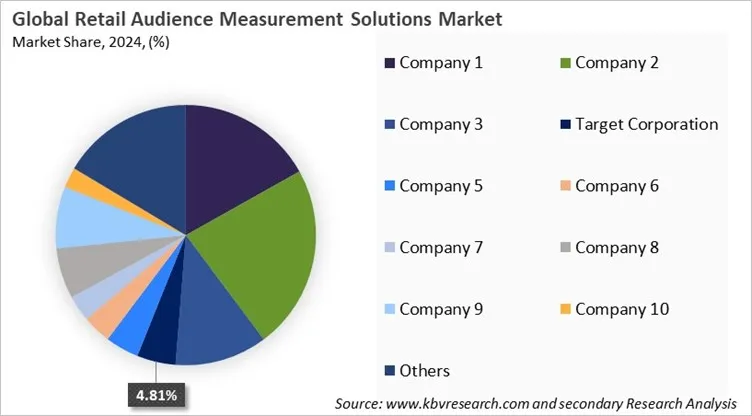
The leading players in the market are competing with diverse innovative offerings to remain competitive in the market. The above illustration shows the percentage of revenue shared by some of the leading companies in the market. The leading players of the market are adopting various strategies to cater demand coming from the different industries. The key developmental strategies in the market are Acquisitions, and Partnerships & Collaborations.
Based on application, the retail audience measurement solutions market is characterized into customer traffic & footfall analysis, demographic & behavioral profiling, queue management, store layout & planogram optimization, and others. The demographic & behavioral profiling segment attained 22% revenue share in the Retail Audience Measurement Solutions Market in 2024. Demographic and behavioral profiling is widely utilized to understand the characteristics and habits of shoppers. By analyzing age, gender, purchase patterns, and dwell times, retailers can develop tailored marketing strategies, personalized promotions, and loyalty initiatives. This application supports both brick-and-mortar stores and omnichannel retail models, providing insights that link in-store behavior with online engagement.
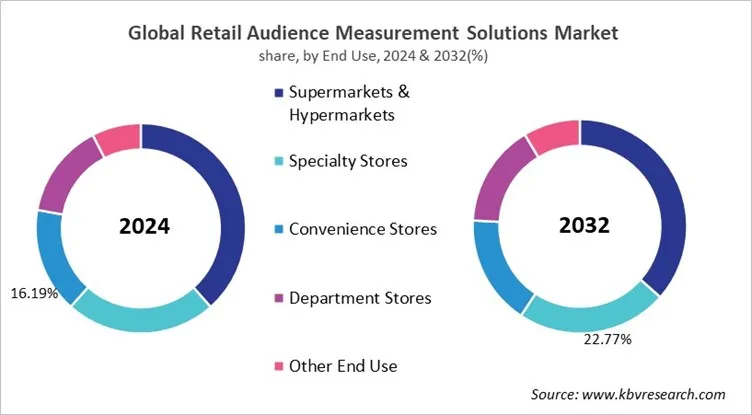
On the basis of end use, the retail audience measurement solutions market is classified into supermarkets & hypermarkets, specialty stores, convenience stores, department stores, and others. The specialty stores segment recorded 23% revenue share in the retail audience measurement solutions market in 2024. Specialty stores, including fashion boutiques, electronics shops, and health & beauty outlets, adopt audience measurement solutions to understand customer preferences and behavior at a granular level. These insights help retailers implement personalized marketing campaigns, optimize inventory, and tailor merchandising strategies to specific shopper segments.
Free Valuable Insights: Retail Audience Measurement Solutions Market size to reach USD 18.90 Billion by 2032
Region-wise, the Retail Audience Measurement Solutions Market is analyzed across North America, Europe, Asia Pacific, and LAMEA. The North America segment recorded 34% revenue share in the Retail Audience Measurement Solutions Market in 2024. The retail audience measurement solutions market is predicted to grow at a significant rate in North America and Europe. This is because of strong investment in AI-enabled analytics, high adoption of advanced retail technologies, and well-established omnichannel retail ecosystems. Retailers in these regions largely rely on queue management, real-time behavioral analytics, and predictive insights to optimise store layouts, retail media monetization, and labor planning. Strict privacy regulations like state-level US privacy laws, and GDPR also encourage vendors toward edge-based analytics, privacy-preserving, creating demand for anonymized measurement platforms. The presence of key players such as Axis Communications, RetailNext, and Sensormatic further surged innovation and deployment across specialty stores, shopping malls, and large retail chains.
In the Asia Pacific and LAMEA region, the retail audience measurement solutions market is estimated to experience expansion during the forecast period. The market is supported by increasing digital transformation investments, modern retail formats, and growing adoption of smart store technologies. In the Asia Pacific, fast growing markets like India, China, and Southeast Asia are accelerating demand for heatmapping, footfall optimization, and computer-vision analytics as retailers scale data-driven and experiential store models. Furthermore, the LAMEA retail audience measurement solutions market is growing at a steady pace. The regional nations are investing in traffic intelligence, mall analytics, and integrated retail media networks as part of retail modernization and smart city initiatives.
| Report Attribute | Details |
|---|---|
| Market size value in 2025 | USD 5.54 Billion |
| Market size forecast in 2032 | USD 18.90 Billion |
| Base Year | 2024 |
| Historical Period | 2021 to 2023 |
| Forecast Period | 2025 to 2032 |
| Revenue Growth Rate | CAGR of 19.1% from 2025 to 2032 |
| Number of Pages | 615 |
| Number of Tables | 501 |
| Report coverage | Market Trends, Revenue Estimation and Forecast, Segmentation Analysis, Regional and Country Breakdown, Market Share Analysis, Porter’s 5 Forces Analysis, Company Profiling, Companies Strategic Developments, SWOT Analysis, Winning Imperatives |
| Segments covered | Application, End Use, Component, Region |
| Country scope |
|
| Companies Included | The Nielsen Company (US), LLC, Amazon.com, Inc., Walmart, Inc., Target Corporation, The Kroger Co., Best Buy Co., Inc., Home Depot, Inc., Sightcorp (Raydiant Inc.), RetailNext, Inc. and Johnson Controls International PLC |
By Application
By End Use
By Component
By Geography
This Market size is expected to reach USD 18.90 Billion by 2032.
The retail audience measurement solutions market is projected to grow at a CAGR of 19.1% between 2025 and 2032.
Rising demand for data-driven retail operations and in-store analytics, supported by the proliferation of digital signage and the growth of retail media networks.
The Nielsen Company (US), LLC, Amazon.com, Inc., Walmart, Inc., Target Corporation, The Kroger Co., Best Buy Co., Inc., Home Depot, Inc., Sightcorp (Raydiant Inc.), RetailNext, Inc. and Johnson Controls International PLC
The Supermarkets & Hypermarkets segment is leading the Global Retail Audience Measurement Solutions Market by End Use in 2024, achieving a market value of $6.90 billion by 2032.
The North America region dominated the Global Retail Audience Measurement Solutions Market by Region in 2024, and would continue to be a dominant market till 2032; thereby, achieving a market value of $6.13 billion by 2032.
Our team of dedicated experts can provide you with attractive expansion opportunities for your business.








 Unique Offerings