“Global Remote Working Software Market to reach a market value of USD 99.43 Billion by 2032 growing at a CAGR of 17.4%”
The Global Remote Working Software Market size is expected to reach USD 99.43 billion by 2032, rising at a market growth of 17.4% CAGR during the forecast period.
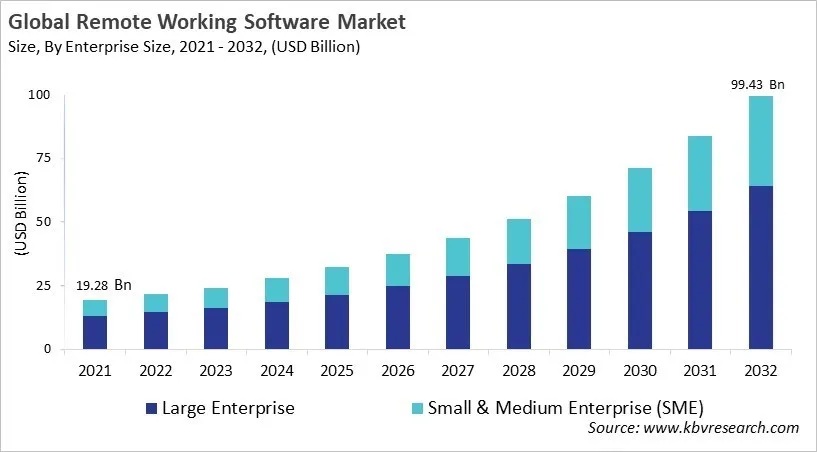
The remote working software market has transformed from regular tools such as VPNs & email to smart cloud-first platforms made for distributed and hybrid teams. Initial implementation was limited by organizational and technological restraints, but increased internet penetration, cloud computing, and favourable government plans prepared the growth path. Furthermore, the COVID-19 pandemic performed as catalyst in the growth of the market, with Microsoft Teams, Zoom, and google Workspace became crucial. Cloud solutions act as pillar in the rise of remote working, provide cost effective, scalability, AI-powered productivity features, and robust security procedures like encryption and zero-trust frameworks. Moreover, growing technologies such as AR, and 5G are adding engaging collaboration, predictive analytics, and real-time translation to the mix.
Three major trends are shaping the market: the rise of unified cloud-based collaboration platforms, a greater focus on security and data governance, and the quick integration of AI and immersive technologies. Microsoft, Google, Zoom, and Cisco are the main players in the market. They use innovation, acquisitions, and ecosystem expansion to make their products better by adding features like real-time transcription, automated workflows, and AR-enabled visual collaboration. There is a lot of competition. Mid-tier companies like Slack and Asana focus on niche features, and new companies are coming up with industry-specific and immersive solutions. The market is likely to stay competitive as hybrid work models become more common. This is due to new technologies, compliance needs, and the need for deep integration with business systems.

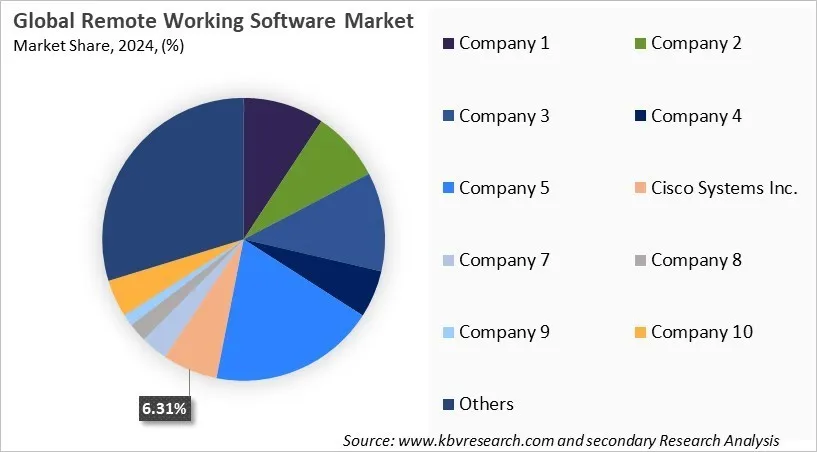
The leading players in the market are competing with diverse innovative offerings to remain competitive in the market. The above illustration shows the percentage of revenue shared by some of the leading companies in the market. The leading players of the market are adopting various strategies in order to cater demand coming from the different industries. The key developmental strategies in the market are Acquisitions, and Partnerships & Collaborations.
During the COVID-19 pandemic, the global market for remote working software saw a huge rise in use as businesses around the world switched to working from home. The need to keep businesses running and make sure employees are productive led to quick investments in cloud-based solutions, project management apps, video conferencing tools, and collaboration platforms. A lot of businesses, even ones that had been reluctant to allow remote work before, started using software to make it easier to have virtual meetings, share files safely, and talk to each other in real time.
Based on Enterprise Size, the market is segmented into Large Enterprise and Small & Medium Enterprise (SME). SMEs represent 33.5% of the market in 2024 and are an important growth segment due to their rapid shift to cloud-based, cost-effective remote work solutions. Unlike large corporations, SMEs typically prefer subscription-based Software-as-a-Service (SaaS) models that offer flexibility, lower upfront costs, and simplified deployment.
Based on Age Demographics, the market is segmented into 25 – 34, 35 – 44, 45 – 54, 18 – 24, and 55+. The 25–34 years age group holds the largest share of remote software users at 25.3%. Their adoption is driven by the need for enterprise-grade security, integrated project management tools, and AI-powered productivity enhancements. A notable example is Microsoft’s Copilot feature launch for Teams in March 2023, which has been widely embraced by team leaders and managers in this age group to streamline decision-making and reporting.
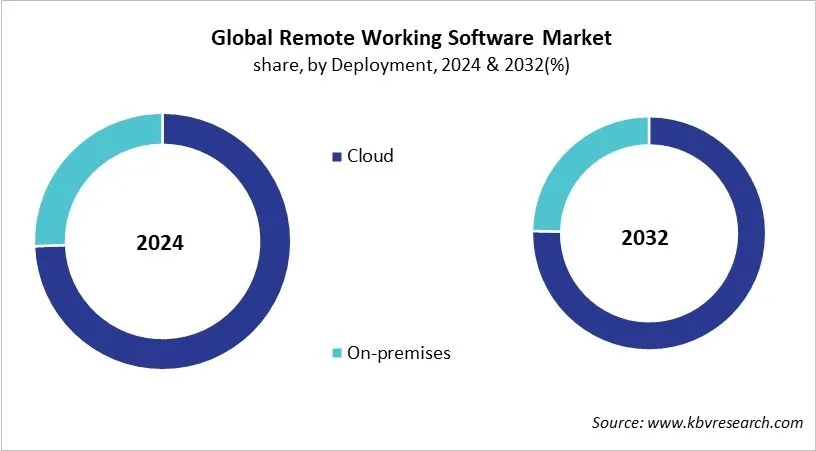
Based on Deployment, the market is segmented into Cloud and On-premises. On-premises solutions hold a 25.59% share, primarily serving organizations with stringent data security and compliance requirements. These solutions offer greater control over infrastructure and security but involve higher upfront costs and ongoing maintenance. This segmentation is shaped by the increasing adoption of hybrid work models, advancements in cloud infrastructure, and the integration of AI-powered collaboration tools.
Free Valuable Insights: Global Remote Working Software Market size to reach USD 99.43 Billion by 2032
Region-wise, the market is segmented into North America, Europe, Asia Pacific, and LAMEA. The North America segment recorded 36.44% revenue share in the market in 2024. North America leads the remote working software market. This is because of its advanced digital infrastructure, widespread use of cloud computing, and the strong presence of major companies like Microsoft, Google, and Zoom. The U.S. is the most innovative and quick to adopt new ideas, due to a well-developed business ecosystem and government-backed telework programs. Europe is next, with countries like the UK, Germany, and France stressing the importance of secure, compliant collaboration tools that follow strict rules like GDPR. Both areas have a high need for integrated platforms, AI-powered features, and strong cybersecurity measures to help hybrid workforces.
Asia-Pacific is growing quickly because more people are working from home, more countries like China, India, Japan, and Australia are investing in digital transformation, and the internet is becoming more accessible. The area is moving toward mobile-first, cloud-based solutions, and there is a growing need for AI, AR, and multilingual collaboration tools. In LAMEA, adoption is speeding up because broadband infrastructure is getting better, there are more startups, and remote work is cheaper. These markets are still new, but they have a lot of potential, especially as companies upgrade their IT systems and adopt hybrid work models.
| Report Attribute | Details |
|---|---|
| Market size value in 2024 | USD 27.84 Billion |
| Market size forecast in 2032 | USD 99.43 Billion |
| Base Year | 2024 |
| Historical Period | 2021 to 2023 |
| Forecast Period | 2025 to 2032 |
| Revenue Growth Rate | CAGR of 17.4% from 2025 to 2032 |
| Number of Pages | 498 |
| Number of Tables | 531 |
| Report coverage | Market Trends, Revenue Estimation and Forecast, Segmentation Analysis, Regional and Country Breakdown, Market Share Analysis, Porter’s 5 Forces Analysis, Company Profiling, Companies Strategic Developments, SWOT Analysis, Winning Imperatives |
| Segments covered | Enterprise Size, Age Demographics, Component, Deployment, End-User, Region |
| Country scope |
|
| Companies Included | Zoom Video Communications, Inc., Salesforce, Inc. (Slack), Google LLC, Atlassian Corporation PLC, Microsoft Corporation, Cisco Systems, Inc. (Webex), Citrix Systems, Inc. (Cloud Software Group, Inc.), TeamViewer Germany GmbH, AnyDesk Software GmbH, and Asana, Inc. |
By Enterprise Size
By Age Demographics
By Component
By Deployment
By End-User
By Geography
This Market size is expected to reach $99.43 Billion by 2032.
Cloud Adoption and Digital Infrastructure Modernization are driving the Market in coming years, however, Digital Infrastructure Inequality and Connectivity Challenges restraints the growth of the Market.
Zoom Video Communications, Inc., Salesforce, Inc. (Slack), Google LLC, Atlassian Corporation PLC, Microsoft Corporation, Cisco Systems, Inc. (Webex), Citrix Systems, Inc. (Cloud Software Group, Inc.), TeamViewer Germany GmbH, AnyDesk Software GmbH, and Asana, Inc.
The expected CAGR of this Market is 17.4% from 2023 to 2032.
The Cloud segment led the maximum revenue in the Market by Deployment in 2024, thereby, achieving a market value of USD 74.89 billion by 2032.
The North America region dominated the Market by Region in 2024, thereby, achieving a market value of USD 34.80 billion by 2032.
Our team of dedicated experts can provide you with attractive expansion opportunities for your business.







 Unique Offerings