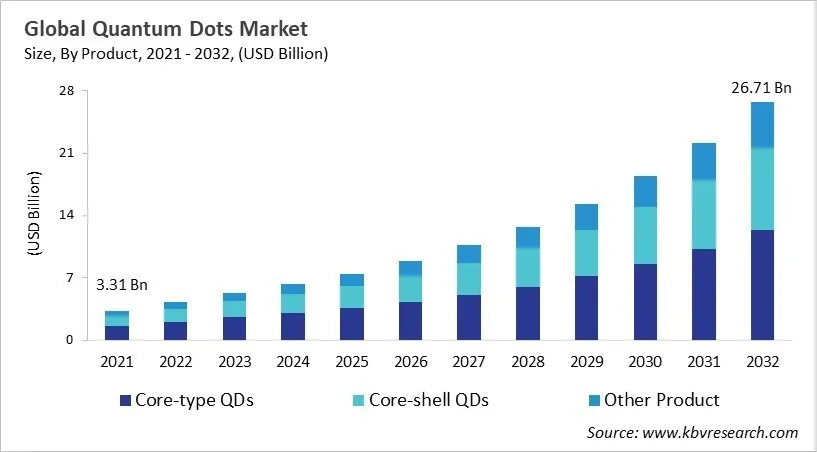
“Global Quantum Dots Market to reach a market value of USD 26.71 Billion by 2032 growing at a CAGR of 20%”
The Global Quantum Dots Market size is expected to reach $26.71 billion by 2032, rising at a market growth of 20.0% CAGR during the forecast period.
Quantum dots are nanoscale semiconductor particles with electronic and tunable optical properties, made possible by quantum confinement effects. Initially confined to laboratory experiments, improvements in synthesis and material stability have allowed their integration into commercial applications like sensors, imaging systems, and displays. Innovations such as cadmium-free compositions and core-shell structures have improved their precision, environmental safety, and brightness. Research institutions, private firms, and governments have partnered to scale production and expand their utility in fields like quantum computing, lighting, and solar energy. This development results in a shift from scientific exploration to industrial adoption, representing the fusion of sustainability, nanoscience, and improved design in redefining modern electronics.
The quantum dots market is experiencing growth supported by key trends including advanced display integration, sustainability, and cross-industry expansion. The transformation towards cadmium-free materials aligning with global environmental standards, while deploying into next-generation display technologies like micro LEDs and quantum dot LEDs, has established itself as a key differentiator in high-performance consumer electronics. The application of quantum dots is surging to quantum technologies, biomedicine, and renewable energy, thereby rising interdisciplinary demand. The market seems to be competitive, driven by strategic collaborations, vertical integration, and technological innovation. Key players focus on intellectual property protection, regional expansion to maintain competitiveness, and sustainable manufacturing.
The COVID-19 pandemic had a big effect on the quantum dots market. In 2020, production and demand fell because of global lockdowns, problems with the supply chain, and limits on manufacturing. Some important end-use industries, like consumer electronics, automotive, and display manufacturing, slowed down, which delayed product launches and made it harder for people to use quantum dot–based technologies. Problems with getting raw materials, logistics, and not enough research and development made it even harder to innovate and sell new products. Also, because of uncertainty in the economy, investments in new technologies fell, which slowed down market growth and cut revenues. The market has started to recover as restrictions have slowly been lifted. This is because there is more demand in the electronics and healthcare sectors. Thus, the COVID-19 pandemic had a negative impact on the market.
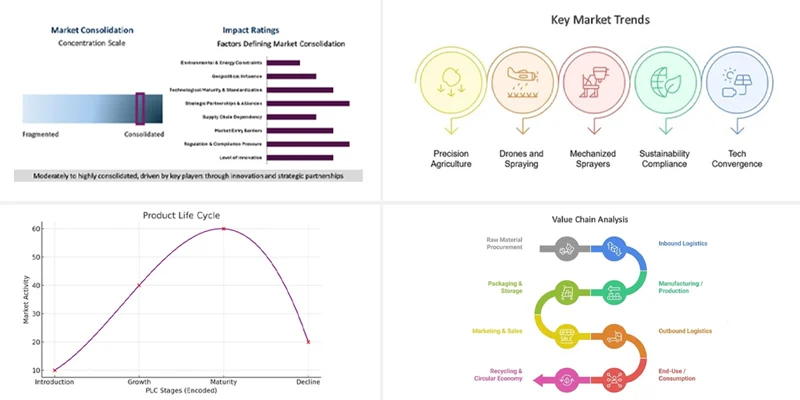

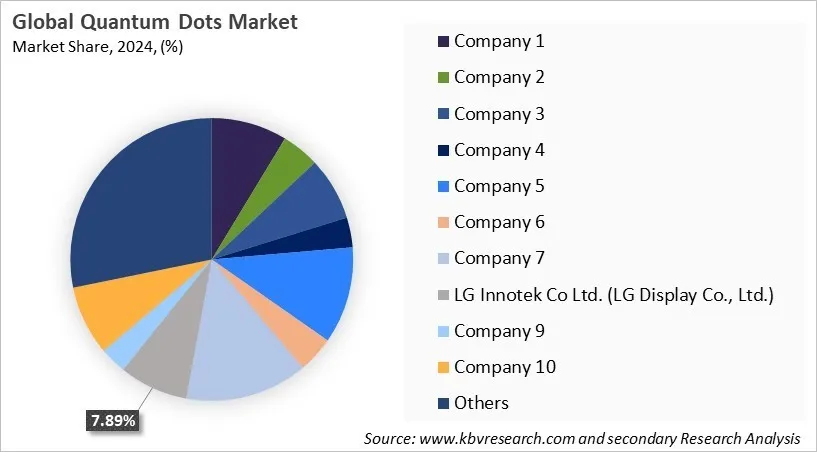
The leading players in the market are competing with diverse innovative offerings to remain competitive in the market. The above illustration shows the percentage of revenue shared by some of the leading companies in the market. The leading players of the market are adopting various strategies in order to cater demand coming from the different industries. The key developmental strategies in the market are Acquisitions, and Partnerships & Collaborations.
Based on Product, the market is segmented into Core-type QDs, Core-shell QDs and Other Product. The core-shell QDs segment attained 34% revenue share in the quantum dots market in 2024. These materials found increasing applications in optoelectronic devices, medical imaging, and solar energy systems, where precision and reliability are crucial. Ongoing research and development activities in regions such as North America, Europe, and Asia Pacific focused on optimizing shell materials to enhance performance and reduce environmental risks. Global investments in sustainable nanotechnology and cross-border collaborations between universities and technology firms accelerated innovations in this field.
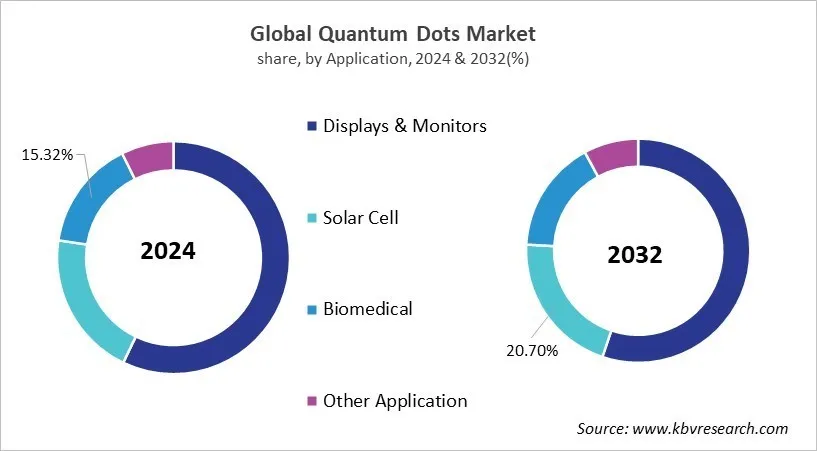
Based on Application, the market is segmented into Displays & Monitors, Solar Cell, Biomedical and Other Application. The solar cell segment recorded 20% revenue share in the quantum dots market in 2024. Quantum dots were increasingly explored for photovoltaic applications due to their tunable bandgap, superior light absorption, and potential to boost energy conversion efficiency. Researchers and companies worldwide focused on developing cost-effective manufacturing techniques and stable quantum dot–based solar cells that could outperform traditional silicon models. Government incentives promoting clean energy and global initiatives targeting carbon reduction created favorable conditions for innovation and adoption.
Free Valuable Insights: Global Quantum Dots Market size to reach USD 26.71 Billion by 2032
Region-wise, the quantum dots market is analyzed across North America, Europe, Asia Pacific, and LAMEA. The Asia Pacific segment gained 35% revenue share in the quantum dots market in 2024. The quantum dots market is witnessing significant expansion in North America and Europe. This is due to the well-established research eco-systems, strong semiconductor industry, and early adoption in imaging and high-end display technologies. In North America, the rising investment in R&D activities, patent activity, and commercialization in life science, consumer electronics, and quantum computing applications. Moreover, Europe’s market growth is driven by initiatives promoting the circular economy and green material principles, focusing on advanced optoelectronic integration and eco-friendly production. Also, partnership efforts among research labs, electronic manufacturers, and universities further strengthen innovation pipelines, ensuring that the region remains at the forefront of quantum materials and nanotechnology development.
In the Asia Pacific and LAMEA regions, the quantum dots market is anticipated to grow at a high rate. This growth is driven by a strong electronics manufacturing base, large investments in semiconductor technologies, and increasing consumer demand for premium displays. Regional nations such as South Korea, Japan, and China are key production hubs for LED lighting, display panels, and QLED TVs, thereby driving large volume adoption of quantum dot materials. Strategic industrial partnerships and government funding in these countries are surging in the deployment of quantum dots into photonic devices and solar cells. Furthermore, the LAMEA quantum dots market is expanding, backed by developing solar energy initiatives and import-driven demand for advanced display products. Also, increasing interest in renewable energy and sustainable electronics solutions is predicted to result in positive growth opportunities in the region.
| Report Attribute | Details |
|---|---|
| Market size value in 2025 | USD 7.47 Billion |
| Market size forecast in 2032 | USD 26.71 Billion |
| Base Year | 2024 |
| Historical Period | 2021 to 2023 |
| Forecast Period | 2025 to 2032 |
| Revenue Growth Rate | CAGR of 20.0% from 2025 to 2032 |
| Number of Pages | 395 |
| Number of Tables | 271 |
| Report coverage | Market Trends, Revenue Estimation and Forecast, Segmentation Analysis, Regional and Country Breakdown, Market Share Analysis, Porter’s 5 Forces Analysis, Company Profiling, Companies Strategic Developments, SWOT Analysis, Winning Imperatives |
| Segments covered | Product, Application, Region |
| Country scope |
|
| Companies Included | The Dow Chemical Company, Ocean NanoTech, LLC, Nanosys, Inc., NNCrystal US Corporation (Hangzhou Najing Technology Company), Nanoco Group plc, Quantum Materials Corporation, Samsung Electronics Co., Ltd., LG Innotek Co Ltd., Nanoplus Nanosystems and Technologies, and Merck KGaA |
By Product
By Application
By Geography
The market size is projected to reach USD 26.71 Billion billion by 2032.
The quantum dots market is projected to grow at a CAGR of 20% between 2025 and 2032.
Emphasis on energy efficiency and sustainable technology development is driving expansion into emerging non-display applications.
The Dow Chemical Company, Ocean NanoTech, LLC, Nanosys, Inc., NNCrystal US Corporation (Hangzhou Najing Technology Company), Nanoco Group plc, Quantum Materials Corporation, Samsung Electronics Co., Ltd., LG Innotek Co Ltd., Nanoplus Nanosystems and Technologies, and Merck KGaA
The Core-type QDs segment led the maximum revenue in the Global Quantum Dots Market by Product in 2024, thereby, achieving a market value of $12.3 billion by 2032.
The Asia Pacific region dominated the Global Quantum Dots Market by Region in 2024, and would continue to be a dominant market till 2032; thereby, achieving a market value of $9.8 billion by 2032.
Our team of dedicated experts can provide you with attractive expansion opportunities for your business.








 Unique Offerings