According to a new report, published by KBV research, The Global Value Stream Management Market size is expected to reach $937.5 Million by 2032, rising at a market growth of 9.4% CAGR during the forecast period.
The concept of Value Stream Management (VSM) traces its origins to lean manufacturing, particularly the Toyota Production System developed in the mid-20th century. Initially conceived to eliminate waste and improve efficiency in automotive production, VSM gradually became a fundamental component in the broader lean methodology. As globalization transformed how goods and services were produced and delivered, the principles of value stream thinking evolved to apply not only to manufacturing but also to digital and service-driven industries.
The Large Enterprise segment is leading the Global Value Stream Management Market by Organization Size in 2024; thereby, achieving a market value of $613.6 million by 2032. Large enterprises dominate the Value Stream Management (VSM) market due to their complex structures and large-scale operations that demand advanced process optimization tools. These organizations possess the financial and technical capacity to implement robust VSM platforms that integrate with enterprise systems and offer real-time analytics. The adoption is driven by needs such as regulatory compliance, digital value delivery, and operational agility.
The Services segment is anticipating a CAGR of 10% during (2025 - 2032). These services help organizations overcome challenges related to legacy systems, cultural resistance, and skill gaps. Trends show rising demand for advisory services and continuous improvement support as enterprises undergo agile transformations. Driving factors include the need for domain expertise, customized deployment, and change management. The competitive landscape includes consulting firms, agile specialists, and VSM platform providers with dedicated services teams.
The On-Premises segment is generating maximum revenue in the Global Value Stream Management Market by Deployment Mode in 2024; thereby, achieving a market value of $532.7 million by 2032. The On-Premises segment garnered the largest revenue share of 56% in 2024, in Global Value Stream Management Market. This deployment mode is especially favored by large enterprises in regulated industries such as finance, healthcare, and government, where internal hosting ensures compliance and seamless integration with legacy systems. Trends highlight the preference for internal governance and tailored configurations. Driving factors include the need for secure, low-latency solutions and complete infrastructural oversight. Competition in this segment is led by enterprise software providers offering scalable, high-compliance VSM platforms with long-term support and customization services.
The Retail & E-commerce segment would showcase a CAGR of 8.5% during (2025 - 2032). Retailers use VSM for omnichannel synchronization, logistics efficiency, and enhanced customer journeys. Adoption is driven by real-time analytics and cost optimization. The Retail & E-commerce segment in the Value Stream Management (VSM) market is rapidly growing as businesses seek to enhance software delivery efficiency and customer experience. Retailers rely on complex, omnichannel digital infrastructures where continuous integration and deployment are crucial for adapting to shifting consumer demands. VSM helps these companies identify bottlenecks, improve cross-functional collaboration, and align software development with business outcomes. By visualizing the end-to-end value stream, organizations can reduce lead times, increase release frequency, and improve agility.
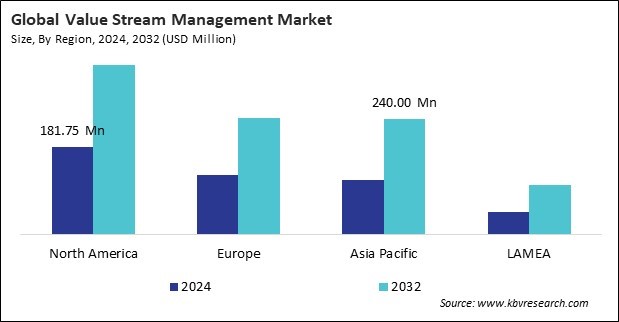
The North America region dominated the Global Value Stream Management Market by Region in 2024, and would continue to be a dominant market till 2032; thereby, achieving a market value of $352.1 million by 2032. Europe region is experiencing a CAGR of 9% during (2025 - 2032). Additionally, The Asia Pacific region would exhibit a CAGR of 10% during (2025 - 2032).
By Organization Size
By Component
By Deployment Mode
By Industry Vertical
By Geography



 Unique Offerings

