According to a new report, published by KBV research, The Global Structured Cabling Market size is expected to reach $26.15 billion by 2032, rising at a market growth of 10.4% CAGR during the forecast period.
The uses of structured cabling are as diverse as its applications, encompassing a wide range of functions that enhance connectivity and operational efficiency. Structured cabling supports high-speed data transmission at its core, enabling businesses to leverage technologies such as VoIP (Voice over Internet Protocol), video conferencing, and cloud-based applications. In office environments, it facilitates seamless communication between employees, departments, and global teams, fostering collaboration and productivity.
The LAN segment is experiencing a CAGR of 9.9 % during the forecast period. A Local Area Network (LAN) is a network infrastructure that connects computers, printers, phones, and other devices within a limited geographic area, such as offices, campuses, or residential buildings. Structured cabling in LAN environments involves standardized cabling systems (like Cat5e, Cat6, and Cat6A) to ensure reliable communication, scalability, and ease of maintenance. LAN structured cabling is critical for enabling efficient data transfer, secure connectivity, and IT and operational technology system integration.
The Copper Cables segment led the maximum revenue in the Global Structured Cabling Market by Product Type in 2024, thereby, achieving a market value of $11.9 billion by 2032. Copper cables are electrical conductors made primarily of copper that transmit data through electrical signals. In structured cabling, copper is typically used in twisted pair configurations (e.g., Cat5e, Cat6, Cat6A) for short- to medium-distance networking applications such as office LANs, voice systems, and security integrations. Emerging trends within the copper cable segment highlight its continued relevance in cost-sensitive deployments and areas with existing legacy infrastructure.
The IT & Telecommunication segment is growing at a CAGR of 9.5 % during the forecast period. The IT & telecommunication vertical encompasses data centers, network operators, internet service providers, and tech enterprises requiring robust, high-speed connectivity. Structured cabling in this domain supports mission-critical infrastructure for voice, data, and video transmission across global networks. Emerging trends include the rapid deployment of 5G networks, cloud-native architectures, and software-defined networking (SDN), all of which demand high-performance cabling backbones.
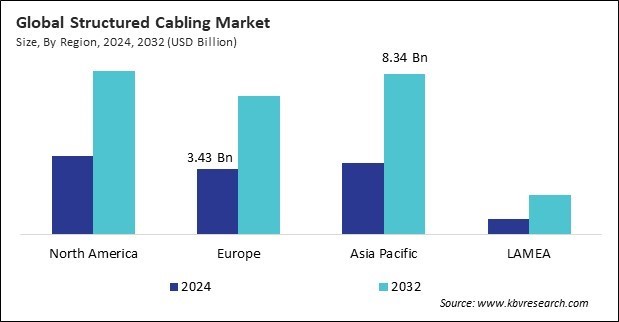
The North America region dominated the Global Structured Cabling Market by Region in 2024, and would continue to be a dominant market till 2032; thereby, achieving a market value of $8.5 billion by 2032. The Asia Pacific region is anticipated to grow at a CAGR of 10.9% during (2025 - 2032). Additionally, The Europe region would witness a CAGR of 10% during (2025 - 2032).
By Application
By Product Type
By Vertical
By Geography
 Unique Offerings

