According to a new report, published by KBV research, The Global Sovereign Cloud Market size is expected to reach USD 482.38 billion by 2032, rising at a market growth of 23.0% CAGR during the forecast period.
The concept of sovereign cloud has emerged as a critical evolution in the cloud computing landscape, driven primarily by growing concerns around data privacy, security, and regulatory compliance. Governments worldwide have increasingly emphasized the importance of maintaining control over sensitive data generated within their borders, fueling the demand for cloud infrastructure that aligns with national sovereignty principles.
The Cloud segment is leading the Global Sovereign Cloud Market by Deployment in 2024, and would continue to be a dominant market till 2032; thereby, achieving a market value of $400.77 billion by 2032. This model allows organizations to utilize cloud resources hosted by third-party providers while ensuring that data residency and sovereignty requirements are met. Cloud deployment offers scalability, flexibility, and ease of access, making it an attractive option for many government bodies and enterprises seeking compliant cloud solutions. Providers have developed specialized sovereign cloud platforms within the cloud deployment category, enabling users to maintain control over their data without compromising on performance or security.
The Large Enterprise segment dominated the Global Sovereign Cloud Market by Enterprise Size in 2024 and would continue to be a dominant market till 2032; thereby, growing at a CAGR of 22.7 % during the forecast period. These organizations often require robust and highly secure cloud environments to manage vast amounts of sensitive data. Their operations typically span multiple regions, and they face stringent regulatory, and compliance demands. Large enterprises seek sovereign cloud solutions that provide strong data governance, enhanced security features, and guaranteed data residency. The complexity and scale of their IT infrastructure drive the adoption of sovereign cloud services that can offer reliability, scalability, and customized compliance frameworks tailored to their specific needs.
The BFSI segment is generating the maximum revenue share in the Global Sovereign Cloud Market by End-use in 2024; thereby, achieving a market value of $119.26 Billion by 2032. This sector has been a prominent adopter of sovereign cloud solutions, driven by the critical need for secure data management and strict regulatory compliance. Financial institutions have increasingly relied on sovereign cloud platforms to protect sensitive customer information, streamline operations, and enhance cybersecurity measures. The focus on maintaining data privacy and ensuring resilience against cyber threats has made sovereign cloud services a vital component within this sector.
The Data Sovereignty segment dominated the Global Sovereign Cloud Market by Functionality in 2024 and would continue to be a dominant market till 2032; thereby, growing at a CAGR of 22.4 % during the forecast period. This segment focuses on ensuring that data is stored, processed, and managed within the boundaries set by national or regional laws. This functionality is critical for organizations and governments aiming to comply with data protection regulations and maintain control over sensitive information. Data Sovereignty emphasizes strict adherence to legal frameworks governing data residency and privacy, often requiring cloud infrastructures to be physically located within specific territories. This segment plays a vital role in building trust and transparency with users by guaranteeing that their data remains protected from unauthorized access by foreign entities or jurisdictions.
Full Report: https://www.kbvresearch.com/sovereign-cloud-market/
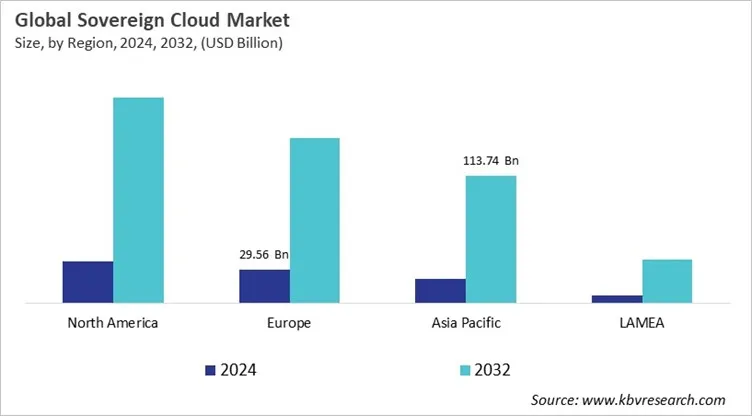
The North America region dominated the Global Sovereign Cloud Market by Region in 2024, and would continue to be a dominant market till 2032; thereby, achieving a market value of $182.87 billion by 2032. The Europe region is experiencing a CAGR of 22.6% during (2025 - 2032). Additionally, The Asia Pacific region would exhibit a CAGR of 23.8% during (2025 - 2032).
By Deployment
By Enterprise Size
By Functionality
By End-use
By Geography
 Unique Offerings

